3 months ago
78
3 months ago
78
When I heard on the radio that more than half of British people would consider cancelling an outing if they saw a 40% chance of rain all day on their weather app, I felt seen. I, too, am a slave to my app. Not that I would ever make a decision based on one whole-day percentage. I pore over three-hourly breakdowns for chances of rain versus minutes of sunshine. If rain is on the cards, I check the probable millimetres. Less than one? I may well throw caution to the wind. Speaking of which, wind speed and direction must also be considered, along with overall and “feels like” temperatures. For the cherry on top, I’ll compare notes with a loved one’s app if they use a different one, quietly mistrusting theirs, and simmering in silent rage if theirs wins.
I’ll admit, though, that my compulsion to check my app (I long ago chose WeatherPro, which I knew nothing about, but liked its layout and name) is borderline neurotic; I fret over probabilities and outfit appropriateness, when I could simply step outside for real-time hyper-local accuracy. I can lose procrastinatory hours consulting long-range forecasts, or checking the weather in Melbourne (where my sister lives) and holiday destinations I have no immediate plans to visit.
Businesses, meanwhile, are complaining that misread apps are costing them money. In March, more than 80 outdoor attractions, including Chester zoo and the Eden Project, wrote to the Met Office complaining that a headline graphic of a raincloud on an app puts visitors off in droves. “Most users glance at the top-line symbol and plan their day accordingly,” the businesses said in an open letter, with Chester zoo calculating that this can cost it up to £137,000 in a day. Are weather apps running, maybe even ruining, our lives? Will I get soaked, boil or freeze without one? I challenged myself to a week without checking mine to find out.
Day one: Saturday
It’s a sunny morning and I dash out to yoga in a light, unlined shacket. The gamble pays off when afterwards it’s warm enough to sit outside a cafe. What a lovely surprise! I dedicate the afternoon to relaxing in the garden but as soon as I recline with my headphones on, a hefty cloud blocks the sun and I’m cold. Are the heavens about to open? No idea, so I put my hoodie on and continue with my guided meditation. Soon enough the sun pops out again and I end up spending the best part of three hours sun- and cloud-bathing. I’m loving the freedom and serendipity of not trying to control and optimise every moment. Had I known how much cloud would blow over, or that it wasn’t really hot, I might have spent all day indoors, without the bumblebees and the breeze and the hope.
Trevor Harley, a psychologist and author of Head in the Clouds: How the Weather Affects Our Minds and Mental Health, agrees that with all the evidence of exposure to nature boosting mental health, “it is better to be outside sensing the weather directly than it is to be indoors looking at a screen”. Checking it to a certain extent is perfectly rational: “We do need to plan,” says Harley. “If showers are forecast I try to fit taking my little dog for a walk into one of the more dry spells. The problem is we take it all too far.”
Weather apps further entice us with control, says Harley. “In this country in particular, the weather is very changeable. Apart from it’s likely to be warmer and sunnier in summer than it was in winter, anything can happen. August might be record-breakingly hot or a wet, miserable write-off – we just don’t know.” Weather apps, he says, help us cope with the uncertainty. “And I think that there’s a broader psychological point that it is an increasingly uncertain world, and we’re made anxious by climate change, and looking at these apps gives us an illusion of control that perhaps is absent from the rest of our lives.”
Day two: Sunday
I have a two-hour, unfamiliar drive ahead, for which I would usually check the weather conditions. Plus I have sartorial considerations for an 80th birthday lunch. Last time I was allowed to check my app, torrential rain was forecast for today, which lingers in the back of my mind as I step outside to sniff the air with the cat (my new morning routine): grey, chilly and windy. I bring a brolly, and make sure I wear a top nice enough to be able to take my cardigan off, should the sun pop out. As it turns out, it doesn’t rain all day and I have lovely drives there and back, and when the sun shines in the evening, once again it’s a wonderful surprise. Having no expectations pays off when it comes to the British weather.
Weather apps can lead us to false expectations anyway. According to a survey by Harris Poll, in response to the letter to the Met Office from businesses, 37% said they only check the headline weather symbol for the entire day. But often this symbol will contain rain, even if there’s no chance of it falling in the precise window of a planned outing. This is because weather apps often have what’s known as a wet bias in how they present the weather, to avoid disappointment. The BBC weather forecaster Matt Taylor told Radio 4 recently the corporation’s own research found that people would rather be told of any chance of rain than see a dry day advertised and then get wet. “We are risk averse,” says Harley. This feels very glass half empty. Fifty-five percent of people consider changing plans if the app gives an overall 40% chance of rain – even though, says Sarah Beams, the managing director of Harris Poll, “if they called it 60% chance of being dry people might then think differently”. According to the poll, 60% of us have ditched a day out only to find the weather was fine after all.
Day three: Monday
The heating has come on so it must be cold. But it’s sunny! With black clouds! The decision of what to wear feels simpler with only my observations to go on. I venture out in jeans, T-shirt and a light mac. It rains, I put my hood up, no biggy.
It’s nice being my own authority. Which app is the most reliable anyway? In 2024, the Reading University meteorologist Rosie Mammatt compiled an accuracy top five (based only on a snapshot over a short space of time) which had the Met Office in third place, followed by Apple and then the BBC, with AccuWeather second and the Weather Channel first. The latter uses a mix of sources including the Met Office, but attempting to compare accuracy is complex and nuanced. When Reading meteorologists went on to compare the BBC and the Met Office, the BBC (shortly before it went back to taking Met data) was more confident with rain whereas the Met was slightly better on temperature, though both were generally good. Harley goes even deeper himself with his own weather station to log conditions where he lives, but for those not ready
for that, he recommends getting greater insight from the Met Office’s “10-day trend on Wednesday on YouTube. They provide such an in-depth forecast and an understanding of why the weather conditions are as they are, so you then understand so much about what the weather is going to be like.”
Today does end up being quite poor weather for May, but had I woken up knowing it would be, my mood would have been less optimistic. “We all have our distinct weather personalities in the same way that there are introverts and extroverts,” says Harley. “I don’t mind any sort of weather, really, because they all contribute to the sense of nature unfolding. But people do differ – not everyone likes it warm and sunny, but most do. So, if you wake up and the forecast is cold and wet, that is going to make you feel a bit glum.”
Day four: Tuesday
After breakfast I tap on my weather app on autopilot. I immediately close it, but not before I see a high of just 15C (59F) for the day. I wish I could unsee it. In an attempt to restore my new devil-may-care attitude, I rashly hang some laundry out to dry. Later, while on a work call, I see it raining heavily.
If you want to get a clearer picture of what a few raindrops on the app really means for you, a Met Office spokesperson, Grahame Madge, advises checking an app’s radar visualisation (wow, I never look at these but vow to in future). Here you get an accurate view of where rain is coming from, and then a visualisation of where it’s heading and whether it’s an unrelenting band of rain, or passing showers. In showery conditions, he says, “showers can bubble up very quickly anywhere, which is notoriously difficult to forecast”, so the visualised showers are random, rather than precise predictions.
It doesn’t rain for the rest of the day, and I appreciate the increasing intensity of the sun when it peeps through.
Day five: Wednesday
I’ve totally got the hang of this week: one minute sunglasses, the next, hood up. But there’s always a surprise around the corner. A hailstorm! Only by luck am I in a cosy cafe when it strikes, so I can enjoy the drama.
Even when you do check the forecast, there are shocks. “The forecast accuracy for the next day or even the next 72 hours is now amazingly good for the country,” says Harley, “but not necessarily for the specific spot you’re in.”
The Met Office has 15 or so radars across the UK, which, says Madge, “can provide pinpoint accuracy as to whether it’s raining or snowing or hail or sleet in a certain area”, but some areas are more prone to evading predictions. “Certainly, the topography of the UK can provide certain challenges, so where you’ve got built-up areas, perhaps increasing heat will create more thermals, which can create showers, so those areas can be a bit trickier.” You can also see the “rain shadow” effect in the lee of hills, with clouds more likely to drop their moisture on the slopes that face the wind. This is why Exeter is often drier than the general weather pattern would have it, because the rain will usually get deposited up on the moors first.
Day six: Thursday
I may not be checking the weather but I can’t stop boring anyone who’ll listen about how liberating it is not doing so. It’s starting to feel like a slightly desperate substitute for my weather app obsession.
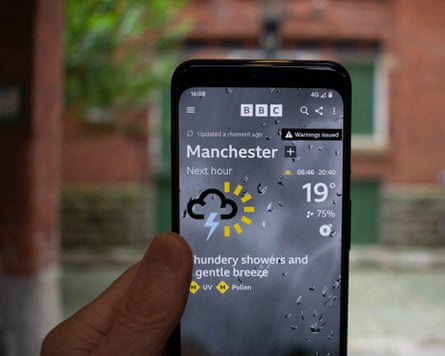
The Met Office vies with the BBC for the nation’s most-used weather app, yet the BBC resumed taking its weather data from the Met Office last year after a break. Apple’s UK weather is also Met Office driven. Yet different apps are often contradictory. Much of this comes down to presentation, says Madge, and how “individual app producers will choose to overcome problems like how to display weather in a single icon”.
This is the Met Office’s method: “For the period between 6am and 6pm, we give that a weighting of two,” says Madge. “So, an hour of daylight is worth twice that of an hour overnight. That gives us 36 [weather] symbols to play with over a 24-hour period.” Rain will make it into the headline weather icon if 13 or more of the 36 show rain. Otherwise it won’t, “even though there’s a slim chance, but you’ve still got it all on the hourly [breakdown]. Other app producers and providers may have a different way of creating their algorithms, which could give a different result, even if the same weather model was used.” But he would prefer, he says, “people to move down the screen slightly, to the hourly symbols, so that you can see what is likely to be happening during different periods of the day”.
Day seven: Friday
I am packing for six days in London, including a night on the town, a day in the office and work drinks. I’m taking the train, so I need to pack light and I just can’t cope with winging it, so I cave and check the weather. HEATWAVE COMING. Welcome back, WeatherPro. Days later, though, my qué será, será attitude has returned, and for the first time I get caught in a shower with no mac or brolly. It’s actually fine.