3 months ago
65
3 months ago
65
Eddie sits at a cafe dressed in a turtleneck and blue beret. “On a scale of 10-10, rate how good I look,” the caption to his post reads.
The socialite’s page is full of candid content: enjoying a doughnut at a popular Melbourne brunch spot, relaxing in a chic robe and celebrating a paid “staycation” at the Hyatt House in Melbourne, adorned in a leopard print outfit.
Eddie has almost 50,000 likes on Instagram, his own brand discounts and an Amazon store. He’s also a chihuahua, and one of dozens of pets being used to tap into an increasingly lucrative influencer market on social media.
As a person who owns a dog and uses the internet, I have not been immune to the attractions of propelling my pet to fame.
This has sent me to some dark places, including briefly signing up my labrador to a pet modelling agency that yielded no results and was probably a scam.
But one thought has always persisted: how hard could it be to make him famous on social media? Is this my ticket to endless riches? And could I go it alone?
My mission, agreed to by editors, was clear. Over a short period, I would devote myself to newly created Instagram and TikTok accounts for my dog, Murphy. The goal? Popularity and virality (paid sponsorships, of course, were out of the question).
I started with research, which involved scrolling the accounts of Australian pet influencers who had already made it and making a series of dot points that included: “outfits”, “appearance of wealth”, “smiling” and “dog has a job/skills/talent”.
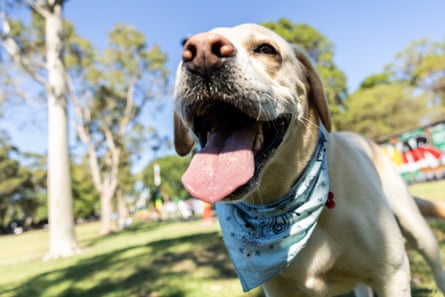
Unlike Winnie, a red Australian cattle dog with 600,000 followers, Murphy could not scale walls, herd sheep or jump through complex hoops. I could not transform my rental apartment into a film set. His outfits consisted of bandanas and a funny shirt I bought him for Halloween.
Instead, I vowed to home in on his charm: being a little bit naughty.
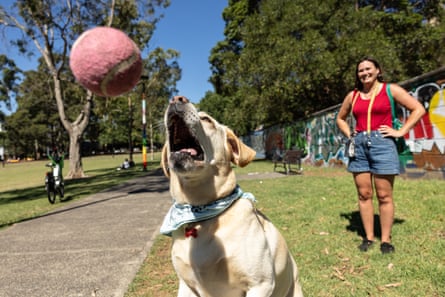
‘Destined for Instagram fame’
Many account handles were taken, so I settled for “murphythegoldenlabdog”, which I felt was nicely literal and to the point.
My younger colleague advised me that the key to going viral was posting enough that something stuck, so I made seven posts in quick succession: Murphy smiling in a park, Murphy wearing my hat on the beach, Murphy drinking a “dog-rita” at the pub, Murphy with a cute puppy.
Allow Instagram content?
This article includes content provided by Instagram. We ask for your permission before anything is loaded, as they may be using cookies and other technologies. To view this content, click 'Allow and continue'.
I went hard on the hashtags, expecting the likes to start rolling in like spring rain. Instead, the only interaction I received was from friends and family members who were in on the experiment.
“Same,” my friend commented on a picture of Murphy drinking a cocktail. “This is the face of a dog destined for Instagram fame,” one colleague replied.
I managed to make it to 100 followers in less than a week, largely thanks to posting in various group chats with a hint of desperation (the vast majority were co-workers or friends of my Mum).
My next challenge was videos. I am only a year shy of being a Gen Z, but TikTok remains a mystery to me. My teenage years consisted of Photobooth and blogs, not viral videos of dance routines.
With assistance from my hip colleagues on the video team, I was told to make sure my clips were backed by popular music and find a niche. My first video, captioned “caught in the act”, showed Murphy attempting to get into his pet food before being sprung, backed to a Taylor Swift song.
Allow TikTok content?
This article includes content provided by TikTok. We ask for your permission before anything is loaded, as they may be using cookies and other technologies. To view this content, click 'Allow and continue'.
It got 47 likes and 2,325 views. “I can do this!” I thought with glee. The next video, captioned simply “noooooo” as Murphy emerged from a pile of mud, received only 28 likes and 312 views.
A clip I was particularly proud of, which edited together footage of Murphy rolling around in various parks backed to Snow Patrol’s Chasing Cars, received just 674 views.
Allow TikTok content?
This article includes content provided by TikTok. We ask for your permission before anything is loaded, as they may be using cookies and other technologies. To view this content, click 'Allow and continue'.
What was I doing wrong? Why did I only have 43 followers on TikTok, and why couldn’t I crack it big on Instagram despite promising follower 200 would receive a signed autograph?
The clues began to come in the form of comments and private messages on Murphy’s Instagram account. “Send me this pic,” one pet page with 129,000 followers wrote on a picture of Murphy sleeping in his bed. “Share us this!!” another daily pet page commented.
When I engaged with the accounts, they would ask if I’d like to “feature my profile” on their page, and prompt me to send a few photos alongside a caption. After this I would receive a big block of text offering various packages that cost between $20 and $500 depending on how many followers I wanted to gain.
When I said I couldn’t pay, they would go dark.
Had it really come to this?
So this was how the world of pet influencers worked. Multiple accounts, it seemed, were making significant profits off the back of people who wanted their pets to go viral and, in turn, could receive their own benefits in the form of paid sponsorships and promotions.
Eddie the chihuahua’s owner/manager, Sue Waters, advised me under no circumstances to put any funding behind promotion.
She’s never done it, she said, but it helps that she has a background in advertising – and that she got Eddie during Covid, when everyone had more free time.
“The more you post and the more time you spend [online], the more you’re rewarded with visibility,” she said. “If you’re in a growth phase, trying to get followers and build, you’re wanting to spend up to 10 hours a week [on it]. And it’s not just putting up a post and then walking away and leaving it. You’ve got to interact with people, you’ve got to comment, respond.”
At the same time, “it helps to have something a little bit more than just a cute dog”.
“Eddie has a personality,” she said. “And I put that out there on Instagram.”
As pure desperation began to hit, I went to the library and printed out flyers of Murphy’s face with a link to his Instagram handle. I would play it the old way, like a newspaper journalist before the invention of computers.
“Hi, I’m Murphy,” the posters read. “My mum is trying to make me famous on Instagram as a weird social experiment. Please follow me … Thanks for reading.”
As I stuck them to poles at a park on Sydney’s foreshore, a pang of sadness hit me. Had it really come to this? Sticking up flyers instead of enjoying a walk with my labrador?
On the last weekend of the experiment, Murphy and I attended a friend’s 30th birthday. He disappeared for a while and returned to the group covered in a black substance, to cries of laughter that quickly turned into shrieks as it became apparent he’d climbed into a septic tank.
“Shut the doors!” people screamed. My friends urged me to film the disaster for content. I went to get my phone, but a wave of fatigue washed over me. Couldn’t we just enjoy this moment in its pure form? Must everything be turned into a commodity for attention, clicks and likes?
I walked Murphy away from the group down to the creek, and we shared a poignant moment. I watched him blissfully frolic in the water, unburdened by society’s expectations, just a man enjoying some time in the sun.
“I could learn a lot from you,” I mused, the smell of shit wafting through the air.