2 months ago
64
2 months ago
64
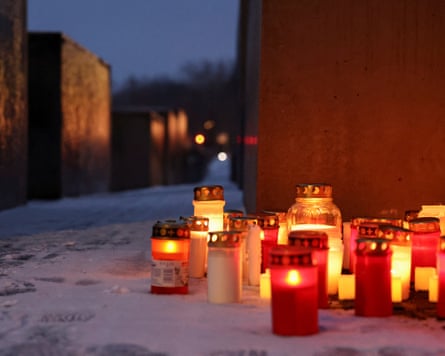
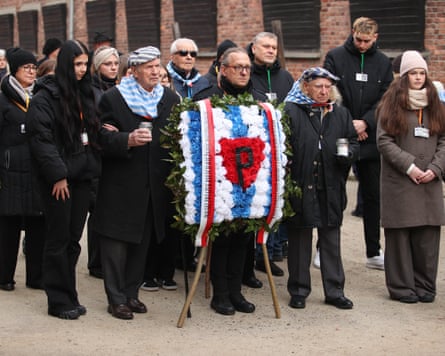
Survivors of Auschwitz, the Nazi concentration camp, laid flowers and candles at the memorial site on Tuesday, as commemorations marking its liberation 81 years ago took place around Europe and beyond.
Marking International Holocaust Memorial Day, Jewish leaders across the continent warned against forgetting the extermination of millions, while some of the few remaining survivors urged ordinary people to stand up against populism and extremism.
One survivor, Tova Friedman, 87, who is due to address the German parliament on Wednesday said she would be speaking directly to the far-right Alternative für Deutschland in her speech and asking them: “How dare you? Who do you think you are?”
The official day of remembrance of Soviet troops’ liberation of the few surviving prisoners of Auschwitz in 1945 from the clutches of their Nazi German captors is 27 January. It was declared the official German day of remembrance in 1996, and officially adopted by the United Nations in 2005.
At the Auschwitz memorial site 24 former prisoners braved freezing temperatures to lay wreaths at the ‘death wall’ where German soldiers killed mainly Polish political prisoners. Polish president Karol Nawrocki later joined survivors for a ceremony at nearby Birkenau, the huge site to which Jews from across Europe were transported to be murdered in gas chambers.
About 1.1 million Jews were murdered at Auschwitz alone, as well as Poles, Roma and others, including people persecuted for their religious or sexual orientation.
At the snow-covered Memorial to the Murdered Jews of Europe in central Berlin, a sea of grey concrete blocks built as an indelible symbol of Germany’s contrition, candles were lit and white roses laid on the slabs.
Elsewhere events were held at museums, schools and railway stations across the country while informal gatherings took place in towns and cities across Europe at Stolpersteine, small brass plaques cemented into pavements marking former residences of Jews who were deported to concentration camps. Present-day inhabitants laid candles and flowers on them.
In Terezín, site of the former Nazi concentration camp Theresienstadt in the Czech Republic, where thousands of Jews were collected and died or were sent from there to Auschwitz and other death camps, a candlelit procession was due to take place on Thursday evening.
The Netherlands marked its national Holocaust memorial day on Sunday with a silent procession through Amsterdam’s Jewish quarter.
In Ireland, the government announced more funding for Holocaust education in schools after a survey found 15% of young people had never heard of it and 10% of those aged between 18 and 29 thought it was a “myth”.
An estimated 196,600 Jewish survivors are believed to still be alive globally, compared to the 220,000 estimated to have been alive a year ago, according to the New York-based Conference on Jewish Material Claims Against Germany.
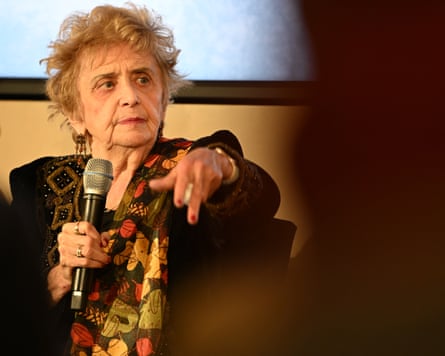
Friedman, who is due to address the Bundestag on Wednesday, was five when she and her mother were deported from their home in Gdynia near Gdansk in Poland, to Auschwitz-Birkenau. She likely survived due to a technical malfunction of the gas chambers and, during death marches in January 1945, hid among corpses.
“I represent one and a half million children who were murdered and who are not here to speak for themselves,” Friedman told German media. “My story is representative of all their stories because we all had similar experiences. I was simply luckier than them, because I survived.”
Together with her grandson, Aaron Goodman, 20, who also accompanied her to Berlin, Friedman has a TikTok account called ‘TovaTok’, in which the two talk about her experience and warn against the growth of antisemitism.
Goodman is one of a growing number of surviving relatives choosing to take on the vital task of telling the stories of their parents and grandparents.
Friedman, who emigrated to the US where she became a successful therapist, warned against the rise of the populist far-right in Europe. She said she would directly address the AfD, which is up for election in five states this year and is predicted to do well in at least three of them.
The anti-immigrant party, which backs policies such as the mass deportation of non-naturalised citizens, has repeatedly called for an end to what it calls ‘Schuldkult’ or a “culture of guilt”, to describe the perpetuation of the memory of Nazi crimes.
“I want very much to face up to them, not to hide away from them,” said Friedman.
Kaja Kallas, the European Union’s top diplomat warned that antisemitism was more rampant than at any time since the Holocaust, and was “taking on new and disturbing forms”. She also warned of AI-generated content which was being deliberately created “to blur the line between fact and fiction, distort historical truth and undermine our collective memory”.
The Frankfurt-based Anne Frank Educational Centre drew attention to a “flood” of AI-generated content being used like propaganda, in which the victims were ridiculed, with the aim of denying or trivialising them.
Representatives of the Jewish community across the world, including Josef Schuster, president of the Central Council of Jews in Germany, urged people to show “civil courage” and stand up for democracy at a time when there was a considerable and growing swell in favour of “pushing us as a Jewish community out of public life”.
“These forces will continue to grow stronger if society fails to stop these threatening developments,” he warned.
Police said they were investigating who was behind the weekend vandalism attack of a memorial in front of the remains of the synagogue in the northern port city of Kiel, which was destroyed in the state-sanctioned attacks on Jewish property in November 1938. Flowers and candles laid at the site were crushed and scattered, local media reported.