3 months ago
76
3 months ago
76
For a while, Erin Doherty ignored Stephen Graham’s calls. Not deliberately, she stresses with a laugh. “I’m just really bad at my phone. I’m such a technophobe, and he knew that,” she says. They had made the Disney+ show A Thousand Blows together, in which Doherty plays an East End crime boss in Victorian London, and Graham had talked about an idea he wanted to dramatise, about a teenage boy who is catastrophically radicalised by online misogyny. A couple of months after they’d wrapped A Thousand Blows, Graham and his wife and producing partner, Hannah Walters, kept trying to get in touch. “I was getting voice notes from him and Hannah being like, ‘Erin, pick up your phone!’” Doherty’s girlfriend told her to ring him back and Graham offered her the role in Adolescence. She said yes on the spot, without reading the script.
Since it was screened on Netflix in March, Adolescence has had nearly 150m views. It sparked a huge cultural conversation; it was shown in secondary schools and its creators were invited to Downing Street. Did they have any idea it would become such a phenomenon? “No, and I’m not sure you’re supposed to,” says Doherty when we speak. She is chatty and down-to-earth, even in the year her career went stellar. As well as starring in A Thousand Blows, her role in Adolescence – as Briony Ariston, a psychologist – won her an Emmy for best supporting actress. “But you do know when you’re a part of something that’s good and deserves to be seen, and we knew that about it. I think because it came from such a genuine place, a place of real purity and rawness, it [fed into] the making of it. From day one, it had that electricity.”
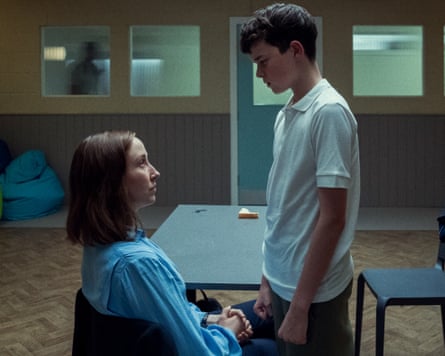
Doherty’s episode – like all of them, it was shot in one take – is the most tense and revealing of the four-part drama. Her character is interviewing Jamie, the 13-year-old accused of murder, in a detention centre, in order to prepare a report before his trial. Initially, she worried about who they could possibly cast as Jamie. “It was the biggest ask I’d ever read for a young person,” she says. “But the minute we got into the rehearsal room, Owen [Cooper] knew his lines, and he wasn’t daunted or fazed by any of it.”
Despite the subject matter, it was a happy shoot. The writer, Jack Thorne (with whom Doherty had worked on one of her first jobs, the musical Junkyard), was “so collaborative, and very much: ‘This needs to feel as real and raw as possible, so if there’s anything that doesn’t sit right, let’s change it.’ He’s such an actor’s writer, which is just so freeing.”
They rehearsed for two weeks, then filmed two takes a day over several days. There was some self-imposed pressure not to mess up a take, but Doherty’s theatre background proved to be ideal training. Two takes a day was enough, she says, “because of the nature of what [director] Philip Barantini wanted to capture. He wanted it to feel dangerous and organic. Any more than that, and you’d kill it.”
Doherty called on her former therapist, whom she saw from around 2017 and only stopped seeing recently, to prepare for the role. “I’m such a big advocate for therapy. I’d had years of admiration for this way of communicating.” Often, she says, screen depictions of therapists are flat, simply there to further the plot and the main character. “I think there’s so much more to them. They’re so skilled to operate between these layers that are going on in any exchange. I wanted to bring that level of humanity to her.” Briony is professional, but she also wants Jamie to show some remorse, some sign that he isn’t irredeemable. “It was interesting to me to put that friction on screen, because otherwise, it’s just one kid in a room, up against this armoured being. Therapists have feelings, and they do battle with their own judgments, so I wanted her to be struggling with that and a genuine investment in this kid.”
That Briony is disappointed by the end of their session is somewhat of an understatement, which brings us to the moment where Doherty is almost upstaged by a cheese and pickle sandwich. Earlier in their session, Briony gives Jamie half her sandwich; by the end, shaken, she is visibly repulsed by it, indented with his teeth marks. Her reaction wasn’t in the script, but on that final take, the tension had “built and built. It really did something to me.” Still, she says: “We didn’t place much importance on the sandwich.” She laughs, then in mock actorly reverence: “OK, this is The Sandwich Moment!” Once the show came out, she was intrigued there were so many theories. “I guess on any given interaction, there are many things at play, and it was lovely people were giving it that amount of time to go into the detail of what that represented.”
Doherty grew up in Crawley, where her dad worked at Gatwick airport and her mum was a receptionist. Acting was all she ever wanted to do. “I didn’t want a plan B,” she says. “I was just: ‘I don’t know how I’m going to live my life without this thing.’” She was also a talented footballer, scouted to play for Chelsea before acting took over. When she watched England’s women’s team retain their European title, did she have a twinge of envy, and wish she’d chosen that other path? She laughs. “No, because I would be on the [subs] bench day in, day out. They are phenomenal. I just love that they’ve become such a part of our culture and ingrained in our world. That makes me so happy.” Anyway, at the age of 33, she would be eyeing retirement from football now, rather than her acting career moving into the premier league. “I know I made the right choice,” she says with a laugh. “I’d be knackered.”

Initially, Doherty was rejected from drama schools, but she persevered and got a place at the Bristol Old Vic Theatre School. Did she carry that sense of rejection – even impostor syndrome – into early jobs? “That was definitely a part of it,” she says. “But I think there’s something really helpful about rejection, and it is part of being an actor – you don’t get every job you want.” In the third and fourth seasons of The Crown, Doherty played Princess Anne – she was brilliant, easily as wonderful as Olivia Colman as the queen, and Helena Bonham Carter as Princess Margaret. “I spent so long just staring at these people being like, ‘Oh my God, you’re amazing’,” she says. This year, she says, has felt a bit more of a shift, with the success of Adolescence and A Thousand Blows. And next year, Doherty plays the lead in Hugo Blick’s BBC drama California Avenue, which also stars Bill Nighy and Bonham Carter again. “Maybe I do feel a little more settled. It’s been lovely going into jobs being more excited about collaborating and being creative, rather than, ‘Oh God, I really hope they don’t want to fire me’. That voice is getting quieter.”
She says she has been “massively inspired” by Graham, as an actor and as a producer. “I think what he’s done with Hannah Walters is incredible, and also his relationship with Jack Thorne. If I could develop those relationships with writers and producers, and can be a part of making stories that [have been] under the radar, that would make me so happy.” She is, she says, “massively passionate about queer stories. That’s something that needs to be mined for more complexity. I also want to be led by what’s going on in the current culture and by what our reality is.”
Doherty had experience of this before Adolescence, with last year’s play Closing Time, the final part of the Death of England trilogy (which began in 2014 as a Guardian-commissioned microplay), in which race, class and what it means to be British was explored, all performed on a stage resembling the St George’s cross. This was the summer that England flags appeared, amid a surge of rightwing support. “I wish we were doing [the play] now,” says Doherty. “I love period dramas, but there is something so necessary about putting on pieces of work that are culturally present.” It was an unnerving experience, she says of her role as Carly, “playing someone who didn’t think they were racist. I had to present as someone completely unaware of these things that they were saying, and my own true self was having to be squashed. I wasn’t in a great place after playing that character.” But it taught her, she says, that “you do have to get out of your own way and tell the stories that need to be told at that moment in time”.
This was also the year Netflix’s “casual viewing” genre got more attention – the shows whose makers know audiences are only half-watching, their eyes also on their phone or something else, and so require simple plots and obvious exposition. Adolescence, with its real-time slowness, intense dialogue and brilliant performances, required concentration. As a huge hit, it shows audiences can be persuaded to put their phones away. Doherty hopes others will follow. “I hate the idea that [the distraction of phones] is going to be a component in a creative mind. That, to me, is like the death of art. So yes, I hope this flies the flag for having faith in our audiences. People don’t want to be spoon-fed and they don’t need to be. We’re way smarter than a lot of stuff out there thinks we are.”
What does she hope is the lasting impact of Adolescence? “I hope that it continues to be talked about,” she says. “Without being a wanky actor, the dream is that you reach through the screen and you speak to people, and so I hope that people keep going back to it, and keep having those conversations.”