1 month ago
67
1 month ago
67
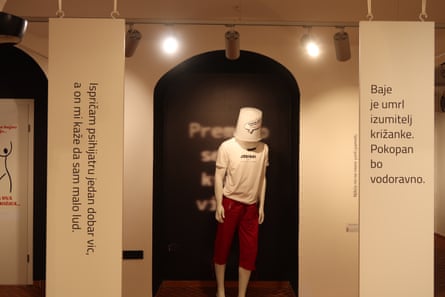
On the main promenade along the river that runs through Ljubljana, Slovenia’s capital, tourists stop to photograph a mannequin with a bucket on its head. Dressed in a pistachio jacket and red leggings, the figure sits at a table in front of one of the houses in the historic Old Town, staring at a spilled cup of Turkish coffee, popular with Slovenes and with the other Balkan and central European citizens with whom they shared a country, until it collapsed in the early 1990s. A large sign in the background reads: “Bullshit Museum: The world is off the rails, and so are we. Yebiga!”
Yebiga, which can be loosely translated as “fuck it”, or “screw it”, is the red thread running through the museum that was launched in May and consists of five small rooms filled with mannequins wearing odd accessories, AI-generated images of laughing characters and scenes accompanying some of the jokes, framed or displayed on cardboard screens. The word encompasses the heart of Balkan humour, says the museum’s founder, Borut Kokelj, who wears a T-shirt emblazoned with the words: “What part of yebiga don’t you understand?”
“Even when there’s no money, when there are no jobs, when nothing is settled, everything can be solved with humour,” he says. “And for that to work, humour must have no filter”.
Although it presents itself as the home of “Balkan” humour, the museum is primarily centred on the joke culture of the former Yugoslavia, the socialist federation that included the Balkan Peninsula countries that are now Slovenia, Croatia, Serbia, Montenegro, Bosnia and Herzegovina, and Kosovo.
Formed out of the wreckage of the first world war, Yugoslavia was a political project to unite southern Slav and some non-Slavic minorities under a common identity and language, then officially known as Serbo-Croatian. But the genocidal wars that accompanied Yugoslavia’s disintegration in the early 1990s demonstrated that the idea of a single Yugoslav nation lacked deep foundations. The region’s different nations have since continued to define themselves through distinct religious identities, including Catholicism, Orthodoxy and Islam, but also separate dialects and languages.
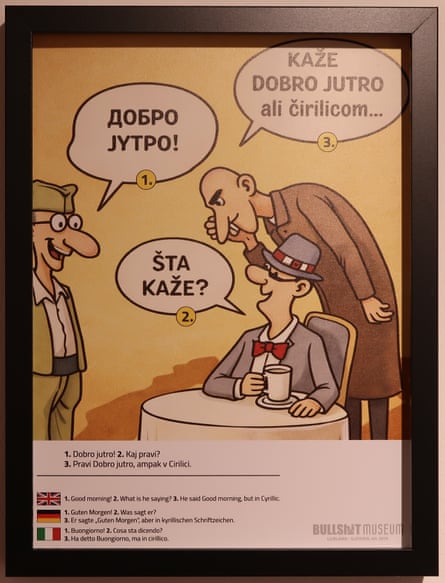
“Balkan” humour, the museum suggests, may have been the glue that held Yugoslavia’s cultural bric-a-brac in place, and it is fitting that some of the jokes on display play directly on the issue of language. “A fool is a fool in both the Cyrillic and the Latin alphabets,” reads a large poster at the entrance, using both scripts: Cyrillic, being associated with Serbs and Orthodox Christianity, and the Latin alphabet being used by other, mostly non-Orthodox nations of the dissolved state.
The armed conflicts that have shaped the region are also reflected in the exhibition, albeit indirectly. There is wordplay on the title of the controversial 1996 Serbian drama Lepa Sela Lepo Gore (literally “pretty villages burn nicely”), about a group of surrounded Serbian soldiers during the Bosnian war, here adapted into the absurdist line Lepa jela lepo goje (“Fine food fattens you up well”).
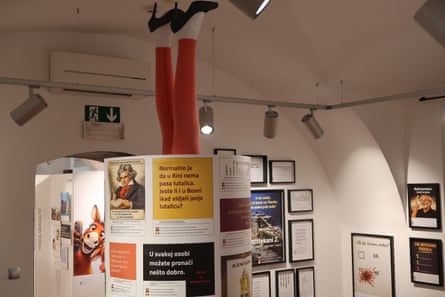
The role and power of women in society also seems to be a unifying factor. “Starleta is the first Balkan mythical being with the body of a woman and the head of a turkey”, reads an “encyclopedic” definition of a “starleta” – a woman who seeks fame and wealth through no other achievements than her (plastic surgery-assisted) beauty. “She wanted to marry a prince, but a horse had more money,” reads another, playing on the word konj (horse), which is used in many former Yugoslav nations to describe a “man”.
Kokelj, who has collected about 25,000 jokes from the region over the years, said he resisted freighting the exhibition with politically loaded humour. “If we were to exhibit all the truly ‘Balkan’ jokes, we likely wouldn’t have opened,” he admits, referring to jokes that directly address religion, ethnicity, or national symbols.
The selection also avoids jokes that mock a specific group or feature characters identified with a particular ethnic group. There are no jokes here mocking the supposed “laziness” of Montenegrins (such as this from the humour section of a local magazine: “What does a Montenegrin say before going to bed? ‘Rise, earth, so that I may lie down,’”). I find only one AI-generated “ethnic” meta-joke: it plays on the stereotype of Slovenes as a nation eager to present itself as the most “elegant” and “European”, thereby distancing itself from the rest of the region: a Slovenian man tells a joke “the Slovenian way”, using innocent euphemistic curses such as “three hundred hairy bears”, while his “Balkan” counterpart has no restraint when it comes to colourful insults.
Overall, most of the jokes address everyday issues and the absurdities of life. “Life is neither nail polish nor acetone,” reads one. “We had it better, and we still complained. Now that things are getting worse, we’re complaining again,” says another. Others focus on romantic relationships: “Love is when you look like a sack of potatoes, but she sees you as fries.” Another recurring theme is the ability to laugh at oneself: “Amateurs make mistakes, but we, the experienced ones, create catastrophes.”
There seems to be one element that holds the exhibition together to this day, though: rakija, the celebrated Balkan fruit brandy. It is served to visitors as they enter the museum and is described in one of the exhibits as “the first aid of every Balkan household”. It is also central to the definition of the infamous yebiga, which one exhibit describes as follows: “The Balkan way of saying: what are you going to do? Maximum feeling, minimum energy. It usually goes with rakija, a cigar and a song that hurts more than it should.”