4 weeks ago
22
4 weeks ago
22
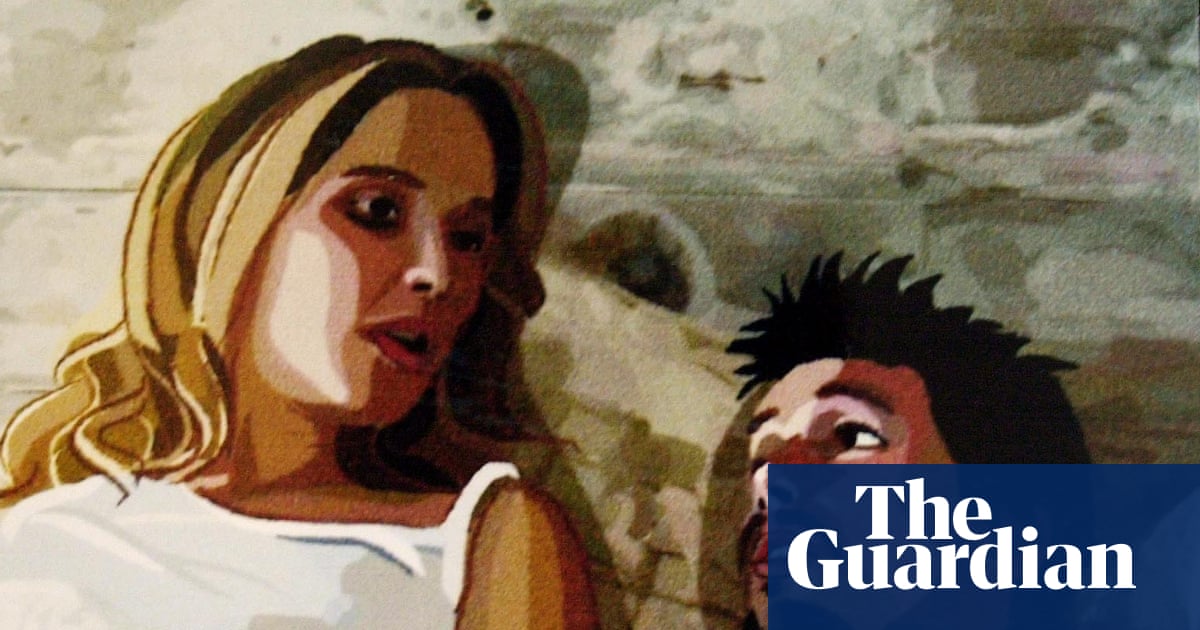
In 2019 at the Edinburgh international festival, the Swiss director Milo Rau staged an intense theatrical investigation, La Reprise: Histoire(s) du Theatre (I), recreating a homophobic killing in Belgium. The murder of Ihsane Jarfi, seven years earlier, had made headlines and the news disturbed choreographer Sidi Larbi Cherkaoui who was just a little older, also gay and had a Belgian mother and Moroccan father like Jarfi.
Cherkaoui now arrives at the same festival with his own act of remembrance, every bit as engrossing as Rau’s, yet more expansive. It pays tribute, too, to the choreographer’s father who died 30 years ago and whose past is interwoven with Jarfi’s death. If that raises any qualms, Cherkaoui’s larger point is about the interconnectedness of all lives and his characters morph into each other. He takes his cue from the victim’s first name, which essentially means “benevolence”, and counters the production’s disturbing flashes of violence with a floating lightness, whether in breakdance or traditional forms, and by presenting ideals of harmonious joy and kindness.
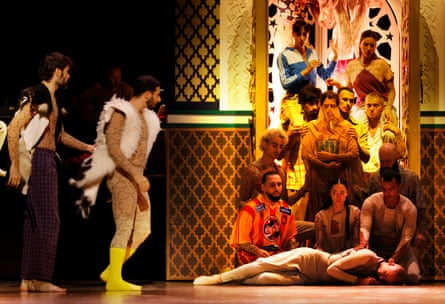
That’s where we begin, in an Arabic class, where the script is written on a board with brush strokes that initially complement two narrators’ graceful arms and echo through much of the show’s smooth flow. The tutor encourages the audience to join in with pronunciations; we share camaraderie and knowledge with the colourfully clad students. They arrange themselves in four rows of four and their tessellating gestures add to the patterns of Amine Amharech’s set and the intricate interplay of viola d’amore, piano, oud and percussion in Jasser Haj Youssef’s compositions. It is a lovely scene of common purpose, brought to an end by the set’s huge golden doors closing.
They reopen to show the death of Jarfi who was tortured and killed by a group of men he met after leaving a gay bar. Here, a solitary figure torments him, with blows that never connect yet each vicious action sends the victim twisting in agony, almost as if by telekinetic force. Much later, the scene is reversed, with the body taken into the care of a woman.
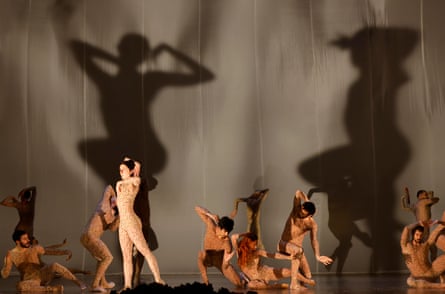
Rau’s forensic production asked why the crime was committed and how performance could ever begin to help us understand it. Cherkaoui includes a horrifying assessment of the injuries, and proves similarly interested in ritual, yet his focus is more on the aftermath, even the afterlife, and how a society heals. Jarfi’s body is reclaimed by a swaying collective under Fabiana Piccioli’s golden lighting, framed within the doors. A silky ensemble, facing outwards and joined in a circle, share a similar glow. Further spoken texts analyse different types of grief and dispel the notion of closure. Time and again the movement highlights the potential of each individual life; one chapter staged with billowing white drapes unites a blissful assembly of dancers in flesh-coloured costumes.
Tea is served during a scene that merges the casual and ceremonial, as a football is kicked across the stage, but amid this vivacity a throat is cut and blood spills across Maxime Guislain’s startling video design. Home movies and reportage also play on screens, and there are meditations on society’s strictures and the march of technology that distract from the emotional impact.
On stage are 18 dancers from Cherkaoui’s two companies, Ballet du Grand Théâtre de Genève and Eastman, joining four musicians and a pair of singers. A whole world is created, merging past and future, and death is met with teeming life.
-
At Festival theatre, Edinburgh, until 20 August