2 months ago
71
2 months ago
71
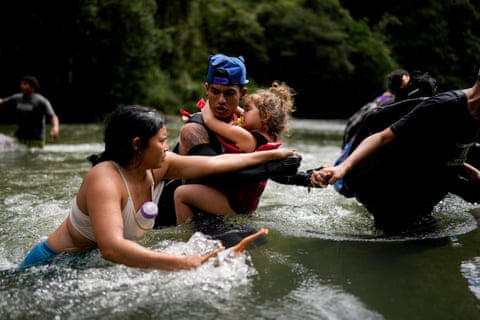
This month Bronx Documentary Center is hosting the ninth edition of the Latin American Foto Festival, on view in New York from 11 to 26 July. The show brings together the work of photographers exploring social, environmental, and political issues from across Latin America and the Caribbean.
Fri 10 Jul 2026 11.00 CEST
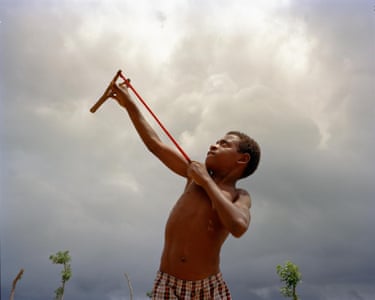
Junior With Slingshot, April 2024, Guardarraya, Dominican Republic.
After traveling to the Dominican Republic in 2021, Chris Perez began photographing the rural communities of Guardarraya and Baitoa, where his father was born and raised. Through his ongoing body of work titled Dominican, he photographs family and community members to explore questions about identity, belonging and cultural inheritance.Photograph: Chris Perez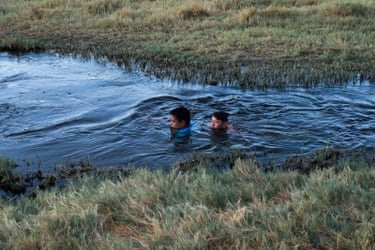
From the project Lo Oscuro del Río, 2025, Chile.
In Cristian Ochoa’s Lo Oscuro del Río, he combines photographs, archival materials, press records and interviews to investigate the decades of harm caused by mining and water exploitation to Chile’s Atacama desert. Through his work he shows the resilience of local communities as they fight back.Photograph: Cristian Ochoa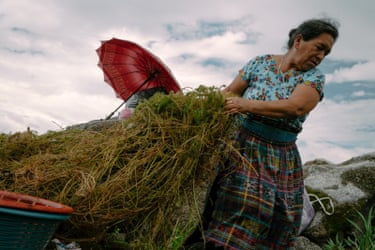
Anita Samol drags bundles of algae from the shores of Lake Atitlán, July 2023, San Pedro la Laguna, Sololá, Guatemala.
Since 2023, Laura Garcia has been documenting the work of a group of Tz’utujil Maya women known as the Guardianas del Lago (Guardians of the Lake) as they work to restore Lake Atitlán in the Guatemalan highlands. Garcia’s Guardians of the Lake series shows the women working to respond to an increase in pollution and improper care of the water, while advocating for structural change that protects their communities’ role in shaping a sustainable future for the land and sea.Photograph: Laura Garcia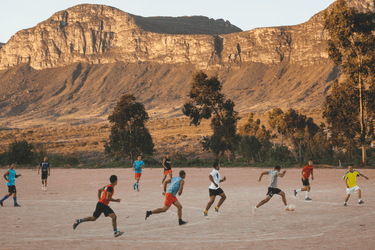
A former mining village in the southern part of Chapada Diamantina national park, October 2012, Guiné, Bahia, Brazil.
Caio Vilela’s Football Without Borders project shows the universal love for soccer, documenting the game in decades throughout Latin America, Europe, the Middle East and Asia. Vilela’s book Futebol-Arte: Do Oiapoque ao Chuí, published in Brazil by Grão Editor, features a collection of images taken across all 27 Brazilian states, showcasing the country’s vibrant communities.Photograph: Caio Vilela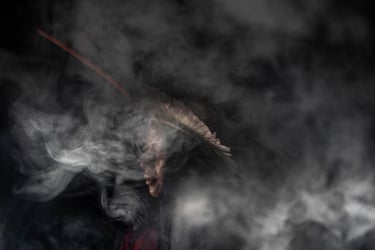
Neusa Quadros, 35, leader of Pindomirim village, smokes her Petyngua pipe inside a prayer house, November 2024, São Paulo, Brazil.
’Neusa led the land-back movement for the Pindomirim village within the future demarcated area of the Jaraguá Indigenous land, now home to 14 families. In less than a year, she established an entire village on the western border of the territory as a strategy to protect it from invasions and illegal activities, such as deforestation and hunting.’Photograph: Rafael Vilela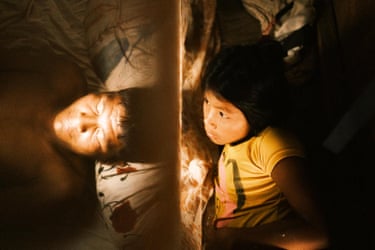
Jaidë, Puerto Antioquia, Colombia.
’Marleni Birry and her father, Dilfido Birry, look at a mobile phone in the morning at their home in the Emberá Dobida community of Puerto Antioquia, Colombia. Marleni is the daughter of Liria Cheito. On 7 April 2023, Liria Cheito attempted to take her own life using her paruma, a traditional garment of her community, after enduring repeated mistreatment by her husband. She is the mother of three children. Liria says that her daughters are the only reason she does not take her own life and that ongoing abuse by her husband is one of the reasons behind her suicide attempt.’Photograph: Santiago Mesa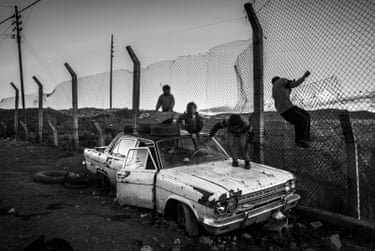
Cerros de Pasco, 2007, Peru.
On 2 May 2007, children play next to the metal fence that separates the city from an open mine more than 2km in diameter and 400 meters deep.Photograph: Marco Garro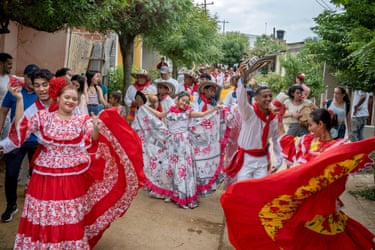
Musicians, dancers and members of the general public march toward the cemetery, August 2022, San Jacinto, Colombia.
Karla Gachet’s work documents communities that are keeping the tradition of cumbia music alive. Gachet’s image is part of the series Cumbia en Mi Tierra, in collaboration with photographer Ivan Kashinsky and NPR, as part of their bilingual visual series Cumbia Across Latin America. Their work spans six countries, showcasing the culture of cumbia.Photograph: Karla Gachet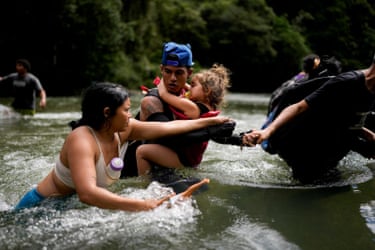
Alvaro Calderini carries his niece through the Darién Gap, November 2024, near Bajo Chiquito, Panama.
Matias Delacroix’s image documents Venezuelan migrant Alvaro Calderini as he carries his niece across a river near Bajo Chiquito, Panama, after walking across the Darien Gap from Colombia on their way north to the United States on 9 November 2024. Matias Delacroix’s long-term project Venezuela in Flux documents the economic, social and political transformation of Venezuela from 2019 to 2024. He documented the communities’ everyday lives across the country and the reverse migration caused by shifting asylum policies under the administration of Donald Trump.Photograph: Matias Delacroix/AP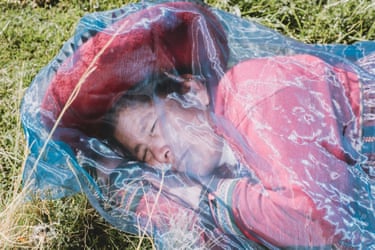
Dionisia Puma sleeps wrapped in a blue blanket, 2025, Chinchero, Cusco, Peru.
Alejandra Orosco’s ongoing project A Dream in Blue/Un Sueño en Azul illuminates the disappearance and transformation of indigo, a color with deep roots in Peru, used in textiles for more than 6,000 years. The Andean community now has to import indigo, disrupting longstanding artisanal practices. Orosco’s photographs focus on the Pumaqwasin artisan group in Chinchero, which is working to reforest the indigo plant in the area.Photograph: Alejandra Orosco
From the project Va a Llover Toda la Noche (It’s Going to Rain All Night), 2022, Mexico City.
In this photograph from her Va a Llover Toda la Noche project, Alicia Vera photographed her mother in Mexico City a year before her Alzheimer’s diagnosis in 2018. Vera notes she was showing symptoms such as misplacing things, withdrawing from social activities, mood changes and increased memory loss.Photograph: Alicia VeraExplore more on these topics