3 months ago
66
3 months ago
66
Assuming Gianni Infantino turns up on time, he is expected to make his customary address to Uefa’s annual congress on Thursday. The couple of hours spent in Brussels Expo Hall 3 will be largely procedural but the Fifa president’s messaging will be worth delegates’ attention. Even by the standards of relations between football’s major governing bodies, the past 12 months have been fractious. The fault lines hardly get narrower and there is certainly no reduction in the number of thorny issues simmering away.
At last year’s edition, in Belgrade, Infantino used the gathering of European football’s great and good to make a caveated case for Russia’s return to competitive action. If that was a rolling of the pitch, his comments on the matter in an interview last week amounted to letting the sprinklers loose. Infantino said the ban on Russian sides should be reassessed, at least for age-group teams, but there is little chance of his views gaining weight around Europe even if he elects to revisit the argument.
It is inconceivable that Uefa’s executive committee, which meets the day before congress, tables a vote to let Russia back in. Even if a constituency exists in favour of their return, it has nothing like the clout to push that through. Privately, a number of Football Associations wonder how the subject can seriously be raised given nothing has changed for the better since Russia’s full-scale invasion of Ukraine in February 2022. A fear in some quarters is that Infantino may attempt to pull levers at Fifa’s congress, in Vancouver on 30 April, to get what appears to be his wish.
The sojourn in Belgium’s capital should be more noteworthy for what is said, in the open and on the sidelines, than any decisions taken. There are many in Europe who would like reassurance that the United States is a fit and proper co-host for this summer’s World Cup, even if the urgency of mid-January has abated. It seems several news cycles ago that potential collective responses were being anxiously discussed by FA heads while Donald Trump stepped up the rhetoric about an annexation of Greenland. Any faint notion of a boycott, always the most extreme scenario, has in effect disappeared. But deep unease, better described as disgust in certain cases, at Infantino’s relationship with Trump is widely felt in Uefa’s corridors of power.
So perhaps Infantino, who sparked a walkout of Uefa representatives at Fifa congress last May after showing up late from business in the Middle East, will attempt a moderate tone. He cut a buoyant figure in last year’s Belgrade address, the expanded Club World Cup in his sights, but the tenor and context of scrutiny have ratcheted up considerably since.
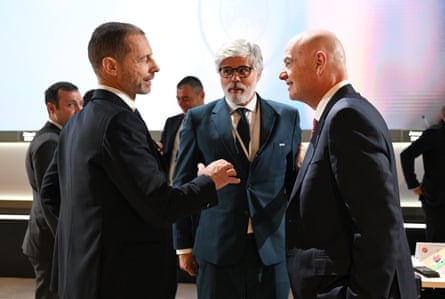
Most of the other geopolitical headaches facing the Uefa president, Aleksander Ceferin, can be kicked down the road for now. There has been no serious movement towards banning Israel since the Gaza ceasefire plan commenced in October, although widespread violations have been reported. Israel’s FA would like to see its country’s sides allowed to stage international games on home soil this year but is understood not to be pushing for that outcome in the short term because of the situation surrounding Iran.
Nor will there be a volte-face in Brussels on the stance around Greenland despite the recent turmoil. Some senior figures believe Greenland, who have long hoped for some form of Uefa or Concacaf membership and were shocked to be rejected by the latter last year, must pick a side if any hopes of involvement in the European scene are to be revived. The subject may arise at a meeting of the heads of the Nordic FAs on Wednesday.
Ceferin’s position, a subject of high controversy in Paris two years ago when he extended Uefa’s presidential term limits before claiming he would step down in 2027, looks unassailable. From virtually that moment it has been widely held that he will, in fact, run for an unprecedented fourth term next year and the expectation among leading FAs is that he will do so unopposed. Suggestions that the Danish FA head, Jesper Møller, made a Uefa vice-president last year, could stand look unrealistic and there is no former player pushing through to make their case as a wildcard.
For now Ceferin can point to a successful women’s European Championship and dance another victory lap for the revamped men’s Champions League, particularly in light of January’s climactic matchday eight. Uefa has also been keen to talk up the success of the new women’s format. He could reflect in his speech to congress that, however Uefa eventually got there, the threat of top leagues hosting domestic games on other continents has been postponed. Now that Barcelona have finally ditched the Super League project he may also claim that, bar Real Madrid, Europe’s superpowers have been lassoed into line.
The extent to which that is true may be seen in any further changes to the Champions League format from 2030, not to mention any further bloating of the Club World Cup. The ever-increasing power of the European Football Clubs group means Ceferin, who has complained of feeling tired in the past, needs a steady hand and strong voice if he really is staying for the long haul. His approach to Fifa, which some regard as too passive despite his public distaste for many of Infantino’s schemes, surely requires similar heft.
Thursday’s addresses to the continent’s big hitters may shine further light on the state of that relationship. The sense persists, though, that football’s biggest tinderboxes are still waiting to be lit elsewhere.