3 months ago
57
3 months ago
57
Mehdi Taremi did what he does best. On Saturday, the Iranian striker turned inside the area and scored for Olympiakos, a well-taken eighth goal of the season for the 33-year-old that clinched a 2-0 win at Atromitos and a place at the top of the Greek Super League. Usually, millions of people in Iran follow every step of Taremi’s European career, one that took off with Porto and has settled in Piraeus via Milan, but not this time.
The ruling regime in Tehran has cut the internet and all communications, which meant that residents of the football-loving nation also missed the non-celebration that followed. “It actually has to do with the conditions in my country,” Taremi said. “There are problems between the people and the government. The people are always with us, and that’s why we are with them. I couldn’t celebrate in solidarity with the Iranian people. I know that Olympiakos fans would like me to be happy, but I don’t celebrate the goals, in solidarity with what the Iranian people are going through.”
And what they are going through seems worse than at any time since the 1979 Islamic Revolution deposed the Shah and put Ayatollah Khomeini in power. Surging inflation and a collapsing currency have sparked major anti-government protests and unrest across Iran. The response has been brutal. The ruling regime is clinging on to power by dealing out death, more repression and an internet blackout that has lasted for days. WhatsApp messages remain with one tick, emails are undelivered and websites unreachable. For the millions of people outside the country with loved ones inside, there is fear and worry.
Football has always occupied a central place in Iran, a country where the government, like many authoritarian regimes, is wary of the power of mass gatherings and their potential to turn political but is also ready to use success for its own ends. When Iran qualified for the 1998 World Cup, players were told to delay their return so celebrations could subside, and in a vital 2010 qualifier, several wore green armbands in support of the opposition leader Mir Hossein Mousavi during protests over a disputed election. Mahmoud Ahmadinejad, the declared winner, visibly tied himself to the team, visiting training sessions and lending his presidential plane for World Cup qualifiers, while at home most clubs remain closely linked, directly or indirectly, to the state.
Speaking out is not easy. Ali Daei, like Taremi a cultural icon, backed protests in 2022 and subsequently saw his family prevented from leaving the country. During the last World Cup, which coincided with nationwide protests following the death of Mahsa Amini – a 22-year-old woman arrested for allegedly wearing her hijab improperly – former national team defender Voria Ghafouri was detained for, according to the Fars News Agency, “spreading propaganda against Iran”.
Last week, Ghafouri, the former captain of 10-time champions Tehran Esteghlal, reportedly announced that he was closing his cafes in the capital in solidarity with the protesters. IranWire, a news outlet run by Iranian journalists in exile and citizen reporters inside the country, reported that Fars had warned of repercussions. “These unrests will soon come to an end, but the real test for officials of the football federation will begin afterwards, when they must show that calls for chaos will receive a firm response.”
Threats against Taremi may not work. Few Iranians are better known internationally. Despite once being seen as a supporter of the regime, it seems as though the player has evolved since making a name for himself at Tehran giants Persepolis. Taremi has criticised the state of facilities back home, including the capital’s iconic Azadi Stadium, and has asked why there is a reluctance to allow big crowds to gather. He was the leader of the team at the 2022 World Cup that did not sing the national anthem in the first game with England, an act repeated on 7 January in the Under-23 Asian Cup in Saudi Arabia when the Iranian team kept quiet before their fixture against South Korea.
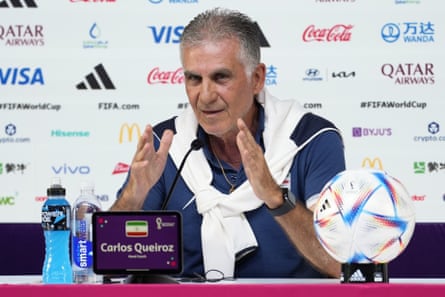
In Qatar three years ago, the players and head coach, Carlos Queiroz, grew frustrated at what they saw as constant questions from western media on the protests back home, rather than football issues, and demanded to know why counterparts went unquizzed. “Why don’t you ask the other coaches?” Queiroz said. “Why don’t you ask Southgate: ‘What do you think about England and the United States that left Afghanistan and all the women alone?’”
Now there is a desire for more questions and more information with Iran cut off from the world. At the weekend, Queiroz took to social media with a post that included a line attributed to the influential Tehran-born poet Ahmad Shamlou, born 100 years ago last month. “Freedom is breathing in an air where there is no lie.”
“To all Iranian people, My beloved Players, Staff and Friends,” Queiroz added, “I have spent many years among the Iranian people – players, staff, families, friends – and I know their dignity, warmth, and resilience. My heart and thoughts are with the people of Iran during these difficult but challenging days of hope. I am deeply concerned for their safety and wellbeing.”