3 months ago
70
3 months ago
70
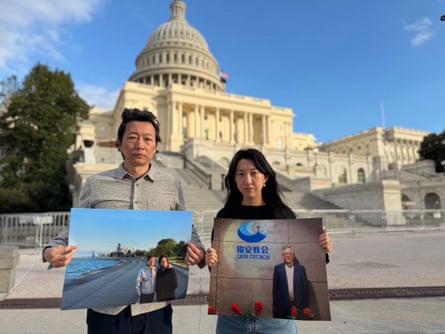
The knocks came at 2am. Hiding out at a friend’s house in a Beijing suburb, Gao Yingjia and his wife, Geng Pengpeng, rushed downstairs to meet the group of plain-clothed men who said they were police officers. Their son, nearly six, was sleeping upstairs, and Gao and Geng wanted to minimise the ruckus. They knew their time was up.
Two months later, Gao is in a detention centre in Guangxi province, southern China, charged with “illegal use of information networks”. His arrest was part of the biggest crackdown on Christians in China since 2018. It has prompted alarm from the US government and human rights groups, with some analysts describing it as the death knell for unofficial churches in China.
“We both knew that as Christians in China, there were risks,” said Geng, who fled overseas for safety with her son. “But to be honest, you can never be fully prepared.”
Gao is a senior pastor in Zion Church, one of China’s most prominent underground “house churches” with thousands of members across the country. His arrest, and those of more than a dozen other church leaders, came after months of increasing pressure on the network. But the crackdown has not been limited to Zion, prompting fears of a nationwide assault on Chinese Christians.
On Sunday, Human Rights in China said more than 100 people had been detained in Wenzhou, a city in Zhejiang province, eastern China, in a raid on Christian groups last week. The US-based NGO said pressure had been mounting on Wenzhou’s Christians for months after a dispute about installing a Chinese national flag inside a local church.

Now Geng is grappling with a set of impossible choices: should she return to China to be nearer to her husband, but risk arrest herself? Should she stay in Thailand, a country that has relaxed visa policies for Chinese nationals but has a history of complying with deportation requests from Beijing? Should she seek refuge elsewhere? Earlier in her religious journey, she sometimes felt her prayers would hit the ceiling and come back down. Now her faith is steadfast, but she’s waiting for guidance: “Sometimes I wonder, is this real?”
The most prominent pastor to be detained in the recent raids is Jin Mingri, 56, Zion’s founder, also known as Ezra Jin. He was detained along with Gao and nearly 30 pastors and church members in October. Eighteen of the pastors have been formally arrested and face lengthy prison sentences.
Following their arrests, the US secretary of state, Marco Rubio, condemned the crackdown and called for the release of the church leaders. He called on the Chinese government to “allow all people of faith, including members of house churches, to engage in religious activities without fear of retribution”.
China has five officially recognised religions: Buddhism, Taoism, Islam, Protestantism and Catholicism, but religious activities outside of officially sanctioned institutions are banned. Christians in particular have long gathered in unofficial house churches to worship away from the eyes of the state.

Zion, founded in 2007, for years operated openly in Beijing in a converted nightclub. But in 2018 the church’s physical space was forced to close amid a nationwide crackdown on unofficial Christian gatherings that led to Wang Yi, the leader of the Early Rain Covenant, another house church, being sentenced to nine years in prison for inciting subversion.
That crackdown prompted Zion to move to a hybrid model that combined large online sermons with small in-person gatherings, with followers resorting to creative methods to avoid detection, such as by renting a tour bus to worship together on the move.
“After 2018, all of these [unofficial] churches went underground, trying to find ways to bypass the tightening controls. Jin’s church was one of the most successful in doing that,” said Ian Johnson, the author of The Souls of China, a book about China’s religious resurgence. With the arrests in October, he said, the government wanted to “make it clear to everyone that this is not acceptable”.
In September, China introduced new rules banning unlicensed religious groups from holding online sermons. Xi Jinping, China’s leader, chaired a senior Communist party meeting in which he urged for the “Sinicization of religions”.
But pressure has been increasing on Chinese Christians all year. In May, the pastor Gao Quanfu from the Light of Zion church (a separate organisation to Zion) and his wife were arrested. Around the same time, several members of the Golden Lampstand Church, an evangelical network, were reportedly given lengthy prison sentences on charges of fraud. And over the summer, more than 100 Zion members were questioned by police and several physical branches forced to close.
Johnson said the “writing has been on the wall for all of these churches since the 2000s” and the latest arrests marked “the final nail in the coffin”.
By some measures, the crackdown is working. About 3% of China’s population identify as Christian, according to official estimates, a level that has remained stable for over a decade despite efforts by churches to grow their numbers. But that figure could be an underestimate, considering the increasing risks of publicly identifying as a Christian. Another survey from 2018 suggested 7% of Chinese people believed in some kind of Christian deity.
Jin held a steadfast belief in Zion’s appeal. After the 2018 crackdown, he was confident that the church would continue to grow, said his daughter, Grace Jin Drexel, who lives in the US. Indeed, in the following years its core membership swelled from about 1,500 to 5,000, with online sermons reaching double that that number.
But for months it has been clear that this year would be challenging for the church. A few weeks before the crackdown, Sean Long, a senior pastor who is now the interim leader, asked Jin if he’d considered the possibility that he could soon be arrested. Jin replied: “Hallelujah, a new wave of revival will follow.”
China’s ministry of public security did not respond to a request for comment.
Additional research by Lillian Yang