3 months ago
74
3 months ago
74
Seth and Summer in The OC
As TV romances go, it’s not the most original. Nerdy teen boy finally gets the queen bee he’s loved since they still had baby teeth – and off we pop on a four-season cycle of dramatic breakups and grand-gesture-fuelled reunions. Yet through all of the faintly ridiculous plotlines, their romance is anchored by that most elusive of on-screen tricks: actual, palpable chemistry. There is the sarcastic sparring, the physical spark (who could ever forget that Spiderman snog?) but also a feeling of deep care and genuine friendship – one that helps both characters grow into promising mini-grownups by the end. Watching the pair navigate insecurities, battle identity crises and generally make some spectacularly poor choices, lets us all feel better about the emotional dumpster fires of our own adolescence. And the fact that they keep on choosing each other speaks to that part of our teen selves that longed to find someone who might jump on to a coffee cart and declare their love for us – or at least wait around all summer while we campaigned to save sea otters. Lucinda Everett
Mae and George in Feel Good
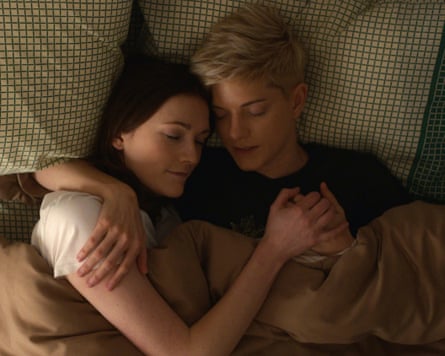
How do I love Mae and George? Let me count the ways. I love the way they’re one of sitcoms’ classic odd couples – so wrong in practice, so right at the naked soul level. I love the way Mae’s name is saved in George’s phone as “Corn”, because her hair is like a head of corn. I love how, in a genre more or less devoid of hilarious and tender portrayals of queer love, they’re so silly, horny, sweet, intense, traumatised, awful, adorable … in short, so real.
I love how they’re kissing within the first 10 minutes of the first episode of Mae Martin’s exquisite semi-autobiographical show. I love how, 12 irreproachable and increasingly profound episodes later, Mae has begun the process of transitioning, faced her past and dodged a bullet going mainstream as a comedian – and that our lovers are still together. And I love how it all ends outside a log cabin overlooking a lake in Canada, the two of them under a tartan blanket, dreaming of becoming ice fishermen in Norway and discussing the chemical process of photosynthesis. It is pure romance. Chitra Ramaswamy
Sun and Jin in Lost
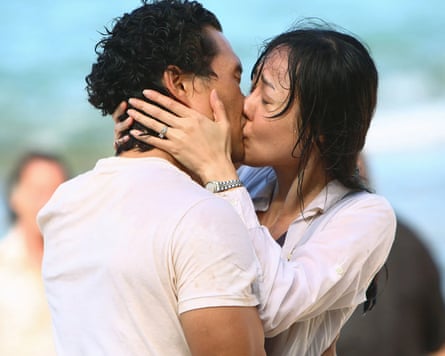
Sun and Jin’s love still has the power to make me weep in public, usually when I’m plugged into Lost’s knee-weakening score. I couldn’t have predicted it: Jin (Daniel Dae Kim) is controlling of his wife when they first crash on the island; Sun (Yunjin Kim) doesn’t even want him to know that she speaks English. But flashbacks show their complicated history – a tangle of honour, tradition and pride – and Jin slowly becomes the husband that Sun deserves, just in time for the arrival of a baby.
It was groundbreaking at the time: Dae Kim talked of his pride at playing Jin, because: “You had stereotypes or tropes that were overturned by great writing and an exploration of humanity as opposed to the low-hanging fruit of cliche and caricature.” It was also one of the first romantic kisses on mainstream US telly between two Asian characters. And what kisses! Their old school Hollywood smooch on the beach, which happens when they meet again after an entire series spent yearning, is one for the ages. But, alas, many great love stories end in tragedy too.
When Sun is trapped on a sinking submarine, Jin reminds her in Korean that he promised to never leave her again. After their goodbye “I love you” – unforgivably from the writers, in English – they clasp hands and let the water take them. I sobbed for a whole weekend after seeing them together again in the finale. They weren’t a perfect love, but I felt it in my bones. Still do. Hollie Richardson
Dawn and Tim in The Office
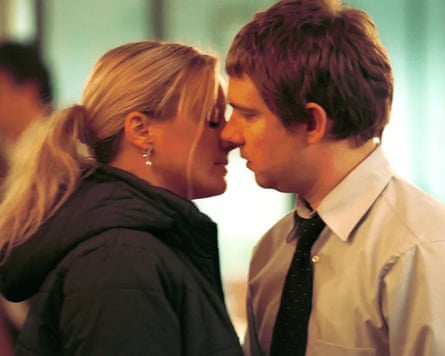
It’s a set of paints that seal the deal. Bored receptionist Dawn Tinsley (Lucy Davis) and sarky-but-sensitive sales rep Tim Canterbury (Martin Freeman) are the heart and soul of the Wernham Hogg mockumentary. For two series, they’re unrequited soulmates, rolling their eyes at boss David Brent and winding up colleague Gareth Keenan. Yet their relationship, like most workplace crushes, remains one of unspoken longing. After all, Dawn has a fiance: boorish, controlling Lee from the warehouse, who’d proposed via the personal ads. As Dawn explains: “He had to pay by the word, so it just said ‘Lee luv Dawn. Marriage?’ It’s not often you get something that’s both romantic and thrifty.”
Following several agonising near-misses, their moment comes in the Christmas finale. After Lee belittles her dream of becoming an illustrator, Dawn tearfully unwraps her Secret Santa gift in the taxi home. She finds a set of oil paints, a sketch she’d drawn of Tim and a note saying “Never give up”. Deeply touched, Dawn breaks off the engagement, hot-foots it back to the office party and snogs Tim. As DJ Keith played Yazoo’s Only You, the nation punched the air and wiped away a tear. Not the most epic love story, perhaps, but the most relatable. Michael Hogan
Bill and Frank in The Last of Us
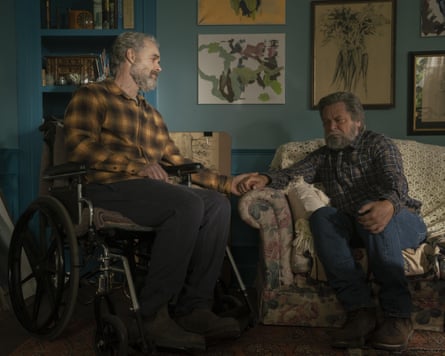
The Last of Us is often unrelentingly brutal. Based on the post-apocalyptic video game of the same name, it shows a collapsed society ravaged by a mysterious fungal infection that turns its victims into bulbous, zombie-like creatures. As you can imagine, romance is often low on the list of priorities, and while there’s a lot of grunting and ejaculating of bodily fluids it’s very much not of the loving kind. Which makes season one’s third episode, Long, Long Time, all the more beautiful. Via flashback, we meet misanthropic survivalist Bill (Nick Offerman), whose life is softened after he encounters the more extroverted Frank (Murray Bartlett). Their idyllic domestic life – growing fruit, quaffing fine wines, painting – is a haven from all the horror, and as they grow older together their love becomes as strong as their home’s defensive fortifications. “I was never afraid before you showed up,” Bill says at one point, encapsulating his joy at his new life and the overwhelming fear of losing it all. As Frank’s body is slowly ravaged not by the fungus but by mundane human illness, the pair choose to end their lives together, in a house that has been transformed into a home. It’s a true encapsulation of, as Rihanna once put it, finding love in a hopeless place. Michael Cragg
Fleabag and the Hot Priest
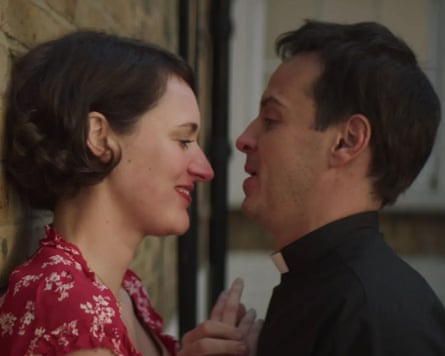
Everyone knows that tragic romances that are doomed to fail make the best on-screen love stories. And there’s no greater tragic romance than the one between Fleabag and the priest. Their relationship develops over flirty chats, cheeky tinnies and a mutual adoration for Winnie the Pooh – but there’s no happy ever after here.
They meet during a phase where Phoebe Waller-Bridge’s Fleabag is trying to turn over a new leaf, away from her former self-destructive behaviour and grief over the loss of her best friend towards a calmer way of living. She lusts over him (“His beautiful neck!”) and kneels down at his command during a sexually-charged confession. Their chemistry is white-hot; it scorches the screen.
Sadly, their romance is short-lived, although a long-term relationship was never the point, not really. For once Fleabag, so used to distracting herself with sex or jokes, allows herself to be vulnerable. The priest is the only person in Fleabag’s life who notices when she withdraws inside of herself and talks to us, the audience, breaking the fourth wall. And isn’t that what we all want, really? To be seen and accepted for who we are? Ann Lee
Charles, Sebastian and Julia in Brideshead Revisited
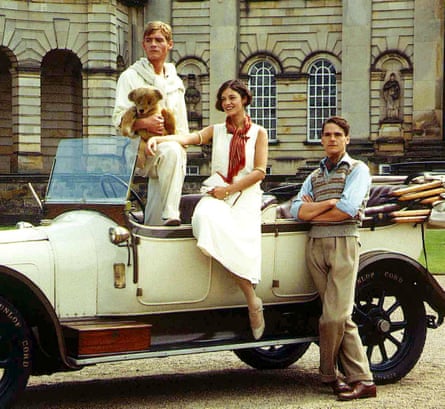
ITV’s languid 1981 adaptation of Evelyn Waugh’s hymn to “the splendours of the recent past” remains one of TV’s most sumptuous heartbreakers, with Charles Ryder’s (Jeremy Irons) doomed infatuation with the exquisitely unhappy Flyte siblings gifting viewers a love story that is as much about Catholicism and self-sacrifice as it is bums and roses. Poor, hopeless Charles. Poor, hopeless Sebastian (Anthony Andrews) and poor, hopeless Julia (Diana Quick). Watching the threesome cling to their faith while their hopes and youth circle the gurgler was enough to make this collapsed Catholic, for one, weep like a chump. Sarah Dempster
Hal and Kate Wyler in The Diplomat
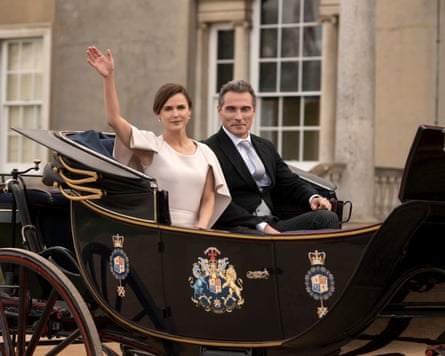
Almost all political dramas have a fantasy to sell you, and The Diplomat is no different. It is set in a world where politics is driven not by money but by emotional intelligence: relations between Britain and America depend on someone sensing what someone else is thinking and feeling, then working out the best way to communicate with them on their level. Kate Wyler (Keri Russell), the US ambassador to the UK, is better at that than anyone – apart from her on/off, semi-estranged, love/bane-of-her-life husband Hal (Rufus Sewell). Theirs is not the sort of romance you’d necessarily want to emulate yourself, since it’s built on stimulating rivalry as much as it is affection: Kate and Hal have each found the only person who can keep up with them, as well as the only one who really knows them. The ongoing storyline where either one could outdo the other by becoming vice-president has added a spicy metaphor for spouses not knowing how completely shared their ambitions are and how much their partner is in it for themselves, too. But all that only makes it more affecting when the love they have for each other occasionally bursts through. In the most recent season they were supposed to be properly, finally divorced and were pretty busy dealing with a potentially catastrophic global crisis, yet they kept giving in to the sort of tender, almost telepathic moments that they could never have with anyone else. Let’s hope they keep driving each other to distraction for ever. Jack Seale
David and Patrick in Schitt’s Creek
Many of us have been reminded of how much we loved Canadian sitcom Schitt’s Creek in recent weeks, following the death of the great Catherine O’Hara. Eccentric faded actor Moira Rose, the character O’Hara brings to life so hilariously, is reason enough to watch, but Schitt’s Creek also contains a moving love story.
When we first meet Moira’s son, David (Daniel Levy), he is single and refreshingly confident in his sexuality – navigating a one night stand with his best friend and describing his pansexuality with the memorable phrase: “I like the wine and not the label”. In season three he meets Patrick (Noah Reid), who, though less confident in his queerness, is more stable in pretty much every other aspect of his life. The pair even each other out, offering one another support, joy, and unique renditions of Tina Turner’s The Best.
Patrick “sees you for all that you are,” Moira tells David in a rare moment of earnestness. Again and again we watch Patrick accepting and loving every part of David – his dramatic nature, his anxiety, even his bed-wetting – while also standing up to him when they disagree. Queer relationships have been depicted on screen as difficult and sad so many times: this sweet, honest – and often very funny – romance is the perfect antidote. Lucy Knight
Niles and Daphne in Frasier
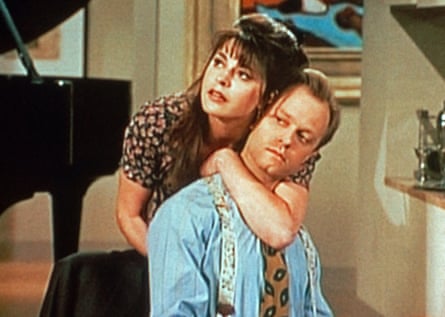
Given that Frasier was a masterclass in flitting from belly laughs to heart-melting pathos, it’s no surprise that it created quite possibly the best sitcom romance of all time. From the first meeting between Daphne (folding her employer’s laundry) and Niles (awestruck by beauty despite the presence of his brother’s undies), it is a joy to watch. What starts as an extremely rich seam of comically unrequited love (“What’s that perfume you’re wearing?” “It’s Obsession.” “No, no it isn’t – I was just asking!”), begins to blossom into so much more – scenes where the air is thick with unsaid words, and Niles’s unspoken longing becomes heartbreakingly poignant.
Theirs is a romance which encompasses comedically erotic tango dancing, Niles smearing himself in paté to seem good with dogs and, eventually, Daphne realising that her dream man might have been lingering optimistically in her life for years. Finally, after half a decade of yearning, they kiss – a smooch born part of longing, part of Daphne’s desire to stop Niles prattling on about the scent of flowers.
Arguably, after they elope in a winnebago, their relationship is never quite as moving again (perhaps unsurprising given Frasier itself took a downward slide in later years), but for seven seasons they had viewers laughing, crying and asking the ultimate question when it comes to TV romances: how many times can one character smell another’s hair before it becomes creepy? Beautiful stuff. Alexi Duggins
Woody and Lol in This is England
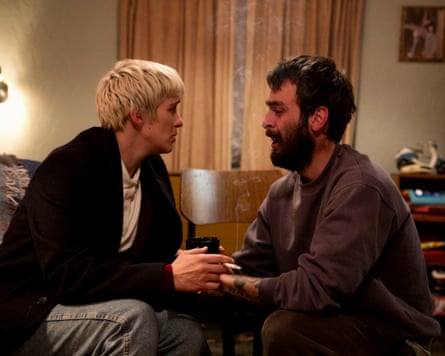
In the final episode of This is England ’90, the drama’s long-standing couple Woody and Lol tie the knot at last. Is their wedding a blissful, idyllic affair? Not exactly. One of the happy couple’s best pals (with whom Lol had enjoyed a brief fling) is suspected of being an accessory to the recent murder of another of their friends, while the bride’s sister – an estranged heroin user – is largely absent from the celebrations. However, this barely-concealed trauma actually serves to illustrate the depth of Woody and Lol’s love. At the heart of a ridiculously dramatic friendship gang whose only constant is wild dysfunction, Woody and Lol are stillness. Their relationship doesn’t just hold them together as individuals. It maintains the perilous equilibrium of the whole group. As such, their nuptials feel like one of the most righteously earned happy endings in TV history. Phil Harrison
JD and Turk in Scrubs
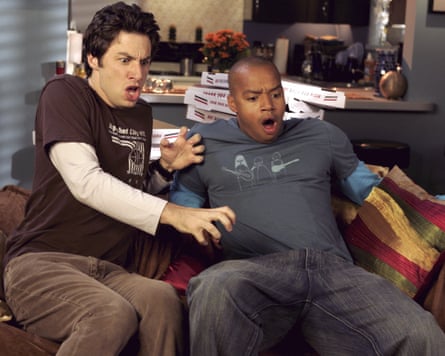
From the show’s pilot episode, Scrubs treats the friendship between neurotic protagonist JD (Zach Braff) and confident surgeon Turk (Donald Faison) with the narrative weight sitcoms traditionally reserve for romantic relationships. They experience jealousy when the other makes new friends. JD prioritises his crush on fellow doctor Elliot (Sarah Chalke) and Turk feels betrayed; before long the shoe is on the other foot as Turk starts dating nurse Carla (Judy Reyes) and suddenly has less time for cold ones with his best bud. In the third episode, My Best Friend’s Mistake, JD even describes feeling “like the girl” when Turk won’t talk about his feelings. The show is bracingly honest: platonic love requires the same care, communication and commitment as romantic love. Sometimes more.
The genius is that Scrubs never made this ironic. When they call each other “Chocolate Bear” and “Vanilla Bear”, or when JD admits “I love you” in the supply closet, it isn’t a joke at their expense. The punchline is the world’s discomfort with straight male vulnerability, not the vulnerability itself. Most TV bromances in that era were built on emotional constipation and “no-homo” avoidance of compromising situations (see: Ross and Joey falling asleep together in Friends). Scrubs just asks: what if two straight men actually loved each other? Sasha Mistlin
Angie and Will in Will Trent
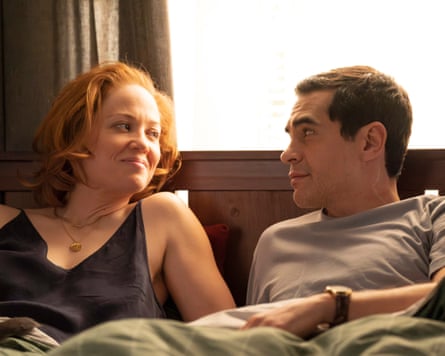
The relationship between crime-solving oddball Will Trent (Ramón Rodríguez) and his childhood friend Angie Polaski (Erika Christensen) is more than just a classic “will they or won’t they”. A touching portrayal of how past trauma informs our everyday, the pair first meet in a foster care home, and now fight crime in Atlanta, Georgia. To mention trauma conjures up ideas of adults tortured by the past, screaming and self-destructive – and yes, there is some of that – but crucially, this relationship doesn’t feel toxic, just complicated. Narratively rich, and with a surprising amount of lightness,the two rescue each other professionally and emotionally – Angie and Will just get each other in a deep way no one else can match. Whether that means they should be together remains unclear but as a counter to the trope that loving someone who is hurt will only result in suffering, they make for compelling viewing. Coco Khan
Chidi and Eleanor in The Good Place
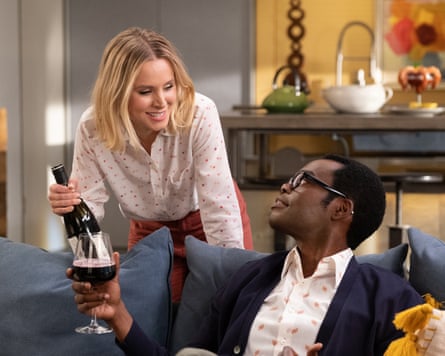
In The Good Place, a 2010s philosophical comedy about the afterlife, protagonists Eleanor and Chidi couldn’t be more different characters. Chidi’s a neurotic ethics professor, Eleanor an amoral salesperson for a sham company. They butt heads, later discovering that they’ve been placed together in the afterlife as a form of torture. This makes their romance all the more beautiful when it arrives at the end of season two.
They’re no match made in heaven (quite literally the opposite). But ultimately, the pair balance each other out and teach one another how to be better people. Chidi relaxes, Eleanor studies moral philosophy and becomes gentler. We later discover that, in a kind of multiverse plot twist, they have chosen each other in almost every timeline. Sometimes the person you need most is the person who pushes you to grow. Micha Frazer-Carroll
Angela and Jordan in My So-Called Life
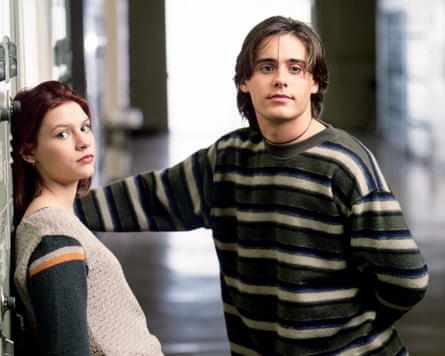
If my obsession with Heated Rivalry has taught me anything, it’s that I am all about the yearning. No one has ever yearned harder than Angela Chase for Jordan Catalano resting his head against a wall in a crowded school corridor in My So-Called Life. Think of it as the lean that launched a million fantasies. Watching the awkward girl with the Crimson Glow hair and fine line in plaid shirts obsess over the blue-eyed, soft-haired, choker-wearing, decidedly un-teenage looking student was a romantic milestone of mine. (Hear me out – I was 11.) Yes, she gets the guy – air punches from awkward girls everywhere – and yes, there are major issues: he tries to keep them a secret from his jock pals, he sleeps with her best friend Rayanne. It isn’t your quintessential romance. But the moment he stops leaning against that locker, strides up to her and takes her hand in full view of everyone, something altered deep within me. A lifelong love of yearning was unleashed. Long may it continue. Kate Abbott