4 hours ago
5
4 hours ago
5
Rob Stickle was six years old and waiting to see The Empire Strikes Back when a ripple passed through the crowd. His mother hoisted him on to her shoulders to see a man loping down one of Toronto’s busiest streets.
“I was a Star Wars fanatic, and I remember saying to mom: ‘He has a robot leg.’”
Who Stickle saw that mid-July day in 1980 was the 21-year-old Terry Fox on his journey to run across the entire breadth of Canada. Residents packed the city’s sidewalks for miles to catch a glimpse. By the time Stickle saw him, and after nearly 2,200 exhausting miles, Fox had completed more than half of his “Marathon of Hope” in aid of cancer research. The distinctive style of Fox’s run – a kind of limping hop – was the result of a journey undertaken on a crude and ill-fitting prosthetic leg made of plastic, leather and metal.
“I didn’t fully appreciate what was happening at the moment – that we were all part of something much larger,” said Stickle, now an elementary school teacher in Toronto. “But what I’ve learned since – after losing my mom to cancer and becoming a teacher – is that we were seeing someone special. Someone who chose the route that was going to hurt. Someone who did it because he believed that the cause was important.”
Fox’s status as a national hero in Canada has never been in dispute, but at a moment when the country’s sovereignty is under attack and people are once again debating what binds the nation together, his story is attracting renewed, and bipartisan, praise. Indeed, for those outside Canada it can be a surprise to discover the degree to which Fox has become less a person than a national symbol: dozens of roads have been named after him, as have 14 schools. A mountain bears his name. Statues of him dot the country. Canada has issued both stamps and coins with his image. Parks Canada designated him a National Historic Person and called Fox “an enduring icon” who “transformed our vocabulary about personal courage”. The annual Terry Fox Run takes place in late September are now held in more than 60 countries and are the world’s largest one-day fundraiser for cancer research. More than C$1bn (US$715m) has been raised in his name.
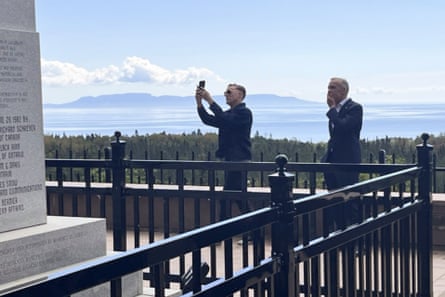
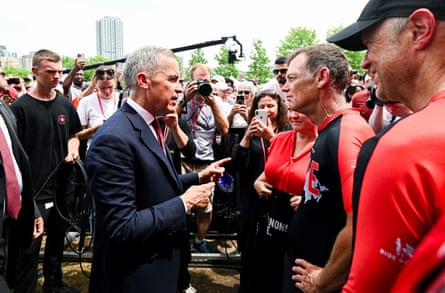
But in 2026 Fox has also become a vector for a renewed sense of Canadian nationalism. The singer Bryan Adams recently joined the prime minister, Mark Carney, to visit a memorial to Fox, in a moment that seemed to signal a confluence of political and cultural powers coalescing around Fox’s legacy. Adams, whose hits include Summer of ‘69 and (Everything I Do) I Do It for You, has penned a new tribute, The Ballad of Terry Fox.
And on 19 September the documentary Run Terry Run will premiere at the Toronto film festival. Compiling previously unseen footage from the 1980s to reveal a shy but determined young man whose singular odyssey enthralled the country before breaking its heart, it also upends myths that Fox enjoyed the country’s full support from day one – showing how he struggled through hundreds of early miles with little support or interest.
“Watching him run, it’s almost impossible for a Canadian to not feel moved and inspired,” said director Sean Menard.
Fox was an avid athlete from British Columbia whose leg was amputated in 1977 after he contracted osteosarcoma.
“He’s presented as almost a superhero today, but he was just a person who had to watch other kids die in the cancer ward,” said Menard.
In 1980, angered by the lack of support for young people suffering from cancer, Fox decided on an ambitious goal: he would run across Canada to raise money for cancer research. On 12 April 1980, after dipping his foot in the Atlantic Ocean in St John’s, Newfoundland, Fox began a journey that, if completed, would span nearly 5,000 miles.
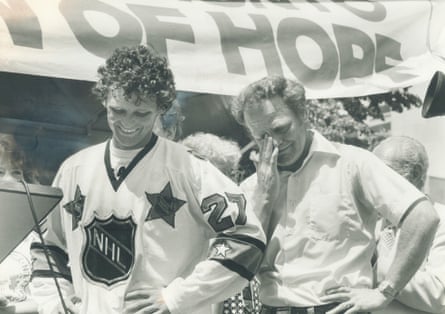
Run Terry Run shows a surprisingly lonely and rag-tag trek, aided largely by friends and family. Dangerous roads, fatigue, heat, rain, wind and painful chafing all threaten to derail the effort.
“The first reel that I found was a three and a half minute shot of him just running up a hill,” Menard said. “And he’s constantly adjusting the leather strap on his prosthetic leg because it’s not designed for that type of momentum and movement. It’s a walking prosthetic.”
But as Fox moved slowly across the country, completing a full marathon each day, word spread. He soon met the prime minister. And by the time he reached Toronto, he received a hero’s welcome.
The film also captures a quiet, goofy and shy Fox, who remains singularly focused on his goal and rarely permits himself moments of emotional respite. In one poignant scene he breaks down while telling a crowd about a 10-year-old boy he’d spent the day with who was also battling cancer. As donation money poured in and Fox exceeded his initial C$1m (US$714, 775) goal, he resisted any endorsements or the use of his name. After passing through northern Ontario – what his team called “the backbreaker” – Fox felt optimistic that the worst was behind him. But in late August he developed a cough and grew increasingly tired. The team soon learned the cough was due to cancerous tumors in his lungs.
On 1 September, Fox was forced to stop outside Thunder Bay, Ontario, after running 3,339 miles over 143 days. The following day, he tearfully announced the Marathon of Hope was suspended. He died the following June.
The documentary has the effect of humanizing a man whose identity has become enmeshed with the country’s narratives.
“At this particular moment in time in Canada, having these kinds of stories remind us of how great Terry was … and his bringing us together is a good thing,” said Adams, whose song is featured in the documentary and has been met with chants of ‘Terry! Terry!’ at performances in Canada. In it, he sings:
Across the asphalt and the gravel
Through the heat and rain
He carried the nation’s weight for twenty-six miles
Then he’d go again
“I tried to encapsulate that story in a lyric as best I could,” Adams said. “I’m glad it’s becoming a near-mythological story in Canada. It should be, because it’s an incredible story about a human being fighting. It’s an odyssey. And it deserves to be folklore.”
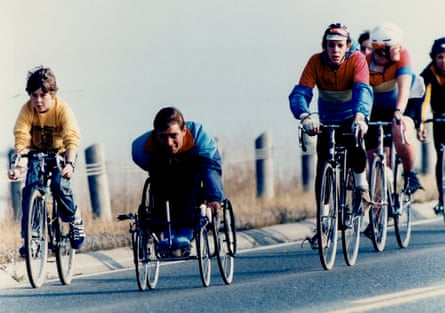
“We like to think of ourselves as selfless. We like to think of ourselves as brave. He even apologized when he had to stop,” said Stickle. “There’s no scandals for him and so it’s easy for people seem him as the emblematic Canadian hero.”
But questions over how much to elevate the runner have long dogged Fox’s legacy.
Rick Hansen, a friend of Fox who recruited the young man to play wheelchair basketball in Vancouver, said he understands the temptation.
“Terry’s story and his legend is basically steeped in our values and our sense of identity as a nation: one in which people deeply care about each other,” he said. “But he also just had an absolute raw sense of purpose and determination to keep going.
“The world is changing dramatically and there are perceived threats to Canada. In this sort of environment, we recognize examples of our country’s DNA in Terry’s journey.”
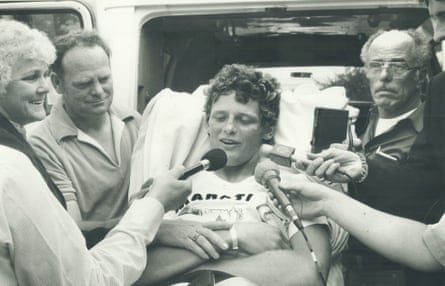
Hansen, who completed his own journey of 25,000 miles around the world by wheelchair, recalled Fox first telling him of his cross-country plan while the pair took a rainy drive in Hansen’s Honda Civic.
“I told him, ‘You need a team, Terry. Because there will be days when it gets hard when you need the support of more than just yourself.’”
Hansen says there were days on his own journey when fatigue would overwhelm him. “But all it took was a little smile on the road or meeting someone who was in a chair and said how much you encouraged them – that kept me going,” he said. “For Terry, when he met young people with cancer, who were struggling, he showed them what hope looked like.”
But Hansen cautions against beatifying Fox, even in a moment of renewed Canadian national spirit.
“The one thing he would not want us to do is create this legend to such a lofty and disconnected status where we couldn’t see a bit of Terry in all of us,” he said. “Terry was an everyday Canadian. But he showed us what could be done with extraordinary determination and purpose.”