3 months ago
83
3 months ago
83
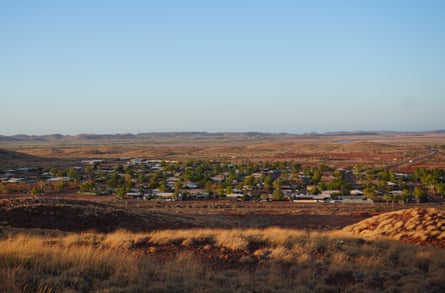
Few places are more exposed to extreme weather than Roebourne, a tiny cyclone-prone town on the Western Australian coast, where public housing residents endure 50C heat without air conditioning.
Lyn Cheedy, a Yindjibarndi elder, takes her grandson to the pool most afternoons.
At first, the cold water is refreshing. Then a gust of wind hits.
“The wind burns you,” she says. “I have to keep splashing my face, and your hair is drying that quick … it’s like you’re sitting in front of an oven.”
In the Pilbara, heat and cyclones are nothing new, says Cheedy. Her people have survived extreme conditions for millennia. Before colonisation, they would follow the rivers inland and seek out shaded water holes. Now a key waterway has been dammed and trees cleared. The storms are stronger and the temperatures higher – three years ago Roebourne hit 50.5C for the first time in recorded history.
Indigenous people across Australia are on the frontline of the climate crisis. As the world gets hotter and natural disasters become more frequent and intense, they are more likely to live in the worst-hit areas – often in substandard housing. Extreme weather also threatens to destroy sacred sites and cultural practices.
Traditional ways of managing heat have been disrupted, says Cheedy. Aboriginal groups from across the Pilbara, forcibly removed from their land, are now living in “flimsy” public housing in Roebourne, which is named Ieramugadu in the local Ngarluma language.
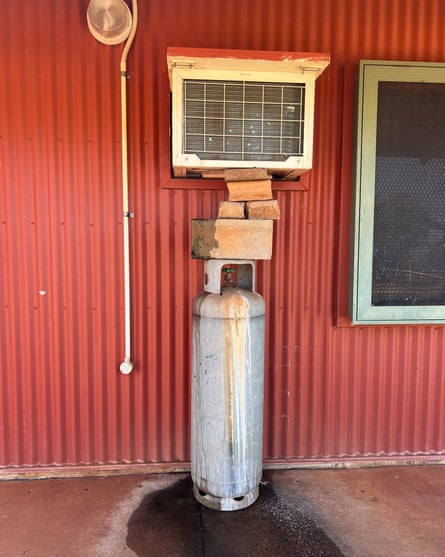
Many of the homes do not have air conditioning. Those that do have usually been installed cheaply, at the tenant’s expense. Air conditioned homes – including Cheedy’s – quickly draw a crowd, with 16 people routinely sharing a four-bedroom house. This leads to eye-watering power bills, which residents struggle to pay.
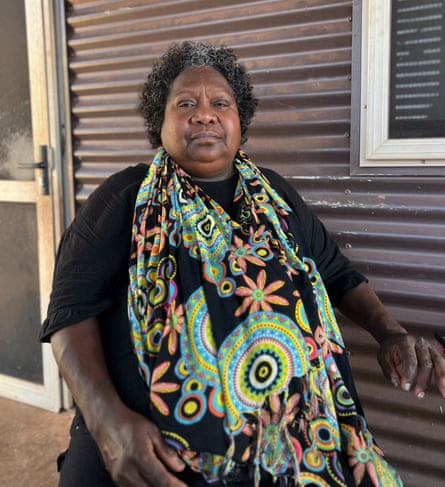
“The government knows that we suffer,” Cheedy says. “And these houses aren’t built properly. We have to keep forking out money, which we don’t have, and then our power gets shut off … if we were animals, they’d get the RSPCA in.”
The extreme heat also has dire health consequences, says Sean-Paul Stephens, the CEO of the Ngarluma Yindjibarndi Foundation Ltd (NYFL), a local traditional owner organisation.
Stephens says there is a potential increased mortality risk, with “elders in extremely vulnerable health situations living in 50C heat in houses without air conditioning”.
Social housing properties are constructed to exceed minimum building standards, a spokesperson for the WA department of housing said, to make them “thermally comfortable and sustainable in terms of costs for tenants to maintain”.
“Ceiling fans, air conditioning apertures and ceiling and wall insulation have been included in all new construction in the north-west since 1990,” they said. “Air conditioning is not a standard inclusion in public housing properties. Tenants may make application to install air conditioning in their rental property, at their own expense.”
Tenants experiencing financial hardship could apply for a grant to help pay their utility bills, the spokesperson said.
Indigenous organisations ‘not funded’ for natural disasters
Similar struggles are playing out in First Nations communities across the country. Record temperatures in central Australia have led to warnings that the region could become too hot for humans. Residents of a New South Wales Aboriginal community destroyed by floods in 2022 are still living in shipping containers, waiting for homes to be rebuilt. Rising tides in the Torres Strait islands are swallowing up graves.
Aboriginal and Torres Strait Islander people are almost four times more likely to be exposed to natural disasters, an analysis by the National Indigenous Disaster Resilience (NIDR) research program found.
Indigenous people make up 13.4% of those affected by disasters, the data shows, but Indigenous-led projects received just 3.1% of the federal government’s first two rounds of disaster ready funding. The analysis excluded $17m for projects led by Aboriginal and Torres Strait shire councils in Queensland because they did not meet the definition of an Indigenous organisation under the funding guidelines.
“The real life impacts of that is that Indigenous community organisations inevitably pick up the pieces, using their own resources,” says Bhiamie Williamson, who leads the NIDR.
“They’re not recognised for that, they’re not funded for that, and it strains already strained organisations.”
This, too, was borne out in Roebourne when the category five Tropical Cyclone Zelia hit in February.
As the system tracked towards the coast, staff at NYFL translated weather alerts into local languages to broadcast on social media and community radio; driving house to house to spread the message to those without internet or phone credit.
The cyclone struck while men’s business was happening in remote bushland without mobile reception, and the staff scrambled to notify and safely house people in line with cultural protocols.
“There was this mad rush where we were all on the phone trying to figure out, how do we navigate the young men that have been initiated?” says Stephens.
“There’s a really intricate system of who can speak to who, especially during that period … it’s another time where the organisations expend their own resources in constant response mode [when they] really should be dedicated to doing the proactive work to deliver the social and economic empowerment that they exist to do.”
Williamson has called on the federal government to allocate at least $30m of the next round of disaster ready funding for Indigenous-led projects, to ensure the funding matches the need.
“Communities are now expecting another flood, they are expecting another bushfire,” Williamson says.
Funding outcomes would ultimately hinge on the competitive grants process, a spokesperson for the National Emergency Management Agency said. The third round of funding – announced last month – included new guidelines to “strengthen support for First Nations communities”, they said, and about 10% of total funding had been awarded to projects undertaken by or in partnership with Aboriginal organisations.
But Williamson says First Nations communities need certainty. “The long-term consequences of the lack of investment now is that Indigenous communities will continue to be more exposed, and there will be more vulnerabilities in the years ahead,” he says.