3 months ago
77
3 months ago
77
There’s a funny moment towards the end of The Tony Blair Story, Channel 4’s three-part documentary about the former prime minister, in which Blair is asked to introspect about his own personality. For the previous three hours or so we have enjoyed a series of talking heads picking over his premiership. Now he breaks the fourth wall and, with something like incredulity, says what’s the point of asking him to identify his own weaknesses when all he’ll give is a “politician’s answer”. Reminded he’s no longer a politician, Blair replies as honestly as at any point in the encounter: “You’re always a politician.”
It is one of the more satisfying exchanges in Michael Waldman’s series, which, depending on your view, is either a futile exercise in confirming one’s existing prejudices about Blair, or more than three hours of great telly. I’m inclined towards the latter, partly for the enjoyment it offers of being yanked back to the memory of all those old horribles. Nothing dates quicker than an out of office politician and it’s a particular nostalgia that’s triggered by footage of Robin Cook at John Smith’s funeral, or Max Hastings describing Blair’s henchmen as “absolutely ruthless bastards”, or Jack Straw being interviewed in a black velvet jacket like something from Death on the Nile.
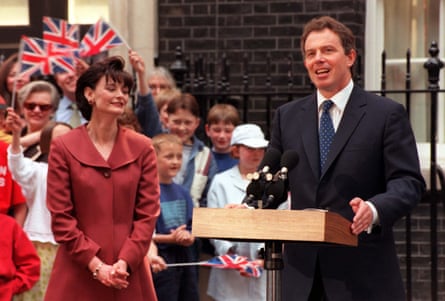
And if there’s nothing new to discover, the remembrance of old battles still satisfies. I was amused by Jonathan Powell’s recollection of Mo Mowlam telling him, in relation to Blair’s success in Northern Ireland, that “Tony succeeded because he thought he was fucking Jesus.” After Kosovo, says Robert Harris, Blair “thought he could walk on water” – diagnosing Blair’s Jesus complex runs like a motif through the show. So, too, does the accusation that Blair’s EQ always outstripped his IQ, often made by people who may themselves not be the brains of Britain. Here’s Jeremy Corbyn, look, whose assessment of Blair as “a man in denial” – not an unfair judgment – would be more authoritative if it didn’t come from someone so apparently incapable of internalising lessons from his own clanging defeats. Blair, he says, got himself into a “messianic trench” over Iraq, which is certainly a trench I’d like to see.
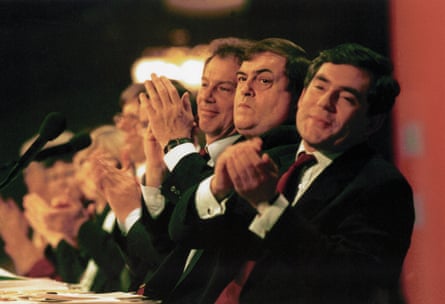
If Waldman doesn’t relitigate Iraq in any meaningful way, that leaves the voyeuristic family stuff. Look at baby Leo, now a strapping 25-year-old, and two of his three siblings, Kathryn and Euan, saying sensible things about their dad. Cherie comes across as a real force, talking with a don’t-give-a-monkeys-any-more honesty. Asked whether she felt sorry for Gordon Brown when Blair snatched the leadership, she looks frankly astounded, as well she might. Cherie, per her own account, pushed her husband to get behind a different successor when Brown’s turn finally came around, underscoring a persistent unwillingness on the part of observers to process the vicious reality of political rivalry.
Similarly delusional on the part of Blair’s critics: the perennial question of money, about which this country remains wilfully babyish, affecting to be shocked – shocked! – that someone with the ambition for high office might be interested in spending more than 300 quid on a suit or making more money than an entry level banker. (See Jacinda Ardern’s current presence on the world’s speaker circuit, and who can blame her.)
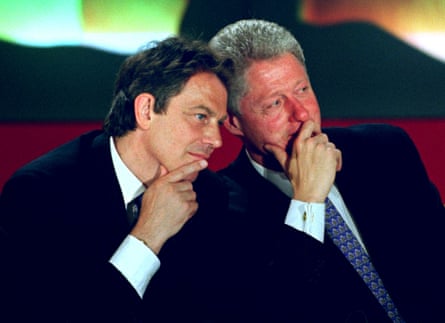
Other stuff: Bill Clinton clearly sympathetic to Blair’s divided loyalties between the US and Europe in the run-up to Iraq, and choosing his words very carefully. Pushed on whether he thinks Blair made a mistake going to war, Clinton concedes of his old friend that “he was in a pickle”. Blair, meanwhile, presents his decision to support George W Bush not as poodledom, but pragmatism. Britain, he implies, is a small country with a middle-sized economy deluded about its own place in the world; of course he threw in his lot with the US.
The irony of this assessment is that, of course, the thing Blair ends up being most credibly accused of is his own delusional overreach. Possibly that delusion persists. Prodded by Waldman, Blair avers that, in his role as head of the Tony Blair Institute for Global Change, he may have more power now than he did as prime minister. That he has been announced, alongside Jared Kushner, as part of the transitional authority to oversee post-conflict Gaza makes one think: “Hasn’t the region suffered enough?”
And so it wasn’t for Blair himself that I came away feeling nostalgic; shots of the Gallagher brothers at Downing Street in the late 90s remain embarrassing. I did, however, feel nostalgic for an era of political optimism that is impossible to find anywhere today; an era during which the country’s spirits matched the energy of a leader habitually captured by cameras boarding a plane by sprinting up the stairs at full speed.
-
Emma Brockes is a Guardian columnist