3 months ago
70
3 months ago
70
If there’s one thing the late avant-garde artist Theresa Hak Kyung Cha is known for, it’s almost certainly her experimental 1982 book Dictée, a hard-to-classify work that has become a mainstay of college curriculums and ambitious writers. Poet Juliana Spahr has described the work as “part autobiography, part biography, part personal diary, part ethnography, part auto-ethnography, part translation”, noting that it collages “multiple voices – American, European, and Asian – so as to build a history”.
A major new retrospective of Cha at the Berkeley Art Museum – Theresa Hak Kyung Cha: Multiple Offerings – aims to go far beyond Dictée to present the artist’s varied and prodigious output, bringing attention to her full complexity as a creative force and the many contemporary thinkers who have been inspired by her career.
“I wanted to decenter Dictée,” show curator Victoria Sung told me during an interview at the Berkeley Art Museum. “Of course it is a huge part of her practice, but it is one of the final works that she made, and I wanted to show the real richness of her practice from the early 70s on.”
Cha originally published Dictée with Tanam Press in the fall of 1982, shortly before she was raped and murdered by a security guard in Manhattan. Born in South Korea in 1951, Cha and her family immigrated to the United States when she was 12. The family found their way to the Bay Area, where Cha became a standout student, eventually earning four separate degrees at UC Berkeley, working at the Berkeley Art Museum and becoming a fixture of the northern California avant-garde art scene throughout the 1970s.
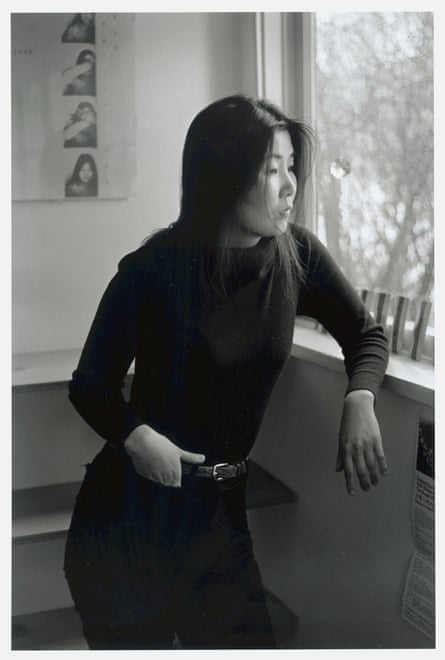
The Berkeley Art Museum became the home of Cha’s art and archives in 1992, following an exhibition of her work that inspired her heirs to donate the materials to that institution. Subsequent shows of Cha’s work occurred during the 1990s, notably at New York’s Whitney Museum, with the first major retrospective in 2001 at the Berkeley Art Museum. According to Sung, another major retrospective was long overdue.
“She was engaging with the diaspora in a really interesting way that many artists weren’t at the time,” Sung said. “She was inserting her body, languaging, memory, familial history, cultural heritage, the untranslatable – she was engaging with all these themes in the 70s and 80s. It’s really only today that artists and audiences are catching up to the work she was making. It still feels incredibly relevant and contemporary.”
Multiple Offerings goes back to Cha’s beginnings, starting with pottery she made as an art student at UC Berkeley and her early work Mouth to Mouth, a video showing an extreme closeup of Cha mouthing the vowels of the Korean language. Cha was exploring her fascination with how the sounds of language translate into meaning, as well as the notion of displacement, a central theme of her career. According to Sung, coming to the US and learning English as an adolescent prompted Cha to reflect on aspects of language that most take for granted.
“She was able to think through language from a more detached point of view because she was learning it later in life,” Sung said. “It was something she was very cognizant of – she had her own understanding of what it is to learn a language and to be able to speak or not.”
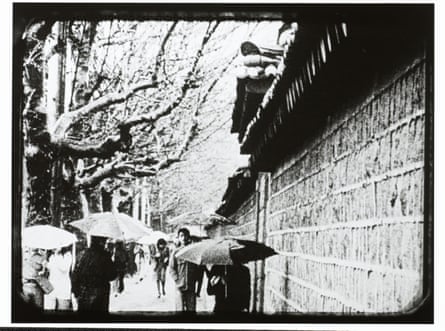
Multiple Offerings presents numerous film and video pieces, including Permutations, likely Cha’s most famous work after Dictée, and Exilée, a simultaneous film and video installation. The show also grants ample space to artistic responses to Cha’s work, among them Now Pretend by the Black queer artist L Franklin Gilliam, a video exploration of the intersection of identity, self-presentation, and the enactment of race, and Rain Dreamed by Sound by the Chilean artist Cecilia Vicuña, a sound installation eulogizing Cha and coming to terms with her murder in the larger context of violence against women. In the piece, Vicuña recalls with sadness: “I was just about to meet her when she was murdered. / I was just a few blocks away, with other Heresies women, but her cry didn’t reach us. / We couldn’t hear the cry coming from the soul of all raped women. / The cry that was becoming a wave, a wave of sorrow asking us to stop / the next crime.”
Bringing in the work of other artists is part Multiple Offerings’s purpose, to demonstrate just how much Cha’s work has resonated with artists in the decades since her death. In her position as a curator of contemporary art, Sung has witnessed Cha’s transform into a vital presence permeating through the artistic culture. “I think it’s quite rare for an artist to have such a large impact on so many different younger generations of artists working in so many different ways,” Sung said. “That’s where the impetus of the exhibition came from.”
Multiple Offerings also presents Cha as a true creative force, a person who found her artistic calling early in life and seemed to pursue it with utter confidence. “It’s very clear that from a very early stage she was very serious as an artist,” Sung said. “She believed in art wholeheartedly from the beginning.” A series of photos documenting her 1975 performance piece A Ble Wail – made when Cha was in her early 20s – show a performer gamely holding sway over the Worth Ryder Art Gallery that she inhabits. Her typewritten description of the performance boldly declares her intention: “In this piece, I want to be the dream of the audience.” Another collection of photos documents an untitled 1974 performance in which Cha burns 10ft-high sheets of paper that she has written single words on. “Not everyone would do that sort of stuff,” Sung said. “She was dead serious and just had an admirable confidence.”
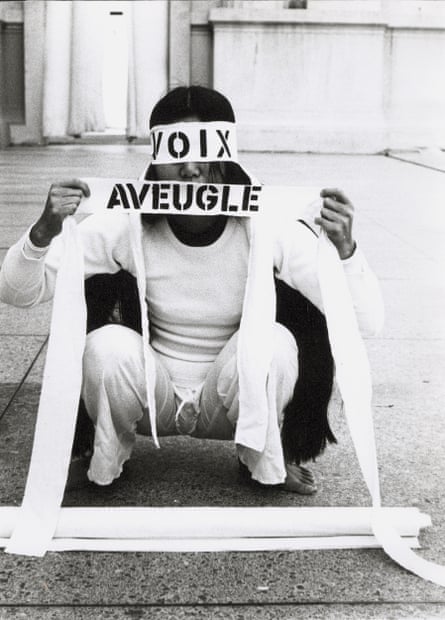
As much as Cha was a prodigy, Multiple Offerings also documents how the UC campus and Berkeley Art Museum offered much inspiration for her creativity. “The arts practice department was very open in its pedagogy,” Sung said. “Jim Melchert talks about how he really encouraged his sculpture students to really approach the UC campus as their studio. Cha was using fiber and twigs that she had gathered from the campus in her weavings.” Through the museum, she was also able to become deeply involved in the Bay Area avant-garde art scene, which Sung characterized as one of artists thoroughly investing themselves into one another’s creative lives and enjoying a scene of profound creative fluidity. “They were testing out and experimenting with different forms of making for one another at a time when nothing was really defined,” Sung said. “The Bay Area was really this hub of conceptual arts performance and working outside of institutional spaces.”
To stand within the galleries of Multiple Offerings is to feel an inspiration that comes from the excitement and openness of an art world that in many ways feels distant from today, one in which a Korean immigrant could spend nearly a decade at a public university and make art that no one had ever seen before. Sung intends Multiple Offerings to be a revelation to audiences, showing them just how much Cha went beyond the boundaries that define the art world – and that they can likewise open their own minds. “ I wanted to dissolve the boundaries as much as I could because she’s not an artist who thought in that way,” Sung said. “Her practice was really so open-ended, and so I’m hoping that it just signals an opening for artists researchers, and other students, people who are interested in learning and wanting to engage.”
-
Theresa Hak Kyung Cha: Multiple Offerings is on show at the Berkeley Art Museum until 19 April