3 months ago
70
3 months ago
70
Lime’s distinctive green ebikes have left many Australians seeing red, attracting hundreds of complaints of injuries and dumped bikes every year. The share scheme operator – the biggest in the country – has released an updated bike model as it fights new regulations and tries to expand into every major city. But are the bikes safe enough for the streets?
Guardian Australia took a mechanic out to survey Sydney’s Lime bikes in January to check whether they’re up to scratch. Here’s what we found.
Bald tyres and missing helmets
Our first sample was one of Lime’s new generation of bikes, launched in Sydney in November. Amy Webb, a mechanic with Laneway Cyclery, delivered the verdict: it’s “pretty much perfect”.
Webb carried out a basic inspection, starting with squeezing the brake handles to check they offered resistance. None of the bike’s parts were loose, the tyres were firm and its helmet was safe in its basket.
The second bike, one of the older generation of bikes launched in 2022, failed that last simple test: it had no helmet.
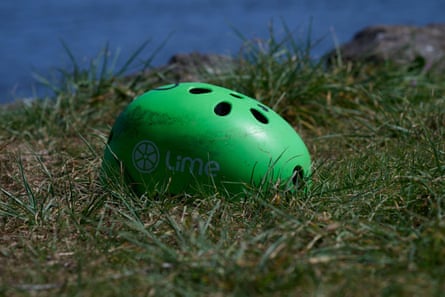
Many of the 72 bikes we inspected had the same problem: 25 of the older models had no helmet; likewise, 12 of the new bikes were missing a helmet despite a redesigned, easier-to-use helmet lock.
Anyone riding those bikes would break Australian law and put themselves at risk unless they wore their own helmet, Webb says.
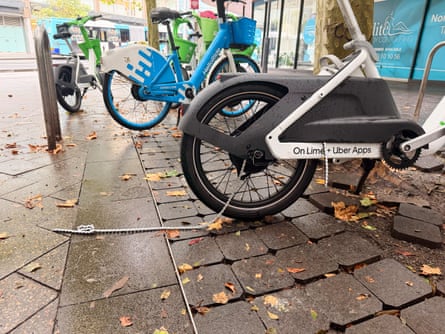
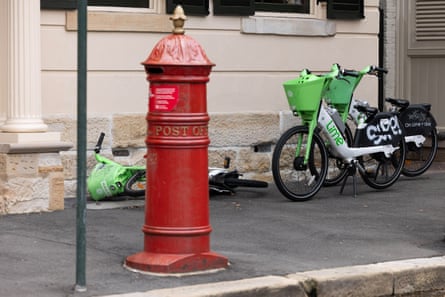
We found that other bikes had fallen to the ground or sustained damage from being knocked over, creating a hazard for pedestrians. One, dumped across a footpath, had a cracked basket, broken spokes and its back light dangling out.
“It’s frustrating to see people just throw them on the ground,” Webb says. “People who are in wheelchairs, mobility scooters or with prams are going to have a hard time navigating around them.”
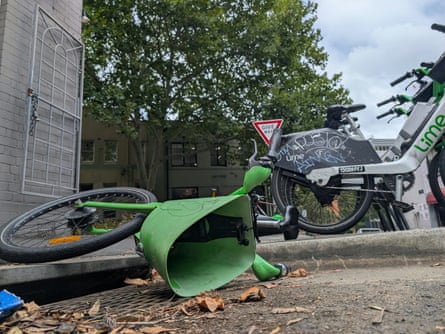
One bike’s helmet holder was bent beyond use, the broken basket holding chicken wings and a cigarette where the helmet should have been.
Basket trash was common – we found dog poo, condoms and coffee cups in bikes along Sydney’s Oxford Street – and could be a hazard when left in a broken basket, Webb warns.
“If someone pops something into the basket and there’s a crack in it, that could fall through and then into your front tire,” she says.
“In cycling, anything that’s unexpected is a hazard.”
Loose items could wedge wheels and send riders flying, as could loose wheel guards, found on nine bikes. Those could also gradually wear away the rubber.
Ten bikes had smooth back tyres, often with treads that were so deteriorated we could see the yellow or blue layers underneath.
Riders should avoid bikes with worn tyres, Webb warns.
“You’ve got no grip, no tread, and if you’re riding in the rain, you’re just going to skid completely.”
Broken spokes are also a no-go: one bike had six snapped spokes, which Webb says would eventually lead to more broken spokes and possibly wheel buckling. It’s dangerous also to ride bikes with flat tyres, broken brakes, snapped chains or missing seats or pedals – problems users have reported but we did not encounter.
Overall, most of the bikes we inspected were safe to ride – except for missing helmets. A similar test of 50 Lime bikes in London in 2025 found much more worrying results.
“A lot of the older bikes, despite looking a bit grim, tend to be structurally all good,” Webb says. Many of the newer bikes were in “great condition”.
The new bikes – released in Sydney, but not in Melbourne or Brisbane – were better designed than their battle-worn predecessors, she adds.
“You’d be concerned if any of these new bikes had obvious signs of wear and tear. That’s the big thing you want to look out for, is anything out of the ordinary?”
‘Hate us, love us’
Concern about the risks associated with ebikes – both rented and privately owned – has risen along with their popularity.
Ebikes were involved in five deaths and 250 injuries in the first eight months of 2025 in NSW, according to the state government. Also, there were four reported deaths on legal ebikes in Queensland last year.
Late last year the NSW government introduced a clutter levy to address public safety concerns about poor ebike parking, and halved the power limit from 500 to 250 watts.
Lime says its data indicates more than 99% of trips are incident-free. It declined to provide details about any specific incidents.
What data does exist is from local governments: in the City of Melbourne, Port Philip and Yarra city council areas in 2025, Lime bikes were involved in two accidents that resulted in hospitalisation and another 21 minor incidents from a total of 900,000 rides; in the City of Brisbane in the 2024-25 financial year there were 33 hospital admissions and 134 minor incidents out of 3m trips. The City of Sydney did not provide data.
Lime says it is working to improve safety, with street crews checking bikes for damage.
Bikes are checked during routine inspections and battery changes, Lime’s Asia Pacific head, Will Peters, tells Guardian Australia. They also check bikes that have been flagged as broken, given a low rating, or hastily abandoned by users.
The company says that faulty bikes picked up in those audits are immediately removed from the hiring pool. Despite this, we saw bikes that lacked helmets or had worn tyres or damaged spokes which had been neatly rearranged into bike racks by Lime crews.
Peters says crews have to replace missing helmets for so many bikes that they can run out of stock. Lime plans to increase fines for riders who end their hire without returning a helmet.
He also blames irresponsible riders and “kids doing burnouts” for some of the damage, and says riders who damage bikes through misuse will be banned.
“Someone hooning down, trying to destroy [it], jump the kerb, they’re ruining it for everyone,” Peters says. “We will get rid of those people as long as there’s evidence.”
Peters says criticism of Lime is sometimes unfair, comparing complaints about the number of the bright green bikes in cities to nimbyism, “from a generation that drives a really expensive car”.
“I’ll be unapologetic. I don’t care if you’re in a Porsche or a Range Rover and you’re complaining that there’s now eight bikes on the road,” he says.
But Lime has committed to force suburban riders to park in designated spots before ending their hire.
“I want everything in a parking bay, I want everything neat and tidy, I want the person who hated us to love us,” Peters says. “And I think we can do it.”