3 months ago
71
3 months ago
71
I once dubbed Christopher Hampton, who celebrates his 80th birthday this month, “the quiet man of British theatre”. By that I meant that he was less prone to expressing his views in opinion pieces than contemporaries such as David Hare and David Edgar. The term also implied that his plays possessed a less idiosyncratic style than the work of, say, Harold Pinter or Tom Stoppard. But I suspect that Hampton’s regard for the classical virtues of objectivity, lucidity and irony means that his work will prove as durable as anyone’s.
He is also, as I have seen, a man of considerable private passion. One incident in particular is branded on my memory. In November 1990 I was one of a group, including the director David Leveaux and set designer Bob Crowley, despatched by the British Council to Cairo to give a number of talks ahead of a visit by the National Theatre. We were privileged to be given a private night-time tour of the pyramids and were enjoying a quiet drink in the neighbouring hotel in Giza when in burst Hampton, who had just arrived from London. “Have you heard the news?” he cried. “Mrs Thatcher has been attacked in the Commons by Geoffrey Howe and it looks as if she’s in trouble.”
It was, in fact, the prelude to her resignation but what I’ve never forgotten is the light in Hampton’s eyes as he passed on the news about her imminent downfall.
This shouldn’t come as a surprise when you remember that Hampton’s original plays – and I don’t have space to deal with his numerous adaptations, translations and work for film and television – are, in essence, political. He once told me: “I’ve always been fascinated by the tension between radicals and liberals. It’s a tension that exists in all my plays and I suppose I’m working out some conflict within myself.”
Re-reading his major work, I am also struck by something else: that, although Hampton creates vibrant female characters, his plays are as often about a conflict between two men as the work of Peter Shaffer, the author of Equus and Amadeus. In Shaffer, it’s a battle between Apollo and Dionysos. In Hampton it is a fight between the revolutionary and the realist.

That conflict is eminently visible in Total Eclipse, where Rimbaud’s wild poetic genius is contrasted with Verlaine’s cautious orthodoxy. But what is astonishing, in a writer in his early 20s, is Hampton’s ability to see both sides. Even in The Philanthropist, from 1970, Hampton’s first big hit, the compulsive amiability of its academic hero is offset by the brutal pragmatism of a visiting novelist: in my mind’s eye I still see Alec McCowen and Charles Gray in the premiere at the Royal Court.
While Hampton has the natural dramatist’s ability to project himself into contrasting characters, you find the balance of sympathy is subtly tilted from one play to the next. In Savages, which in 1973 confronted the genocide of Brazil’s Indigenous people, you felt that Hampton invested more in the local revolutionary than he did in a kidnapped British diplomat (played, respectively, by Tom Conti and Paul Scofield). The opposite happens in Tales from Hollywood (1983), in that Hampton clearly leans more to the liberal writer, Ödön von Horváth, than he does to the revolutionary Bertolt Brecht. Yet seeing the play’s premiere in Los Angeles, I found myself warming to the disruptive, buccaneering Brecht. It is the mark of a good dramatist that, by exploring their own contradictions, they can also expose those of the spectator.
Although Hampton often writes about competing male egos, it would be misleading to suggest that his women are automatically subordinate. Re-reading the domestic drama Treats, which I rather casually dismissed in 1976, I was struck by how skilfully the central female arbitrates between her rival lovers. And we all seriously underestimated The Talking Cure when it was shown at the National in 2002. Again the play is about the conflict between the radical and the liberal: in this case, Freud versus Jung. But what gives the work its power is its sympathetic portrait of Sabina Spielrein, who went from being Jung’s patient, and presumed lover, to a devoted follower of Freud.
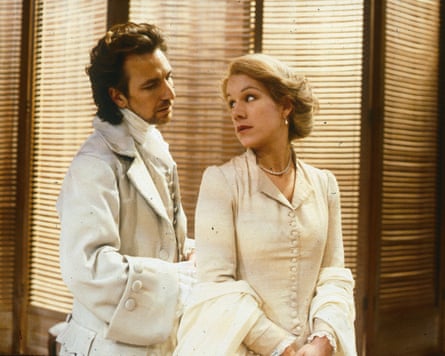
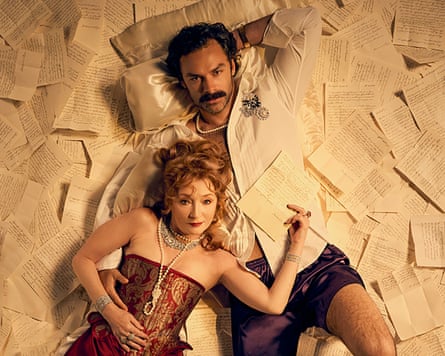
Hampton’s ability to create great roles for women is confirmed by his celebrated version of Les Liaisons Dangereuses, soon to be revived at the National. To call this an adaptation is to do it a grave disservice. This is a radical reinvention of an epistolary novel that, in the manipulative Marquise de Merteuil, gives us one of the most coldly demonic women in all drama, and shows how the mathematics of seduction is eventually undermined by the unstoppable power of love. It may well be Hampton’s masterpiece and, although I called him the quiet man, a better term, as he enters his ninth decade, might be the classical survivor.