3 months ago
81
3 months ago
81
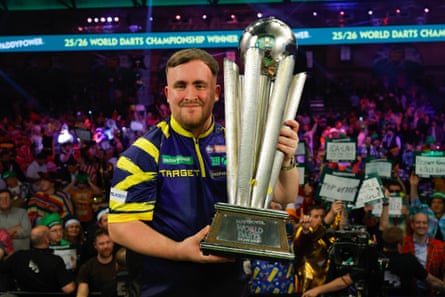
The winning moment seemed to drain all the strength from his body. He leaned against the drinks table and let it take all his weight, clasped his face in his hands, cried a little. As if only just feeling the shape and hue of the unspeakable thing he had just done. As if some great act of violence had just left his hands. Perhaps it had.
And before the double world champion, before the social media phenomenon, before the commercial giant, before the global icon, there was Luke Littler the darts obsessive. A kid steeped and stewed in the heritage of the game, fully aware of the landmarks he is now chasing, the tapestry of greatness into which he is now indelibly woven.
Perhaps in hindsight there was an element of wish fulfilment in the way we – the pundits, the public, the punters – had tried to will this final into a contest. Gian van Veen came into the game on the back of the greatest season of his life, as the only player on tour with a winning head-to-head record against Littler in 2025. But in dismantling the Dutchman 7-1 in a little over 40 minutes, the 18-year-old again demonstrated that over the longest format and under the highest pressure, he remains untouchable.
There was blood on the board and a wasp on the oche, but nothing could throw him off balance. And perhaps the unique genius of Littler is the ability to locate the effortless state that produces great darts and to live in it, breathe in it, turn those seven feet of pure windless air into his home and his castle. To whisk sets away from you in the space of two or three minutes of pure magic, and do it again and again. He doesn’t get in the zone. He is the zone. The zone is Littler-shaped.
He nails the relentless consistency that creates opportunities, and the big moments that seize them. He can speed it up and slow it down. His averages this tournament: 102, 97, 107, 107, 100, 105, 106. And above all he masters the visceral quality of combat darts, aware that this a sport that – both in a competitive and a commercial sense – is essentially an act of showmanship. You create a character, project an aura, burnish a brand. Throw the right darts at the right time, ride the energy, harness the noise, and you can suck the very essence out of your opponent.
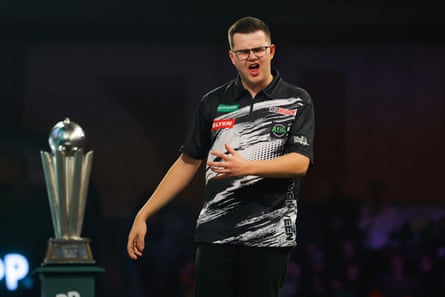
And this was essentially what happened to Van Veen. He didn’t play a bad game – average 100.0, 38% on his doubles – but both were down on his best, a measure of the pressure he was put under. He won the first set, had darts for the second and was basically beaten by the end of the fifth. The force and torque he was putting into his throw eventually broke the skin on his thumb, leaving traces of blood on the 5-segment and forcing the board to be replaced. Turns out darts was a contact sport after all.
Meanwhile Littler seemed to click into gear after losing that first set, snatching his darts out of the board, marching up the oche and then slowing himself down in between throws, in utter command of his emotions and his game. There was a big fish to take the third set. There were crucial double-fives. There were 16 180s. Almost a fifth of his visits ended with three trebles.
How do I sign up for sport breaking news alerts?
ShowDownload the Guardian app from the iOS App Store on iPhone or the Google Play store on Android by searching for 'The Guardian'.
If you already have the Guardian app, make sure you’re on the most recent version.
In the Guardian app, tap the Profile settings button at the top right, then select Notifications.
Turn on sport notifications.
And before long, he stood a leg away, 327 to get. Hit a maximum. Hit a treble-20. Hit a treble-19. Hit the double-15 to unleash chaos, a millionaire’s finish to claim a million-pound prize. He didn’t throw a nine-darter in the end, but at least he got a 147.
The first ever £1m cheque in darts is a once unthinkable windfall that owes itself not entirely but largely to the Littler effect: an electrifying ripple of attention and interest that has drawn in the younger audiences other sports spend decades trying to chase down. Quite apart from his brilliance, Littler gets the intensely visual appeal of darts, celebrating memorably, interacting with the crowd, albeit not always in the most cordial way.
The boy is now a man, and how the paying public respond to this era of sublime dominance remains to be seen. The sport has broadened and deepened immeasurably since the dominance Phil Taylor enjoyed in the 1990s and 2000s. Taylor’s 16 titles still feels impossibly remote, but there are other records and milestones to chase in the meantime.
The World Masters later this month is one of the two remaining majors he is yet to win, along with the European Championship in October, which will require him to conquer the hostile German crowds. Littler is still yet to win in Germany at any level. The Premier League title he lost to Luke Humphries last year will need to be regained.
But set aside the numbers and the monuments, and perhaps Littler’s greatest gift to us is the sheer joy of brilliance: the haptic rush of seeing a skill perfected, of talent in its fullest expression, of an athlete and an audience in perfect harmony.
Sir Chris Hoy was on stage to present the trophy. Terminally ill with cancer, the great man doesn’t have many nights left, but he wanted to spend one of them at the darts. To be where life is, a place where the humdrum everyday can be inflected with fun and flamboyance and colour. And on nights like this, where the genius of the individual and the genius of the collective collide, there is no better place on earth to be.