3 weeks ago
62
3 weeks ago
62
The recent Marvel’s Spider-Man games have become so tightly interwoven with the character’s core that they’ve been cited, by both actor Tom Holland and director Destin Daniel Cretton, as an influence on this year’s blockbuster film Spider-Man: Brand New Day. Now the same development studio – Sony-owned Insomniac Games – is taking on one of Marvel’s other most recognisable characters in his first video game-starring role since some deeply mid-tier film tie-ins back in the 00s. So can they pull off the same trick with Marvel’s Wolverine?
Storywise it certainly takes a similar approach, once again grabbing ideas from a wide selection of inspirations and remixing them into a brand-new continuity. We first meet this version of Wolverine as he is discovered: wild-eyed, wilder haired and practically nude. Before we see his saviour’s face, we hear a well-spoken voice (provided by legendary game actor Troy Baker) promising a safe place “for people like us”. Surely this is Charles Xavier?
But no! It’s Nathaniel Essex, better known as Mister Sinister – the very same character who has just been unveiled as the villain of the first MCU X-Men movie. Here, though, he’s something of a father figure to Wolverine, and operator of the mutant-liberating Team X.
There are no X-Men in this universe as such. That idea’s component parts are split between Sinister’s Team X and the Mariposa School for mutants, run by Jean Grey. It’s not hard to imagine where this might all be going, not least because Wolverine’s current teammates include traditional baddies Sabretooth and Mystique, while all signs point towards a Wolverine-Grey romance. Still, it makes for a distinctive status quo that Insomniac can build on.
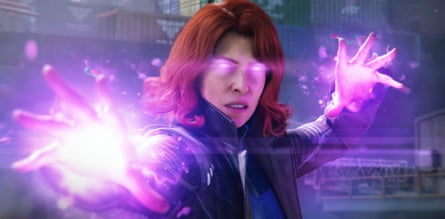
Foregrounded as the narrative might be, it’s ultimately not what will most occupy you here. In the Spider-Man games, your time was divided between fighting crooks and – much more memorably – web-slinging through the skyscraper valleys of New York. In Wolverine it’s almost entirely the former.
This makes sense given the iconic resonances of each character. Spider-Man is the lithe, always-late city boy; Wolverine is the violent berserker with knives for hands. But that puts a lot of weight on a combat system that, at least in the early hours, doesn’t seem to have evolved far from Insomniac’s Spider-Man games, themselves inspired by Rocksteady and Warner Bros’ Batman: Arkham series.
Enemies swarm you from all sides, throwing in attacks that flash a particular colour to indicate how you should respond: a bright-blue means parry, red means dodge. At the same time you’re bouncing from one target to the next, dealing out retribution. Mainly it’s a case of deciding when attacks should be distributed widely, in order to keep your opponents on the back foot, and when they should be focused on a single target to remove that particular enemy from the fray.
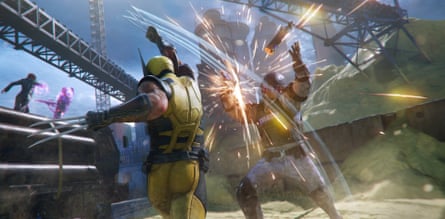
The main difference is that Wolverine doesn’t share Spidey and Batman’s no-kill ethos, and Insomniac clearly delights in running with that. Each claw stab sends gobbets of blood flying; occasionally it’ll even sever a limb. And when Wolverine himself comes under attack, it strips the flesh from his metallic bones.
This is the kind of splatter-house violence I associate with, well, mid-tier games of the 00s, but given the kind of graphical flourish only possible with modern technology (and budgets). This dynamic gore is technically impressive, and perfectly underscored by the DualSense controller’s haptics, which send each hit thudding into your palm. And yet somehow it all feels rather weightless. Audio-visual effects aside, Wolverine’s adamantium claws are functionally the same as Spidey or Batman’s fists, interrupting attacks only when the combat systems deem it appropriate.
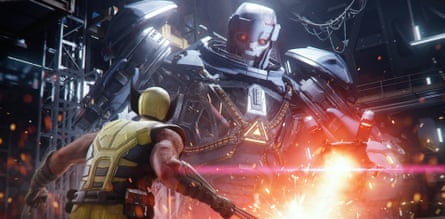
This becomes particularly apparent when, later on, I sample a boss fight against that classic X-Men foe, a Sentinel. This colossal robot cannot bleed and barely reacts to any of the hundred slashes required to bring it down. I’m left alone with the game’s combat systems, revealing them to involve an awful lot of tapping the square button and studying various on-screen gauges. Wolverine’s healing factor is represented by a rage meter that fills with each hit, allowing him to resurrect as long as it’s passed a certain threshold, while cooldowns limit his more powerful attacks.
Wolverine is in some ways the perfect video game hero, being essentially a walking excuse for violence. But to really capture his abilities – claws that can slice through anything they touch, a healing factor that makes him long-term immortal but short-term vulnerable – would require a greater rethink of standard action mechanics than Insomniac seems willing to risk.
I came away from the first couple of hours feeling not like I’ve truly embodied this hero but rather that I’ve played another perfectly solid Insomniac superhero game. Unless the story has a few more continuity-bending tricks up its sleeve, it seems unlikely to drive the direction of any future films.