3 months ago
62
3 months ago
62
Fashion is a dance between rules and rebellion. Great style requires a bit of both. The rules are essential, because one of the key emotional benefits that a great wardrobe can deliver is a sense of control in a chaotic world. The rules are there to simplify and clarify, lighting our route to a well put-together outfit. That well put-together outfit has the power to help you feel calmer, simply because you look in the mirror and see a competent person and therefore feel like a competent person. Style rules also come in useful for making sense of the world around us. Dress codes, style tribes, the signals we send – whether as blatant as the slogan on a T-shirt, or as subtle as the brand of your rucksack – hold an important social function, making other people legible to us.
But style also needs friction. Fashion dies if it stops moving, because moving with the times is what makes it fashion rather than just pretty clothes. The restless forward energy that moves hemlines and invents new silhouettes is what drives the plot and keeps us interested.
So the sweet spot in fashion is where rules and rebellion meet. Your outfit is telling a story, and a story needs both a comprehensible plotline and a dose of dramatic tension. Great dressers know this instinctively. The pop of red lipstick against a simple dark dress, the vintage jeans worn with a smart blazer and heels. A little artistic licence is what elevates a look from being perfectly nice to being red hot. Like the Boss said, you can’t start a fire without a spark.
So allow me to introduce fashion’s most useful new catchphrase: If It Doesn’t Go With Anything, It Goes With Everything. This is a rule – but at the same time it is a kick against the rules. It does both at once, sort of like a two-in-one shampoo and conditioner. If It Doesn’t Go With Anything, It Goes With Everything is chaos theory, but make it fashion – an anti-match system which gives you an ingenious new way of solving your wardrobe puzzles, because it hands you a new tool to unlock the what-shall-I-wear question.
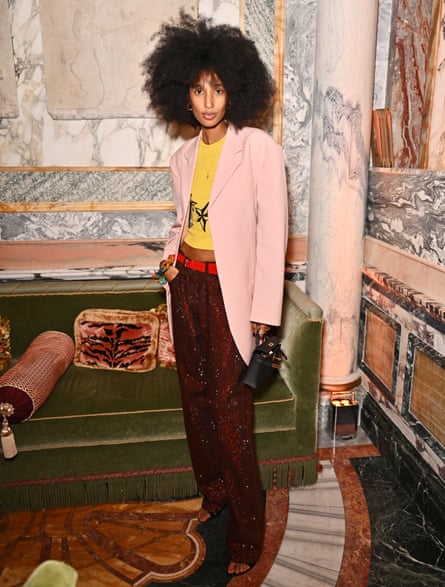
You know that piece in your wardrobe that you love, but rarely wear, because it never feels as if it goes with anything? That is your new best friend. This is an expansion of last year’s Wrong Shoe Theory, which held that an unexpected shoe – trainers with a tuxedo suit, biker boots with a tulle skirt, kitten heels with a slouchy track pant – was the key to making an outfit compelling. Extrapolating from Wrong Shoe Theory, we can now see that anything – a crazy jacket, a bright pair of trousers, a kitsch handbag – can be the grit in the oyster that produces a pearl.
The genius of this theory is that it brings your wardrobe orphans in from the cold. You know the ones I mean. The cardigan from a posh shop in an overexuberant colour, which you bought because it was 50% off in the sale. Almost anything you bought on holiday. The mistake we often make is to try to make those pieces work by partnering them with something plain. But a rainbow crochet jacket with sober trousers and a white T-shirt makes no sense – so wear it over a zebra-striped shift dress instead. Instead of thinking of outfit building as a logic puzzle requiring pieces that slot neatly into shape, indulge in some free association. Instead of looking for the piece that will match the rest of your outfit, look for the one that will energise it.
If you need proof that this rule works, consider how certain forms of it have become style staples already. Leopard print, for instance: once we started treating this as a neutral and wearing it with Breton stripes or neon pink, it found a permanent place in our wardrobes. Or take, for example, the wearing of a band or slogan T-shirt – could be the Ramones, could be J’Adore Dior – under a blazer. This is visually illogical, because you can’t read the T-shirt properly. But it looks great. Go figure. The rules are there to be broken. And sometimes two wrongs do make a right.
Model: Orla at Milk. Styling assistant: Charlotte Gornall. Hair and makeup: Delilah Blakeney using Celui and Nars. Earrings, £180, Giovanni Raspini. Coat, £82, Next. Dress, £218, Reformation. Boots, £495, Russell & Bromley