3 weeks ago
25
3 weeks ago
25
For most people, the word “cowboy” still summons a figure from Western folklore – a rough rider with a weathered face and a steely gaze, a self-reliant loner who answers to nobody, is fearless in the face of danger, and protects his lands from predators – animal and human alike.
But over the past 15 years, a new range rider has emerged in the American West, one that is out on a wholly different mission: to live in a wild landscape where livestock and predators can co-exist.
Within the context of the “New West” – where extraction economies have given way to tourism, technology, outdoor recreation and rising development – the modern range rider may be a cattle producer on horseback, a wildlife technician setting trail cameras, or a ranch hand on an ATV. They may help livestock producers with day-to-day work, set up electric fences, or handle the carcasses of deceased animals.
“Range riding can mean a range of things,” said Jeff Vance Martin, a research social scientist for the USDA Forest Service’s pacific south-west research station. They’re the eyes, ears and messengers of the range, watching for environmental threats and signs of conflict, while reporting information back to producers.
Most of all, they help manage a new reality in states like Montana, Idaho, Oregon, Wyoming, Washington, Arizona and Colorado, where ranchers, conservationists, and state agencies search for ways to live with rebounding populations of wolves and grizzlies.
The return of predators
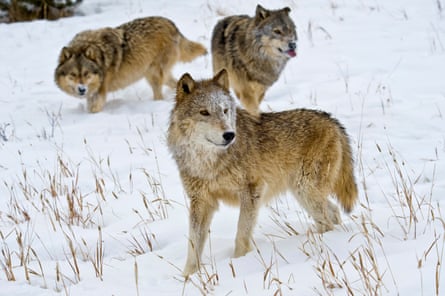
Across the American West, predators like gray wolves, Mexican wolves and grizzly bears that were once on the brink of extinction have returned through reintroduction efforts and decades of recovery work. It’s been cause for celebration among conservationists, tribal nations and wildlife advocacy groups, but it has meant increased fear and uncertainty for some ranching communities.
For ranchers whose livelihood is tied to their livestock, one dead calf can represent a devastating loss of time, of resources and even thousands of dollars. That reality has long dictated the attitude of ranchers, and range riders towards their environment.
When Eric Graham worked as a range rider, 15 wolf packs were known to move through the 1.5m acres of the Blackfoot watershed in Montana that he helped monitor. “I was spread pretty thin across several ranches, and I’d have these nightmares where I’d be working on one ranch one day, and then another ranch would have a [livestock] loss.”
The shift to an environment where predators like grizzlies and wolves were allowed to roam has not been easy for everyone. “If your ancestors just spent the last 150 years getting rid of wolves and grizzly bears to make the West safe for sheep and cattle, it’s hard to accept that society actually wants wolves and grizzly bears now too,” said Matt Barnes, rancher and rangeland scientist at the Northern Rockies Conservation Cooperative. “And so bringing wolves back can feel like a repudiation of your entire cultural history.”
Keeping stock
Finding a middle ground in this new reality is where the modern rancher comes in. Malou Anderson grew up in a family of ranchers on the northern edge of Yellowstone national park, in the pine savannahs and granite ridgelines of southern Montana. Raising cattle and sheep in the Tom Miner Basin, she recalls seeing a grizzly bear only once. Now, they are part of her daily life.
The return of the giants to their historic range pulled Anderson into a charged question: how do humans share working landscapes with them?
Together with her sister-in-law, Hilary Anderson, she established the Tom Miner Basin Association, the first modern range riding program in the US.
Anderson has come to believe that when it comes to shared landscapes, ranchers are responsible for properly managing their livestock. Rather than asking how large carnivores can be controlled, she looks at various ways livestock can be managed to make them less vulnerable in the first place.
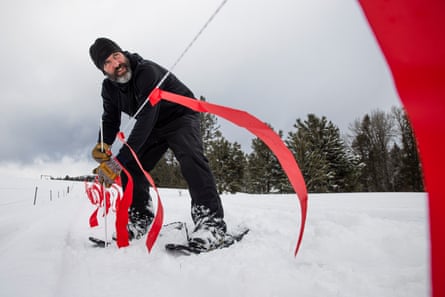
She uses methods like regenerative grazing practices to mimic the movement of wild bison. Through electric fencing, she keeps cattle bunched up in the same fashion bison would have moved for safety and power in numbers – a specific stockmanship strategy known as low-stress livestock handling.
At the Association, where the majority of range riders are female, Andersonsaid good range riders need keen observation and humility. “To us, range riders understand the unfolding story that happens in wild places … they’re a part of that story, but aren’t dominating or dictating it.”
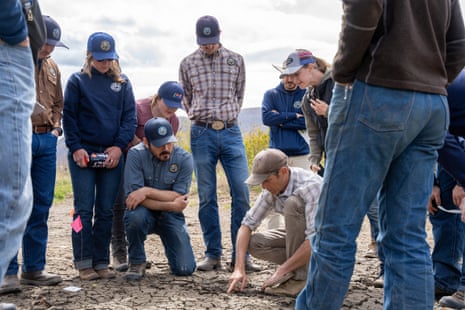
Sometimes, a rider may have to haze predators with non-lethal scare tactics. But overall, the work is far less confrontational than it traditionally has been portrayed. “There is a misunderstanding that range riding is engaging in predator warfare,” says Rae Nickerson, the wolf damage and conflict minimization manager with Colorado parks and wildlife. “A lot of the riders I work with won’t even see a wolf the whole season, and what’s sad about the head narrative is it makes folks feel like they’re not doing a good job.”
Modern range riders need to possess backcountry skills that are crucial to survival, but also be proficient in technology like telemetry, virtual fencing tools and data systems. They need to be excellent communicators who regularly check in with producers and remain trusted to provide accurate information.
Finding the middle ground
This modern approach to range riding has its skeptics. That unique mix of knowledge required of riders helps explain the main critique of the programs: they’re hard to scale. Early findings suggest riders can help prevent conflict, but the work is labor-intensive, funding is often piecemeal, and seasonal programs struggle to bring back experienced riders year after year.
“We really wanted to create a more stable financial structure, so that we could prevent [rider] turnover. It takes a long time to train up a rider, sometimes two years,” says Nickerson.
Proving a rider’s effectiveness is hard to quantify. When range riding succeeds, it leaves behind little, if any, tangible proof. “The problem with conflict prevention from a scientific standpoint is it’s almost impossible to measure. You’re talking about something that could have happened, but didn’t,” said Barnes.
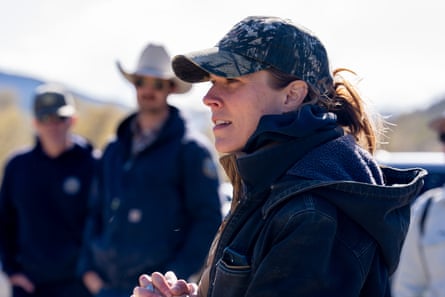
The approach also still lands unevenly with livestock owners, especially when it feels like outsiders are telling them how to handle their own animals, said Barnes. “We can do a lot more to manage livestock than we can to manage predators. Yet most people aren’t really ready to think about that.”
Still, some initiatives are trying to cement long-term solutions. There are now many nonprofit range-rider programs throughout the West. And in 2025, Colorado started one of the few state-run range rider programs in partnership with Colorado parks and wildlife (CPW) and Colorado department of agriculture (CDA).
“Range Riding points to examples of success that maybe we can learn from and scale up. It points to the willingness of people on the ground to find those practical, pragmatic kinds of solutions to what is often a very polarizing discussion,” says Martin.
As a PhD candidate at Utah State University’s department of wildland resources, Nickerson is working to evaluate the effectiveness of range riding in minimizing conflicts. Studying fifteen ranches across five western states, she brings producers and riders into the same room where they can talk honestly about what works and what doesn’t.
“When you have wolves, your whole life can change overnight,” says Nickerson. “So to me, range riding is a more holistic approach compared to other nonlethal approaches where you’re able to give [a producer] some space and time back that wolves have taken away to be with their family more, sleep more, and get other things done. Producers are always going to want extra help checking on their livestock when they have wolves. Period. And riders provide that needed support.”