3 months ago
64
3 months ago
64
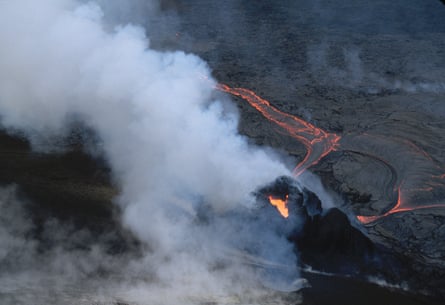
The 1993 erotic thriller Sliver should have ended differently: Zeke, played by William Baldwin, was scripted to fly a helicopter towards an active volcano, after Sharon Stone’s character, Carly, reveals she’s the killer. The pilot, Craig Hosking, had been tasked with flying low over Hawaii’s Kīlauea volcano, accompanied by the director of photography, Mike Benson, and his assistant Christopher Duddy, to film the bubbling lava and white plumes of smoke escaping from the Puʻu ʻŌʻō vent. It was a clear day on the Big Island when Duddy watched a corkscrew trail form in the smoke behind the helicopter, and he remembers thinking: “I can’t believe I’m getting paid to do this.”
It was November 1992, and a big storm was due to hit the area, so they were shooting as much footage as they could along the coast, capturing the rainforest and brilliant blue ocean shimmering against the black lava of the volcano, before the weather disrupted production. But as they dipped over Puʻu ʻŌʻō for a second time, the helicopter’s engine failed. Their visibility faded as thick smoke engulfed them. Duddy jolted his eyes away from the camera monitors towards the open doors and saw that they were heading straight for a cliff. There was a loud crash as the rotor sheared off on impact and the helicopter went into freefall.
Duddy doesn’t remember how long they were plummeting – everything seemed to happen so fast. They were lucky to land upright, on the helicopter’s skids, on a ledge. Hosking’s eye had a gash and blood was pouring down his face, but they were all alive. “We didn’t even realise where we were when we jumped out. Then we started looking around and realised we were inside the volcano, about 50 yards away from the lava pool.”
Immediately, they began to choke on the fumes. Duddy’s eyes burned from the sulphur, which smelled of rotting eggs, and they all coughed uncontrollably. He could feel the heat of the boiling lava through his shoes and smoke was shooting from his footprints with each step. To escape, they needed to climb a 300-ft cliff-face to the volcano’s mouth. “I got in the lead because I was maybe the most scared,” says Duddy. “I’m definitely afraid of heights,” he says. “But it was pure survival mode.”
The climb itself “was gnarly. You would grab on to the dried lava and it would just break away and rocks would come flying down.” Duddy scrambled halfway up the inside wall and, when he couldn’t go any further, took root on a little ledge. He could hear the others hundreds of feet below him, but he couldn’t see them.
Hosking returned to the site of the crash to call for help on the helicopter’s radio, which had been crushed like a beer can. The dash was broken so the radio didn’t work but he managed to connect the camera battery and make a mayday call. “Every once in a while, the smoke would clear and you could see the helicopter on the ledge at the bottom of the volcano. Craig kept running up to this little mound to get some cleaner air because he was really choking and coughing and vomiting. He was not good. It was a little better where we were, on the cliff. There was a little pocket of air that was breathable.”
They heard a helicopter hovering overhead. Hosking was yelling to Duddy and Benson, but they couldn’t make out what he was saying, and then everything went quiet. “We thought he’d died,” says Duddy. In fact, the volcano park rescuers had picked Hosking up, but it sent Duddy into a panic. Benson was calmer. He kept saying: “Just stay put. They know we’re in here. They’re going to rescue us.”
Sure enough, a couple of hours later, the volcano park rescue team returned on foot and yelled down from the rim and began throwing ropes. “I felt a sense of relief,” says Duddy. But after several hours of the rope missing their location – they couldn’t see where the men were through the thick smoke – he started getting frustrated. “You hear the whoosh, the rope comes down again, and it was still 10ft away.” The rescue team were struggling – there was a huge crack on the rim, and they were worried that if they put too much weight on it, they would cause a landslide.
Then there was silence. “We’re yelling: ‘Throw the rope down, throw the rope down.’ And we hear nothing. An hour would go by and we’d hear nothing. It started to get real worrisome.” The storm had gathered power. “It starts to rain on us. I’m soaking wet, I can’t see, can’t breathe.” Although the hot lava wasn’t that far away, the wind and rain made it very cold. It was November, about 5.30pm, the sun was setting and Duddy was “losing hope”. The rescuers returned, only to tell them they’d come back at first light because the weather was getting too bad. “We’re like, wait, what? We’re gonna be in here all night?”
Perching on the rock, unable to fall asleep for fear of falling off the cliff, was terrifying and exhausting – but also incredibly beautiful. “It was like a light show in there. All these colours of orange, red and yellow, through the mist,” says Duddy. “Throughout the night, there were all these trembles. You could hear the lava flow. It was like when you’re camping by a river and you can hear it flowing.” Duddy curled up into the foetal position, pulling his sweatshirt over his face and putting his baseball hat on to create a tent that he could breathe in. He kept his eyes closed most of the time, otherwise they would burn from the fumes, and left his sunglasses on a ridge so that the rain would pool on them and he could hydrate himself a little.
At first light, the rescue team returned but the weather got worse and worse until, at midday, they disappeared again.
Duddy sensed the only way he was going to survive was by getting himself out. On late Sunday afternoon, the clouds started to break and a beam of sunlight hit the cliff above him. “I saw this path, and I’m like: ‘Oh my God, why haven’t I seen this path for the past 28 hours?’” At this point, his throat was swollen from the sulphur-soaked air, he was struggling to breathe and he thought: “Either I’m going to die sitting here or I’m going to die trying to get out.”
He started climbing. “I was very athletic growing up. I have two older brothers and we played sports, but I was never a rock climber or anything. I think it was pure adrenaline.” But when he was about 5ft from the rim, the surface flattened, becoming impossible to scale. “Whereas below there had been big chunks of lava rock that you could grab on to, here there was nothing.” He used all his strength to stay rooted in position, knowing he wouldn’t survive the 300ft fall if he lost his grip. Eventually, he dug his arms into the gravel for leverage to lunge up. “It was like sticking your arm into broken glass because it was sharp. I was shredding my arms,” he says. “I don’t even know how it worked but I got my arms in and I just flipped myself and landed on the rim on my back. I was laying there looking up and I’m like: ‘I did it.’”
At the top he watched, mesmerised, as the smoke swirled in the rain. Quickly, jumping to his feet, he started racing down the back of the cone, while Benson stayed put, still waiting for the rescue team to return. “It’s like you’re on the moon,” says Duddy. “The lava fields are otherworldly but you don’t know if you’re going to step into a crevasse or crunch into another lava tube.”
He followed orange cones the rescuers had laid out to create a pathway to a camp, which was deserted except for a couple of tents, bottles of water and some oxygen tanks. Duddy started guzzling the water but it wouldn’t go down because his throat was so sore. He put the oxygen tank on and waved down a helicopter that had been flying back to the small base camp set up on the side of the volcano. “The minute the guy grabbed me, my whole body went completely limp. Like I just became paralysed. They had to pick me up, carry me to the helicopter and strap me in,” says Duddy, who hadn’t eaten or slept for more than 28 hours. “I just started bawling and I was like: ‘Mike is still alive, you got to go get Mike, let’s go get Mike!’”
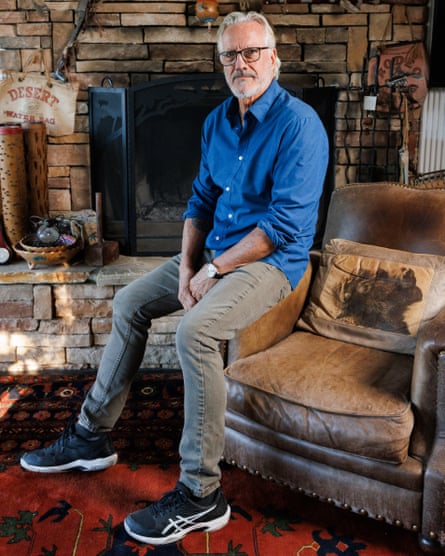
At base camp there was a frenzied scene: ambulances, fire trucks and news vans all focused on Duddy. Hosking ran up to the helicopter and helped him to the ambulance, which transported him to the hospital for monitoring.
With the sun setting, the rescue team said they wouldn’t be able to recover Benson until the following day. The next morning, a pilot set off with a basket on a rope hanging from his helicopter. It was a whiteout over the volcano again. The first time he dropped the basket, it hit the cliff and a big rock fell into it, which the pilot thought was Benson. But the second time, he succeeded, flying Benson to base camp in the basket. “It was three different rescues on three different days,” says Duddy. “It’s pretty unbelievable that we all survived that ordeal.”
When Duddy got home, he says his phone never stopped ringing. He did interviews for magazines and newspapers, and all three of the men went on the Oprah Winfrey show. Someone wrote a script for a movie telling the story of his miraculous escape from the volcano, but it was never made. Sliver’s director scrapped the original ending – another character was outed as the killer, and the volcanic finale was replaced with a shootout.
Apart from the bronchitis that saw him coughing up sulphuric phlegm for several months, Duddy’s physical ailments were minimal. He was worried about lung damage, so started exercising and doing cardio work, including mountain biking around Los Angeles, where he lives. What was more difficult to overcome was the psychological impact of the accident – he had a panic attack the first time he flew in a helicopter after the accident, and developed a fear of commercial planes.
Duddy had done a lot of aerial photography before the crash. After the accident, he began working with Canadian director James Cameron and his company Digital Domain, where in 1997 he was the visual effects director of photography on Titanic and Dante’s Peak, a disaster flick about a volcano erupting in a small town. Duddy was asked to travel to Mount St Helens, a volcano in Washington state to shoot footage. “I was like: ‘I’m not going to fly over another volcano. Are you crazy?’”
Despite this, his career took off after the crash. In the early 00s, he started his own production company and, later that decade, directed his first movie, Cougar Club. “The crash changed my perspective on everything really,” he says. “I just had a tremendous amount of confidence and bravado because I felt as if I was invincible.” But that didn’t mean he wanted to relive any part of his traumatic experience. “I would run into Craig and every time I would see him, he would just start crying. He would hug me and he would start crying.”
In 2021, he returned to Hawaii to film two seasons of Magnum PI, including an episode featuring a helicopter rescue in the jungle. “A couple of times, I had to walk away from where we were shooting,” he says. “I was having full flashbacks. It was wild.”
Despite the trauma of the crash, the island still has a special place in Duddy’s heart. “There’s something about the air there. Maybe it has something to do with my experience after being rescued and breathing again. The ocean water is a perfect temperature, the climate is not too humid, it’s not too hot. The people are wonderful,” he says. “Going back, I felt really lucky.”