3 hours ago
22
3 hours ago
22
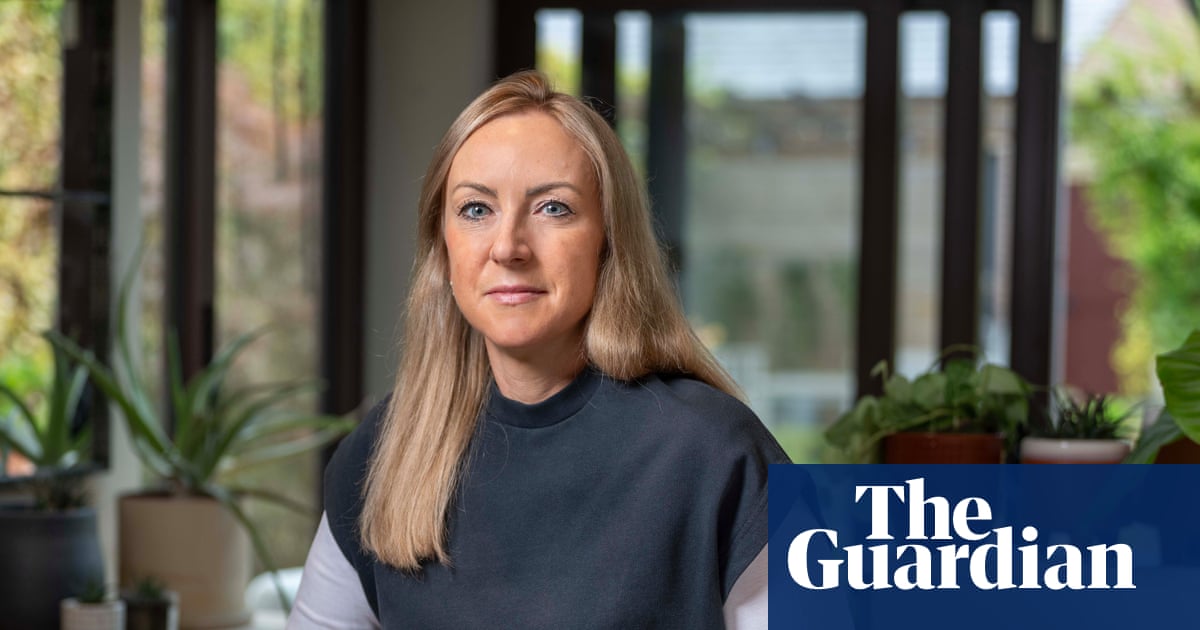
There is a single minute in Buy the Dip, Nimesh Patel’s new Netflix comedy special, in which the comedian nimbly and hilariously goes from describing his wife in labour with their first child to complaining about a Rolex sporting doctor wearing “insurance payments on his wrist” to Luigi Mangione. “He killed one guy, allegedly,” Patel quips, arguing that the terrorism-related charge Mangione got stuck with (which a judge dismissed) was offensive to real terrorists.
The hilarious bit is impressive for how much Patel packs into a single minute and how much it all speaks to the comedian’s own experience, expertise and worldview.
Patel, who hails from New Jersey, was once a pre-med finance graduate from New York University. He entertained going into healthcare before joining the ranks of finance bros. He abandoned all of that when he found a path in comedy alongside the likes of Hasan Minhaj and Rami Malek, a generation of brown guys who came of age in the shadow of 9/11 and have had to grow up being associated with Al-Qaida by the most racist swaths of American society. Patel is maybe the only one of them who could land that punchline about Mangione, which exists in the exact same intersection as him: of healthcare, finance and charges of terrorism that don’t stick.
“It wasn’t by design that I was going to condense all that into that bit,” Patel says, humbly, on a Zoom call from his home in Brooklyn, New York. “It just so happened that that’s where my brain goes.”
The words “it just so happened” gets at Patel’s magic trick as a comedian. In Buy the Dip, and across a lot of his comedy found online, Patel maintains the most laidback, effortless and unbothered vibe. He’s the kind of stand-up who makes it genuinely seem as though he’s floating along and the jokes just so happen to make their way to him.
Patel understands that passive air to be both a feature and a bug. Throughout our conversation he looks back at moments in his life and career, at times with regret, where he “didn’t deal well with adversity” (he gave up on pre-med after getting a C in one class) or he let fate decide his life choices for him. On the latter front, for instance, Patel lost his job in finance in 2016, at the same time that Chris Rock discovered him at the Comedy Cellar in New York, where he had been performing and honing his craft for years.
“It was a very star-aligning kind of a moment,” says Patel, looking back at how the decision to commit full-time to comedy was made for him. Rock tapped the newly unemployed Patel to write for his hosting duties at the 2016 Oscars, which led to, among other things, Patel becoming the first Indian American to join the writer’s room at SNL, where he lasted a single season that nabbed him an Emmy nomination.
“I’ll happily admit that I was not good at those jobs,” he adds. “I was still finding and having to cultivate my own voice. I have my own way of delivering my jokes in my worldview. To then recalibrate that and figure out how someone else would say it is actually a pretty difficult thing. Some of those joke writers are the best joke writers on the planet, but I’m a very good stand-up.”
Through our conversation, Patel’s brain regularly goes to finance, whether he’s crunching the numbers on ticket sales growth at his shows (“I might have been the first comedian that proved that you could sell tickets via TikTok”) or casually dropping a reference to Apple and Nvidia’s stock growth while calculating what he sacrificed (a $125,000 payday) when backing out of the Saudi Arabia-sponsored Riyadh comedy festival last year. “I’ve said and I stated, if it was more money, I definitely would have gone,” says Patel, being bluntly honest about the accounting that would trump his moral discomfort with a festival sponsored by the Saudi Arabian government.
Even the title to his special, Buy the Dip, is a finance phrase for buying stock while it’s low, which Patel wields playfully. On the one hand, it’s a reference to Donald Trump’s corruption, a big talking point in the special. Over the past year, the president’s tariffs wreaked havoc on the stock market. In April 2025, Trump posted advice to followers on his social media platform Truth Social to buy stock, hours before he announced a pause on tariffs that saw stocks bounce back. “You can’t say ‘buy the dip’ after causing the dip,” says Patel, sounding exasperated. “It seems illegal.”
But for Patel, “buy the dip” holds an alternative meaning.
“I have a kid,” says Patel. “I’m trying to remain an optimist in this world that tries to shake down optimism and punch it in the face. ‘Buy the dip’ is such an optimistic phrase. It says things will get better. You just gotta believe. Sometimes things get bad but if you, if your thesis remains the same, if you have conviction, you will be rewarded.”
Throughout Buy the Dip, Patel navigates parenting while prodding at the broken healthcare system, Maga and anti-immigrant sentiments, all while maintaining that hopeful and yet still unbothered vibe I’ve seen in his social media clips.
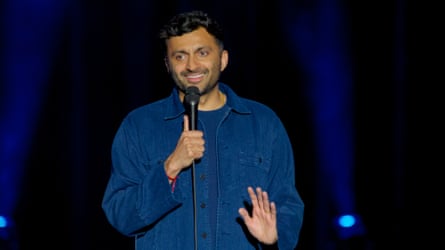
Patel first landed on my radar because TikTok’s algorithms served me a viral crowd-work clip, recorded at New York’s Comedy Cellar in 2018, when the comic was interacting with an Israeli musician who said he makes “progressive rock”. In one of those moments where a joke just seemed to materialize on the spot, Patel asked what Israeli progressive rock would sound like, before miming guitar play and singing, “Free Palestine”. The room erupted. Even Patel, in that moment, was visibly astonished at how he came up with that.
“That clip has had a long shelf life,” says Patel, sharing regret that the joke has only grown more relevant in the years since and that he wasn’t more prepared to go in-depth at the time. In that 2018 interaction, Patel claims ignorance on Israel’s war on Gaza, and shrinks from taking a stand on the issue. “I wish, at that time, I had more of a knowledge base about the conflict to really dig in on it.”
“It should be obvious,” adds Patel, speaking to his position on the matter over the years since. “It should be obvious what my position is because the instant you see the genocide in Gaza, as a brown person, [you know] that is the position of the oppressed.”
Patel, whose wife is Jewish, is much more pointed on the issue in Buy the Dip. He has a bit where he speaks out against making false equivalencies between Judaism and the Israeli regime. But then he can’t resist trolling with a punchline knowingly predicated on that very same false equivalency. “When it hits,” says Patel, “it hits really hard.”
I push back on the idea that Patel’s position on Israel and Palestine, as a brown person, should be obvious, because there are so many brown people who do support Israel’s actions. Patel gets that. He points to India’s prime minister, Narendra Modi, as an example. Modi, who is accused by many of stoking violent Islamophobia with his Hindu nationalist rhetoric, is a staunch ally to Israel’s Benjamin Netanyahu. Though Patel himself is wary of prescribing Islamophobia as the reason behind their alliance. “It is very interesting and confusing partnership on the surface of it. If it’s based in Islamophobia, that seems very superficial.”
“I find it funny that religious people really forget their religion when they start talking about other people’s religions,” says Patel, whose dives into his upbringing within a devout Hindu family in his material. “It’s like the tenet of the Gita to love everybody and treat everybody equally. The way that religion’s been weaponized is ugly.”
Throughout Buy the Dip, Patel navigates the ideological rifts between himself and other south Asians. It’s his burden, as an Indian American, as a Patel even, to put some distance between his demographic at large and those whose views or prejudices he doesn’t share. Kash Patel, the FBI director whom the comic refers to as Trump’s brand of DEI (“dick-eating Indian”), is a prime target.
Patel – Nimesh, that is – is also compelled to clock and respond to a rise in anti-Indian sentiment, which he tells me he’s witnessed in videos and online commentary coming from Canada and the US. The situation reared its head just over a week ago when Bo French, the Republican nominee for Texas railroad commissioner, posted a viral photo on X of students celebrating the University of Texas’s college football win against Ohio State University. A number of the joyful students in the photo appeared to be of south Asian descent. French, in that post and a subsequent post, decried that foreigners were displacing Americans. On Saturday, after my conversation with Patel, the US Department of Education’s X account seemed to piggyback on French’s sentiments, posting a photo of the crowd at a University of Texas game with the slogans “make college football great again” and “make education great again”.
“Most of those students are probably Indian American,” says Patel. “Those kids likely represent some of the best students in Texas. And they are Americans. They’re rooting football on. They’re drinking beers. What could be more American than that?”
Patel then plays devil’s advocate, speaking directly to the folks who are mad at the sight of Indians, whose anti-immigrant fury is stoked by partisan politics without self-reflection.
“The H-1B program in America was signed into law by [George] Bush, the first one,” says Patel, demanding they address the root cause instead of the symptom. “Corporatists taking over the country wanted cheaper labor that was beholden to the visa. These companies hire people who effectively have a gun to their heads, because if they don’t work, they can just be shipped back.
“I don’t agree with not letting people in at all. Every place is richer and better because of immigrants and what they bring to the countries that they go to. But if you have a problem with immigrants –and you shouldn’t have problems with immigrants – you should be addressing the people on both sides that foster that situation in the first place.”
Patel than takes a step back, turns the lens back on himself and his wider audience, and situates the relationship between the two in this conversation about what it means to be American.
“[Buy the Dip] is probably the most Indian special I’ve put out. It’s Indian in that everything is rooted in an Indian POV. But it’s also deeply American, and I think very universal. I hope people see the optimism in it and take something special away for themselves.”
-
Buy the Dip is out on Netflix now