3 months ago
66
3 months ago
66
“Anything I can do to help?” If ever a line was guaranteed to incense the person in charge of cooking for a crowd, it is this one: uttered in seeming innocence by a guest roused by the sound of clattering pans, and who wants to seem polite but in reality hopes the answer is: “No, thank you.” This was drilled out of us from a young age by a mother who firmly believed that those who are serious about helping need not look far to find vegetables to chop or pots to wash up. But for guests who can’t “read” kitchens – or minds, for that matter – there are some principles that might prove helpful at this time of year. And, for hosts who hate delegating, there are a few ways to share the load (and increase the fun) without losing your sanity.
The easiest and perhaps most obvious job at Christmas is to pour drinks: for the principal cook first, and then for others. Not only does popping a cork or shaking a cocktail make a cook feel less like a caterer and more like part of the party, the sound has the effect of drawing in other helpers. “If you make a cocktail and divvy out jobs, even peeling vegetables is fun,” says Wahaca founder and Guardian regular Thomasina Miers, who enlists everyone in preparing for festivities.

“Glass of wine, some music playing – it’s lovely,” says Passione Vino’s Luca Dusi of hand-making pasta with family and friends. “So long as they get out of the kitchen when I come to make my ragu. Then I do not want helpers.”
Of course, some tasks lend themselves more to communal prep than others, and pasta dough is a great example: anyone can lend a hand in the rolling and stretching stage. For the same reason, the Henderson family often make dumplings on Christmas Eve. “The kids sit around filling the dumplings and making the broth, and they love that,” says Margot Henderson of Rochelle Canteen. “But there are many things about Christmas dinner that lend themselves to group preparation.” As a cook, she shares my mum’s views on the anything-I-can-do? brigade. “It should be obvious!” she says, but experience has taught her that it’s worth “having a big plan in your head, so you have a job to delegate when someone inevitably asks you”. For all the noise that surrounds it, Christmas dinner is a simple meal. “It’s just a big roast,” says Ed Smith, author of several cookbooks including his bestseller on side dishes, On the Side. “And that means the trickiest thing is that the prep is time-consuming.”
Peeling and chopping parsnips, potatoes and sprouts, for example: these are easy jobs, but they take time “and should absolutely be delegated, preferably the night before”, Smith says. One of the most foolproof ways to work out what needs to be done and how is to envisage your dinner on Christmas Day – specifically, whether you’re leading or following. “Can I peel those vegetables? Can I lay the table? Suggest a menial task that demonstrates you mean your offer of help, as opposed to platitudes,” my mum says. Likewise, for the lead cook, specificity is key. “Particularly if, like me, you’re a control freak,” Smith says. “Put out all the right tools, cut the first piece at the size you want, and let that be a guide. That way, you’ll spare yourself the horror of discovering that your sister-in-law cuts parsnips into rounds and prefers skin-on roast potatoes.

“The assumption is that you can’t delegate and be a perfectionist,” Miers says. “But I would argue that many Michelin-starred chefs are perfectionists, and that they get there by delegating. You have to delegate with care: show people how you want things done, rather than just saying ‘chop this’, ‘cook that’,” she adds. Yes, it’s more time-consuming at first, but doing so pays dividends in the long term (particularly with young kids). “It’s not just teaching them how to fend for themselves, it’s showing them that the whole family makes Christmas, not just the parents or, in most cases, mum.” It gives young and old alike some ownership over the meal, and it avoids conjuring up that most unwelcome of Christmas spirits, the kitchen martyr, who insists on doing everything only to be exhausted and irritable by dinner.
“No one wants a martyr at the table,” Miers agrees – and no one wants kids who think the festival is “just about the presents: the ripping and grabbing”. Involving them in festive preparations is a heartwarming way to counter this tendency, and indeed some of my fondest memories of Christmas as a child are centred on food preparation. I loved making (and sampling) brandy butter with my brothers, decorating the cake on Christmas Eve and even preparing the sprouts, peeling away what I always thought of as their little green bomber jackets. Age-appropriate tasks are key, of course – I was, on reflection, a little young to be “testing” brandy, and handling knives afterwards. “But if you don’t take part in the buildup to Christmas, it’s all over so quickly,” Miers says. “The shared rituals that make Christmas come with decorating and cooking.”
To this end, there is merit in giving your helpers some scope for creativity, even if you are something of an autocrat in an apron. Henderson runs a tight ship at home as well as at Rochelle Canteen, but she has also learned that “people aren’t machines. If they don’t feel able to express themselves, they will be miserable.” Just how much leash you allow will depend on the nature of your regime, such as Dusi allowing his kids near his pasta dough, but drawing a firm line at his ragu or broth. It could be as small as letting a kid judge the amount of bacon “blanket” per sausage “pig” – a job that means Miers’ middle daughter is entitled to extra helpings every year – or as big as delegating an entire dish.
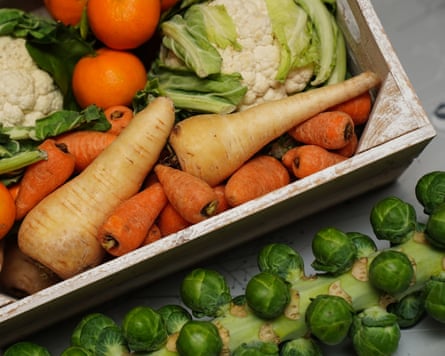
“Most things that are delicious in Christmas dinner are best cooked in the moment,” Smith says. “But there are a few things that can be done in advance.” Cranberry sauce, bread sauce, stuffing, even a slightly fancier vegetable side, though purists will tell you that Christmas dinner has enough going on without the need for such extravagance. “If you’ve room for a side that’s a bit more interesting, a sprout gratin is very good and can be done in advance,” says Smith, who shares such a recipe on his Substack. Another idea, which could stand in for multiple sides, involves potatoes, chestnuts and parsnips. “It’s a delicious dish that someone can easily do, and it’s just as good the following day,” he says, should leftovers be on the Boxing Day menu.
The biggest condition of any offer of help, large or small, however, is that you finish the job. “If you’re washing dishes, put them away,” Henderson says wearily. Ditto dirty dishes in the dishwasher and vegetable peelings in the compost bin. “Cooking is fun, but it’s not just about the end product,” she says. “It’s all the little boring jobs, which are enjoyable when done together, but if they’re not done, it’s just one person cleaning up the mess.” And that, of course, makes for the dreaded martyr.
That said, there should be only one person in charge, Dusi insists. Some may resent it, but years of working in restaurants have taught him: “there cannot be too many voices in a kitchen. You may disagree violently with the person leading, but there has to be someone directing the traffic. If you disagree with them when things are stressful, things will go south.” The proverb “too many cooks spoil the broth” is true of professional kitchens and those at home alike. The time to discuss leadership style is after Christmas, when everyone has calmed down, Dusi adds. “The middle of service is not the time to suggest a change of direction.”
Inevitably, there will be some cooks who cannot tolerate help; who will combust if someone so much as picks up a spoon, let alone stirs with it. If this is you – or the person whose Christmas you’re at – remember that help does not have to be confined to food. Though chefs Itamar Srulovich and Sarit Packer are married and the co-founders of a small Middle Eastern restaurant group, Honey & Co, they can’t be in the kitchen together either at home or in any of their restaurants. “All we would do is instruct each other,” Srulovich says. “And that would mess up our business and ruin our marriage as well. So, if Sarit is cooking dinner for friends, she does the whole thing from peeling the carrots to loading the dishwasher. And vice versa.”
That doesn’t mean the other half sits on their bum. Srulovich says: “They help with shopping, the cleaning, getting flowers, laying the table – these are not insignificant things. If every time you cook with your partner it ends in a passionate lovemaking session, then go with it. If it ends in friction, avoid. Know thyself and thy relationships, and do whatever works for you. And remember: there are jobs outside the kitchen as well as in it.”