3 months ago
71
3 months ago
71
Felix Valdés García was nine years old when the revolutionaries came to blow up his trees. It was the verge of the 1970s and his father, Felin, was losing the family farm to Cuba’s 10-year-old communist regime. A push called the Revolutionary Offensive was under way, mobilising the people to sow, clean and harvest 10m tonnes of sugar cane in an effort to make Cuba financially independent. The land needed to be cleared.
For decades the family had nurtured their 800 hectares of rich loam alongside the meandering Sagua River. Eight couples, all related, worked the fields, while Felix and his sister had fruitful adventures among the royal palms, avocado, mango and magnificent ceiba.
“The sappers arrived,” Felix writes in his family memoir. “A gang of agile men who opened holes in the roots and placed charges of dynamite. There was a terrible roar and the trees flew into the sky, defying gravity, then fell shuddering with broken branches.”
Felix is my father-in-law, and I recall this moment when I think about Cuba’s revolution, which is often as the country spirals into tragedy around me.
A vast human experiment is coming to an end. Fidel and Raúl Castro’s communist revolution is crumbling, to be replaced by … we know not what. The US government, after six decades of aggression, is seeking the endgame. The Trump administration, newly energised from decapitating Venezuela’s Bolivarian revolution, is looking for “assets” within the Cuban government, and briefing of warships enforcing a total oil blockade. “Make a deal before it’s too late,” President Donald Trump told Cuba’s leaders.
The Americans are facing a country where the lazy tourist’s recommendation – “See it before it changes” – no longer applies. In the pit of an economic slump, the island has gone from being run-down and picturesque to a horror show. The economy contracted by 11% between 2019 and 2024, with a further 5% fall through September 2025. Rubbish fills the streets, picked over by burgeoning bands of beggars. Rolling power cuts rack the island, spoiling the little food people have in their fridges, and making it hard to sleep. Anyone who protests is met with authoritarian force.
It’s not the first time Cubans have gone hungry. The “special period in a time of peace” following the collapse of the Soviet Union saw people begin to starve. But those who lived through those times say these are different. The government, out of money and ideas, has allowed a small super-class of Cubans to emerge, licensed to import products including food. But inflation means very few can afford their goods. “In the special period things were very bad, because there was no food, but we had hope,” said Carlos Bustamante, a film producer. “Now there is food, if you can afford it, but no hope.”
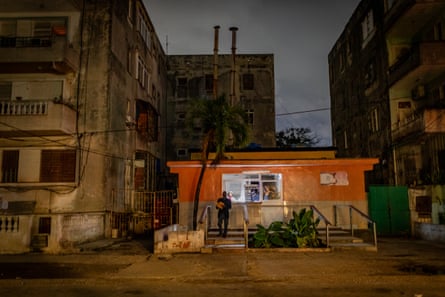
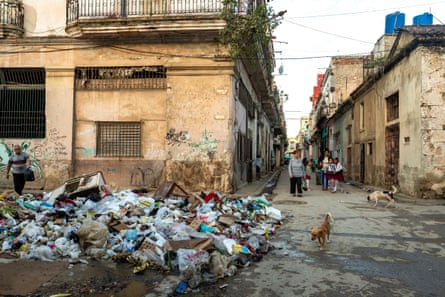
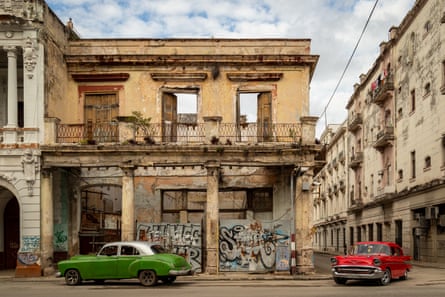
The wealthy drive Mercedes and Dodge Rams past the famous 1950s Ford Fairlanes and 1970s Russian Ladas. In the special period neighbour helped neighbour, but such communitarianism is collapsing. Every generation is affected by the crisis, but none more so than the one that built the revolution, who rallied to the call to put aside personal gain for the common good. It was they who volunteered to cut cane during that 10m-tonne harvest, on the understanding that they would be provided with food and healthcare until they died.
The revolution raised many out of poverty, its great achievement. But it is now beggaring them again.
For some it was enough. I stop an old man sweeping the path outside his house in Havana’s Vedado neighbourhood. Darío Díaz Machado says he was a lieutenant colonel in FAR, the revolutionary army. His 4,500 pesos a month pension may only be worth $10, but his son, a surgeon in Spain, sends money.
“I was a peasant, working the land,” he says. “After the triumph of the revolution I began to attend schools and improve myself. I’ve come this far. I feel happy.”
This is not a widely held view. An estimated 20% of the population – among them the best and brightest – have emigrated since the pandemic, often with children. The shock on the faces of their elderly and increasingly lonely relatives matches the state of their clothes.
Martha Ortega was a secretary in a Communist party office in central Havana. She now lives with her daughter, who is deaf and mute, on a pension inflation has reduced to $5 a month. “We lived with a dream, with a devotion. And then everything was gone,” she tells me.
What Cubans now live with is an electricity grid that regularly collapses. The first time it happened, in October 2024, I was making breakfast for my then two-year-old boy, Santiago. Five days of blackout also meant the water supply had failed. He was potty training, and turning to check on him, I discovered he’d pooed on the floor, putting his dirty hands to his face.
I looked at the useless taps, aware that our cupboard of imported medicines didn’t include anything for conjunctivitis. Picking him up, I thought: what are we doing here? Many have no choice, but we do.
Part of it is that my wife, a literary professor at the University of Havana, has never wanted to go. We’ve lived together for eight years in her small apartment overlooking the Florida Straits and she remains in awe of her home city. “All this,” she’ll say, looking at some magnificent building. “In the Caribbean.”
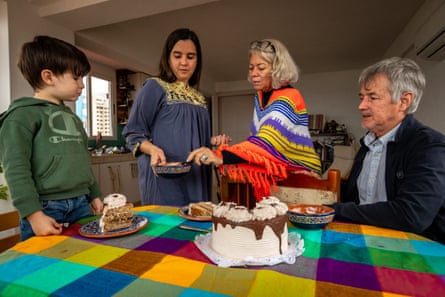
But all her friends have gone. A graduate of the once meritocratic powerhouse of a high school, La Lenin, she shared a dorm with friends who are now spread across North America. They wonder why she won’t go, too. Instead she heads off to classes during the extended power cuts in the hope that her students will turn up in the gloom (they usually do).
But part of it is me. Cubans now refer to themselves as a “third world country”. Marco Rubio, the US’s Cuban-American secretary of state, who is at the forefront of the administration’s effort to change the Havana regime, called it “fourth world”. This makes me furious because neither is true. Or at least it wasn’t. Cuba is something else, something unique and terrifying, which is what this article is about.
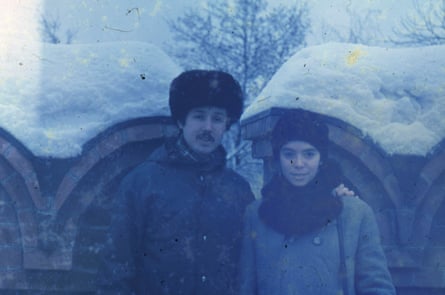
I came of age in Scotland when the Berlin Wall fell, and was told the good guys won and the bad guys lost. Felix heard it differently. In the 1980s he had left the house in Santa Clara in which the family had been resettled from the farm, to study philosophy. He boarded a ship in Havana Bay and set off across the Atlantic to study in the Soviet Union. The cruise liner refuelled in Algeciras, Cuba’s communist students shouting down to Spain’s until recently fascist stevedores. Then it was through the Bosphorus, and a landing in Odesa.
There Felix met Yohanka, also Cuban, also a philosopher. (You get used to this sort of thing if you live in Cuba: I like to fish and Felipe, my Cuban guide, is a trained psychologist.) Felix and Yohanka were beneficiaries of a revolution determined to educate. “Without education there is no revolution,” Fidel Castro said. Yet all attempts to pay for this education were failing. The sugar harvest that saw Felix’s beloved trees blown up fell short by between 1.5m and 2.5m tonnes, and was soon excised from national conversation.
Other attempts to centrally plan prosperity sputtered into life. There was an ambition to build a network of nuclear power stations, which collapsed after Chornobyl, a bioengineering sector to manufacture drugs, which was met with an international shrug, and a tourism industry that necklaced the best beaches on the island with ugly all-inclusive hotels. Without capitalism’s glinting edge, the government’s money-making attempts either limped on or collapsed. Each time I pass through Havana’s José Martí airport, I laugh at a billboard attempting to encourage medical tourism. It shows a smiling couple saying, “I choose Cuba to procreate.” I mean, I chose Cuba to procreate, but I wouldn’t have put it quite like that.
Doctors have been trained by the thousand, and sent to more than 160 countries on medical missions. These have been a subject of pride and scandal: the doctors earn up to $1,000 a month while the state charges the host country five times that.
Nothing has given the island – 777 miles long, with a historic population of 11 million – the velocity to escape the financial kindness of other nations. Instead, the economy has lurched from one crisis to another, as insidious sweetheart deals have been done with Russia, Venezuela, Iran and China. Meanwhile, the fundamental infrastructure rots. “This country has never been economically independent,” says Katrin Hansing, a professor of anthropology at the City University of New York. “Full stop, since colonial times.”
The government blames its woes – with justification – on the US and its decades-long economic embargo. Others – with equal justification – point to ageing political leaders ineptly running a moribund, centrally planned state. What is certain is that the vast majority of Cubans on the island no longer care who is to blame.
As 2024 turned into 2025, we took a family trip to Viñales. If you have visited Cuba, you will probably know it: a village in the island’s west in a valley full of mogotes, steep-sided rocky hills. There was a pig roast, presided over by a local lad sporting a solid-gold chain and a vast medallion. I liked his shtick. He’d made money trading cars. His children were like little Mowglis, charging around bareback on horses, before falling asleep together in a hammock.
But my parents-in-law eyed him in confusion. “He’s just not emancipated,” Felix said. I’d laughed, teasing him, but I kept thinking about it afterwards. It reminded me of a line in Secondhand Time, Svetlana Alexievich’s Nobel prize-winning book of interviews with people after the fall of the Soviet Union. “There were new rules,” one said. “If you have money, you count – no money, you’re nothing. Who cares if you’ve read all of Hegel?”
I tell the story to Hansing, the City University of New York professor, who is a classic example of the curious people you meet on the island. She arrived in Cuba in the 1980s as a teenager, daughter of South African anti-apartheid activists. She was educated on Cuba’s Isle of Youth alongside students from a slew of African countries, part of Fidel Castro’s then global outreach.
“I know so many people who grew up in the early years of the revolution who became professionals, doctors, engineers, university professors, journalists,” she says. “But their children or grandchildren, if they haven’t been able to leave, are now doing manual labour because it pays better.” She is grim about the future: “There’s a growing sense of not only anti-intellectualism, but anti-education among many young people.”
Cuba’s revolutionaries made the island an icon of the international left. In some ways it still is. In January, there was a gathering to mark the anniversary of the 1966 Tricontinental Conference which drew anti-colonialists from all over the world. And yet lately, the government’s apparent acceptance of the suffering of its people has been causing a degree of circumspection even among true believers. Heinz Bierbaum is a former president of the European Left who, as chair of the Rosa Luxemburg Foundation, is a regular visitor to the island. “Solidarity with Cuba is very important because it’s a socialist country in an unfavourable environment,” he says. “But we have to talk about the situation, to enter a dialogue with the government about the problems.” (To be fair, he told me this before the US assault on Venezuela, which is bound to harden opinions again.)
It didn’t have to be like this. In 2016, then US president Barack Obama flew into Havana to “bury the last remnants of the cold war”. He was greeted by a population who believed fundamentally in free healthcare and education. It wouldn’t have been a reach for Cuba to give its people a little opportunity, allowing them to earn money while asking them to pay decent taxes towards such benefits. But the government didn’t think so, at least not on any effective scale. Instead it cleaved to policies that maintained its control of the economy, often in baffling ways. A programme of hotel building has been under way, with 7,000 more rooms added since 2019, despite tourist numbers halving in the same period. And no one answers the question why.
Meanwhile, in 2021 came a unification of two currencies, one pegged to the US dollar, one local, which resulted in hyperinflation that collapsed the value of state sector pay and pensions. The minister responsible, Alejandro Gil, was charged, convicted and given a life sentence for corruption and, more startlingly, espionage. Again, no further explanations were given.
Michael Bustamante, chair of Cuban and Cuban-American Studies at the University of Miami, and one of the most fair-minded observers of the island, says the government has “missed every opportunity” to make the economy better, and the effects are heartbreaking. Children who would once have had to answer to the police if seen on the streets in school hours now use the time to beg. Parents struggle. A friend received a call from her sons’ school after a rainstorm asking that she pick them up. A lack of gas meant they had been cooking lunch for the children over fire, but their wood got wet.
Doctors battle on, working in dirty hospitals, sharing any functioning machines, doing what they can. But once-vaunted infant mortality rates have doubled and even the government admits medicines are scarce.
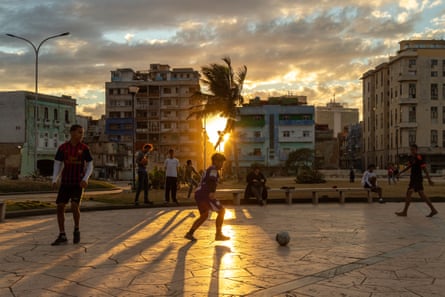
And people keep leaving. There are no firm figures but estimates are as high as 2 million. My wife’s speciality is the literature of emigration, her PhD on writers making sense of their broken families and exile. Her subject has been Haiti, a deflection not lost on her.
Across the Florida Straits, Cuba’s exile community watches events on the island carefully, sensing the end even as they struggle with this latest, unprecedentedly large, influx of refugees. In an office on the 11th floor of a glittering building in Miami’s Brickell mall, Pedro Freyre is one of the city’s leading attorneys. The 76-year-old is exile aristocracy, his family having fled a beautiful house on Havana’s Fifth Avenue ahead of the revolution. His brother fought against the Castros in the Bay of Pigs and his brother-in-law died there.
Cuban Americans are proud of their relationship with their adopted country, he says. “We were well received, well treated. And, as the song says, we built this city.”
Despite his family history, Freyre was closely involved in the effort to bring investment to Cuba during the thaw in relations started by Obama. “Trump’s people were there,” he says. “You see the property that they were looking at as you fly in. It had a landing strip, and he was going to build a golf course.”
He has lost patience now, saying many Cuban Americans would support intervention – something I never hear in Cuba itself. He calls nonsense on my suggestion that the revolution gave Cubans a unique intellectualism. “That’s a very Cuban tradition that has been around since the inception – think of José de la Luz y Caballero and José Martí.”
This remark brings me up short and I mull it as I drive away. I think also of pre-revolutionary artist Wifredo Lam, writer Alejo Carpentier and singer Benny Moré. Then I look around, at Miami’s flatlands full of strip malls and faux-this-and-that houses. Cubans may have built this city, but they didn’t do it with any poetry.
Still, I am on my way to meet a man who will shed no tears if the revolution collapses, who has experienced the darkest side of its legacy. In a small apartment under the flight path into Miami airport, I find José Daniel Ferrer, who for much of this century has been de facto head of the Cuban opposition. On and off, he has spent 12 years in Cuba’s jails as a political prisoner (one of nearly 1,200, according to human rights group Prisoners Defenders). “I saw things I never thought a human being in the western hemisphere could see,” he says, including being held in darkness for months, force-fed, attacked by both guards and prisoners. He says he watched two men get beaten to death.
Despite this, he always refused to leave Cuba, determined to be a thorn in the side of the government from within, but in October last year he’d had enough and accepted exile. “There is nothing to lose with the fall of the regime,” he says bitterly. “Rather we will gain freedom, opportunity and prosperity.”
The worst years of his incarceration, he says, came after 2016. It’s a reminder that, even if everything had gone smoothly following Obama’s visit, it’s unlikely Cuba would have easily pivoted into a cosy social democracy. “Cuba hasn’t had a democracy, let alone a social democracy, since 1952, so there is a lot of work to be done,” says Bustamante, the University of Miami academic. “And the tenor of political discourse among Cubans doesn’t give me high hope for the defence of democratic values.”
Indeed, inside Cuba, misery has led to a cyclone of cynicism, projected in bitter humour. During the last May Day celebrations, a joke circulated that the vast annual march, when workers are bussed in from all corners, would no longer lead to the city’s Plaza de la Revolucion … but instead to the psychiatric hospital.
For those the revolution educated, the sad last act of the great experiment appears to be extraordinary individual tragedies. Says Hansing, “For many of the Cubans I know, these are the questions: what have I lived through? What was all that for? What was my life?”
Reading this article, my father-in-law Felix said sadly, “You [he meant western Europeans, Americans] use communism as a hammer, but to me it remains a beautiful idea – perhaps the most beautiful idea.”
I drive my family down the island for a cousin’s wedding. We take the northern road, past the tourist beaches of Varadero and along a crumbling highway next to Cuba’s palm-fringed coast. Despite the power cuts and lack of gasoline, it remains a journey I love above almost all others.
The people we pass appear exhausted, as if waiting for something they can no longer even articulate. My wife and I have made a habit of exploring Cuba’s sideroads and we do so again, arriving by chance at a hotel once known for its natural springs. The whole family get out. The lobby is clean and the shop is open, selling beach towels and hats. The staff are welcoming, their uniforms pressed. The swimming pool is empty and there are no guests. I ask when the last came through and the receptionist tells me four years ago.
Later, at the wedding in Sagua La Grande, where the power cuts are now more than 16 hours a day, the priest tells the congregation not to throw rice, but to instead give it to the happy couple.
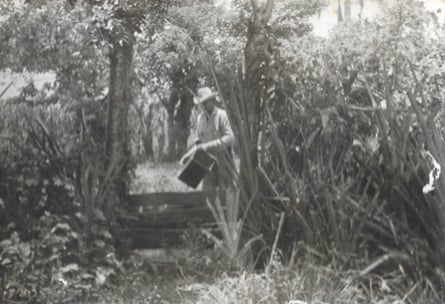
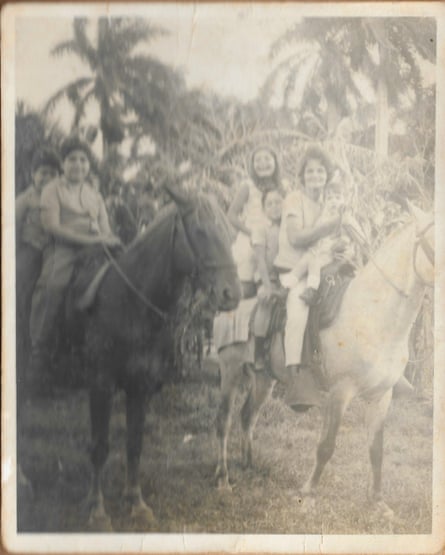
Still caught by the story of the sappers blowing up the family’s trees, I suggest we visit the farm on the way back to Havana, and plant a few fresh saplings. From the highway, I see the gesture is unnecessary. The whole place has turned to thick forest. But Felix has brought a tree anyway, a lemon that had grown from a discarded fruit in the Santa Clara house in the years after his father, Felin, died in 2021.
We pick our way through the woods, through rattlebush and punarnava, Felix plunging ahead with such intent, I worry the rest of us will lose him. Finally we emerge into a clearing where the Caribbean sun is diffused by the canopy.
Nothing remains of the farm, not even the foundations of the house. We stand astonished. All traces of Felin’s work, of the eight couples who lived here, have disappeared. All the pain and sadness Felin suffered on losing his land was unnecessary, and is now forgotten by everyone except this family.
I start digging. My boy Santiago runs over to help, pulling up rich, fecund soil with his little hands. When it is deep enough, Felix plants the lemon tree.
We press down the roots and christen it with water. A burst of sunlight draws out the deep green of its leaves and a yellow butterfly, magnificent and huge, floats by. We all watch it go, its journey as random as madness.