3 months ago
71
3 months ago
71
Stuart Vevers, the British designer of the American mass luxury brand Coach, is working to keep sustainability in the spotlight at New York fashion week. Not an easy task, when environmental concerns are slipping down the global agenda and fashion, perennially a mirror to the world we live in, has reverted to putting profits first.
“I’m an optimist, but it’s not a blind optimism. There’s a lot of tension in optimism, because the world is challenging and I am not ignoring that. My optimism comes from believing that the young people of today are going to make this world better,” he said before Wednesday’s show, held in the historic Cunard building in downtown New York.
A decade ago, Vevers felt guilty about working in fashion. “It was starting to eat at me. I was struggling with it. One day I realised: don’t feel guilty, take action. That was the gamechanger for me. I still don’t have all the answers by any means, but every day, I’m thinking about it and working on it, and we’re making progress.”
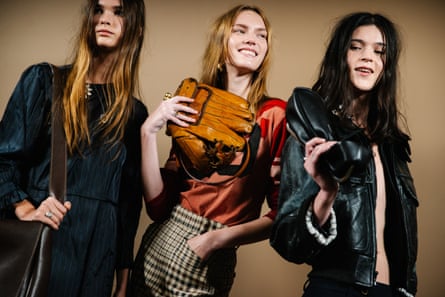
So the ripped jeans on the gender-fluid catwalk were not artfully distressed, but entirely made from post-consumer denim. Leather handbags looked like beaten-up baseball gloves because they were actually made from vintage baseball gloves. “The funny thing is, the older the baseball glove, the more beautiful the bag ends up looking,” Vevers noted backstage.
In Coach stores, upcycled denim has been scaled from capsule collections, and is beginning to make up a “meaningful” segment of the brand’s offering, Vevers said. “There are some really great materials already out there in the world, and my team and I have the creative ideas to refresh them and make them feel new again.” Trench coats made from old chinos have recently gone on sale. Last year, Coach partnered with Bank & Vogue, the parent company of Beyond Retro, to produce handbags made from upcycled corduroy, as part of an initiative to promote circularity in fashion and reduce landfill.
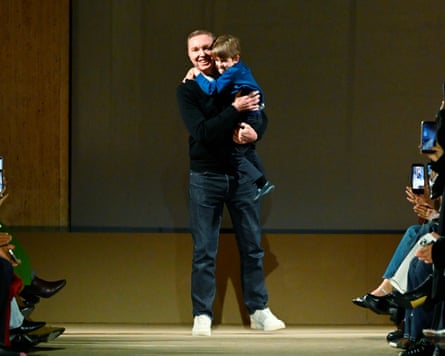
The show was dedicated to Fawn, Vevers’ nine-day-old daughter, and inspired by a Christmas afternoon that he and his husband spent watching The Wizard of Oz with their five-year-old twins, River and Vivienne. “Watching that film at Christmas was a tradition I grew up with, and when I watched it with my kids, seeing their reaction when the film switches from black-and-white to colour sparked something in me.”
So the show began with 10 monochrome looks, before bursting into colour with a pillarbox red shirt. Coach, which began as a family-run workshop in New York in 1941, now melds influences from past decades of American youth culture with a distinctive gen Z sensibility. Midcentury varsity jackets are worn with baggy, 1990s skate shorts. The styling – gender-fluid, defiantly anti-polished – is part punk, part grunge. On their feet, models wore frayed sport socks with scuffed trainers, the laces removed and replaced by the snaffle hardware that Coach’s first designer, Bonnie Cashin, made a house signature in the 1960s.
Vevers, who was born in Yorkshire, was last year made an OBE for his services to fashion and transatlantic creative relations. His antennae for youth culture tracks with Coach’s astute pricing strategy, which has targeted consumers who have been left behind by the luxury inflation that have seen the price of top-tier handbags rise out of reach. (At Chanel, leather handbags now start at about £5,000.) Coach’s sales grew 25% to $2.1bn in the last three months of 2025.