3 months ago
60
3 months ago
60
I’m deeply saddened by the IOC banning skeleton athlete Vladyslav Heraskevych from the Winter Olympics. His helmet depicting images of athletes and children who died in Russia’s invasion of Ukraine, some who he knew personally, was a human display of remembrance. The IOC’s response was not an appropriate one.
One only needed to look at the image of Heraskevych’s father when he was told the news of his son’s disqualification – doubled over with his head in his hands – to know the emotional toll. I cannot imagine what they are experiencing but, as both a former athlete and a just a fan watching on, I also feel emotional about it and cried when both Vlad and his dad messaged me on social media to say thank you for my messages of support.
Heraskevych has taken his appeal to the Court of Arbitration for Sport but the damage has been done. Amid the controversy and the wider issues, it is easy to forget that sport has also suffered. Heraskevych was a genuine medal hope for Ukraine and has worked his entire life to be here. Nobody has won from this situation, the IOC is now under intense scrutiny while Heraskevych has had his Olympic dream taken away.
The IOC are obviously worried about the potential chaos if they did not protect the field of play but the messaging has been confusing. Kirsty Coventry, the IOC president, came out in tears after failed negotiations to persuade Heraskevych and his father to change their stance and then a spokesperson, Mark Adams, took a more hardline approach, arguing that there were 130 conflicts going on in the world and that “once you start, as a sporting organisation, taking stands against wars and conflicts there is no end.”
That the IOC allowed Heraskevych to wear his helmet in his six practice runs shows they concede that this is not a straightforward case, even offering a compromise to swap his “helmet of memory” for a black armband in actual competition on Thursday. The IOC also gave Heraskevych ample opportunities to show the helmet in the mixed media zone.
There have been further inconsistencies. Earlier this week, the Ukrainian luge athlete Olena Smaha displayed the words “remembrance is not a violation” on her glove and she was allowed to compete. Heraskevych also pointed out that the Italian snowboarder Roland Fischnaller displayed a Russian flag on his helmet, for which there were no consequences. Russia is banned from competing here and the use of its flags was thought to be forbidden.
If the IOC intended to keep sport and politics separate at these Games, they have failed. The presence of ICE agents and politicians such as the US vice president JD Vance in the stands has made that very difficult. The IOC’s interpretation of their own rules and regulations here has only shifted the focus away from sport and led to more, not less, political discourse, with Ukraine’s president Volodymyr Zelensky also weighing in on Heraskevych’s ban.
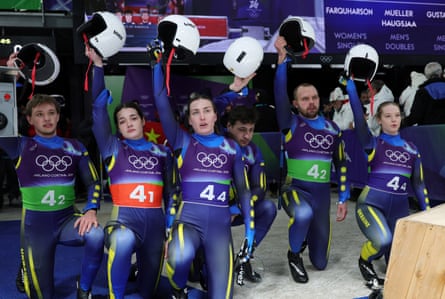
The IOC’s ban centres on Rule 50.2 of the Olympic Charter: “No kind of demonstration or political, religious or racial propaganda is permitted in any Olympic sites, venues or other areas”. A key point here is that Heraskevych believes he is not breaking any rules: his central argument was that the images on his helmet were born of remembrance, not politics.
We are athletes but we’re also human beings. We have passions and things that are really close to our hearts. As athletes we try to focus on our event and the task at hand, entering the Olympics without distraction and outside noise, but our lives do not take place in a vacuum.
I don’t think anyone in the sliding community thinks Heraskevych was trying to distract or take advantage of the attention. Talking of peace doesn’t feel political. Watching his interviews after his disqualification, you can see the sadness in his eyes – he doesn’t normally look like that. Vlad is a very capable and skilled athlete, and he was also carrying with him the memory of fellow athletes and Olympians who have lost their lives. I really appreciate his bravery. After being banned, Heraskevych posted a picture on social media of the helmet with the caption: ‘this is the price of our dignity.’ I think that’s a very powerful, well written, direct message.
It was the incorrect decision for the IOC to take away Heraskevych’s accreditation. The IOC owe him an apology.