2 months ago
56
2 months ago
56
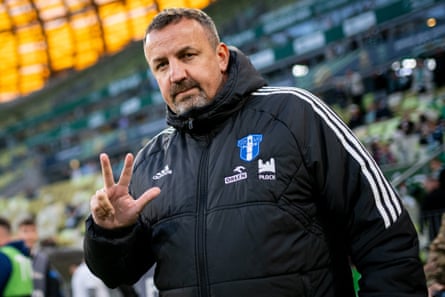
The temperature will be far below zero when Zaglebie Lubin and GKS Katowice restart Poland’s top flight on Friday evening. A bitter new wave of winter is about to hit central and eastern Europe, forecasts suggesting this is only the start. When the surprise Ekstraklasa leaders, Wisla Plock, play Rakow Czestochowa two days later the thermometer may plummet to -12C. It will take serious resolve to make these games happen but, after a break of almost two months, appetites to get back up and running are strong.
Why would they not be? The Polish league is in its best shape for at least 30 years, feeling the benefit of a booming economy that is outperforming most of its European Union peers. Attendances are soaring and its football infrastructure, whose transformation was catalysed by co-hosting Euro 2012, sets standards for much of the continent. Then there is the remarkable way in which this season’s competition is poised. The gap between first and eighth is only four points; even Bruk-Bet Termalica Nieciecza, at the bottom, are only 11 points from the summit.
At long last, Europe’s largest sleeping giant may be waking. “All the ingredients are there,” says Olivier Jarosz, whose consultancy LTT Sports has worked closely with the Ekstraklasa on its strategy. “Now there is another one: financial capability. If you have infrastructure, passion, history, players, money and investment then you have the recipe for making it happen.”
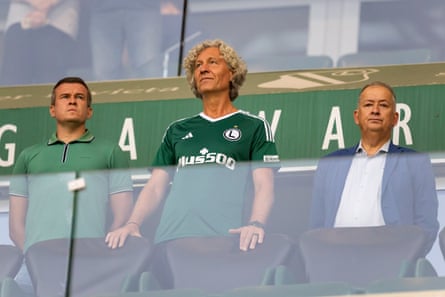
It is a league whose most internationally famous club, Legia Warsaw, flounder in 17th but can still hold out hope of a charge towards the business end. “It’s very competitive,” says Dariusz Mioduski, the Legia owner. “We’re getting to the point where the league really has the potential to crack the top 10 in the next couple of years and stay there.”
Poland sit 12th in Uefa’s coefficient rankings, compiled according to rolling five-year performance in European competitions. It is a long way from their position of 21st two years ago, which informed their number of places in this year’s tournaments. Opportunities provided by the Conference League have boosted its prospects but, in turn, so has the fact that the Ekstraklasa can provide a depth of competitive teams. Last season, Legia and Jagiellonia Bialystok reached the quarter-finals. This time Jagiellonia, Rakow and Lech Poznan will play knockout football.
“The idea of the Conference League has worked and Poland has benefited,” says Mioduski, who was instrumental to its creation through his role as vice-chair of European Football Clubs. “But the ambition is not to purely be competitive at that level. It is to start playing in the Europa League and eventually have representation in the Champions League.”
Jarosz is even more bullish. Like Mioduski he identifies a nailed-on top five European leagues but believes the Ekstraklasa has the potential, as rugby did when expanding the Five Nations, to complete a “big six”. There remains a long way to go. Sustained continental presence among a wide range of Polish clubs is regarded as a safer path than creating a league in which one or two bigger sides consistently hoover up. “It potentially shows a level of maturity,” Jarosz says, pointing to the fact Legia’s current struggles do not appear make or break for the coefficient.
It makes Poland the most interesting proposition in Europe: a country that increasingly has the means, intent and entrepreneurial drive to compete with other leading nations but must bridge a gap that, in football, has increased wildly. Much of the former eastern bloc has all but disappeared on elite club football’s map. The Czech Republic has, largely through the Prague sides, flown a flag for the region; it has 30% Poland’s population but has traditionally been considered more stable. Maybe a burgeoning market will not tolerate being on the sidelines forever.
Before eyeing wider domination, the domestic product must be on point. “It’s a very intensive, physical league,” Mioduski says of a division that has had four title winners in the past five years. “If you’re just a good football player and don’t come with the right intensity, physicality and mentality, it won’t work out. Young players who succeed here can thrive pretty much anywhere. The technical level is getting higher, and more foreign players are looking at the league as a place where they can develop rather than simply make money at the end of their careers.”
Sam Greenwood, the 23-year-old former Arsenal and Leeds player who joined mid-sized Pogon Szczecin for €2m in August, is a high-profile example. Widzew Lodz, struggling in 15th, set a league record when they signed Osman Bukari, the Ghana winger, from Austin FC for a reported €5.5m last month. Poland’s clubs are casting off the restrictive shackles of city council ownership and discovering some spending power. “More than half the clubs are privately owned, mostly by Polish businesspeople,” Mioduski says. “These people don’t treat them as toys: they treat it as part of their portfolio and have a businesslike approach to it.” Jarosz wonders whether, in the future, council-owned clubs may not be permitted a licence to play in the top division.
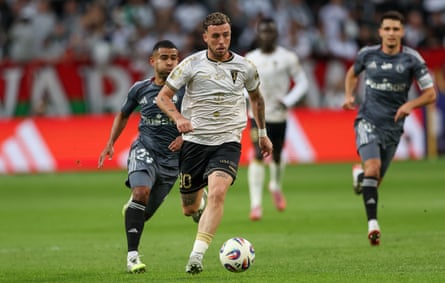
Many of these local institutions are forging a barely precedented connection with their communities. The average crowd in the first half of 2025-26 was 13,674; that is 1,000 up on last season and more than 4,500 bigger than the typical attendance a decade ago. That is without the presence of giants such as Wisla Krakow, who lead the second tier and average more than 26,000. What were once grim, sometimes hooligan-infested venues have become modern crucibles in which the dream of playing in Europe burns for almost everyone.
“Weather conditions and infrastructure quality were among the previous challenges, but now the whole package is making people come,” Jarosz says. “It’s still affordable and, as people get richer, they like to find more sources of entertainment. Now the question is how to find the fan of the future, attract them and keep them.”
Another goal is to fully maximise the league’s television rights potential. In a market that more widely shows signs of bottoming out, Poland detects room to develop. The current deal with Canal+ is worth about £67m a year; for comparison it is about half what the Dutch league brings in. “Because the league has become much better, much more attractive, we expect the value of the rights to grow in the future,” Mioduski says. “The issue is it’s coming from a relatively small base. We need to reach values that are considerably higher than we have today. I think it’s going to grow significantly in the next 10 years.”
Even if ice and snow present a short-term hindrance, the Ekstraklasa is warming up. “We have technology, growth and interest, so now it’s about continual development,” Jarosz says.
The thrills and uncertainty that lie ahead between now and May can only help its cause.