3 months ago
77
3 months ago
77
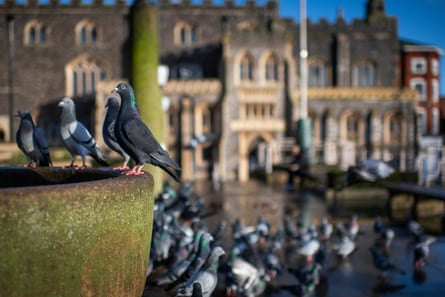
At nine o’clock on Saturday morning, Norwich market is only just stirring: shutters are still down and the aisles are quiet. In the nearby Memorial Gardens, however, a large crowd has already gathered: the market’s pigeons are waiting to be fed.
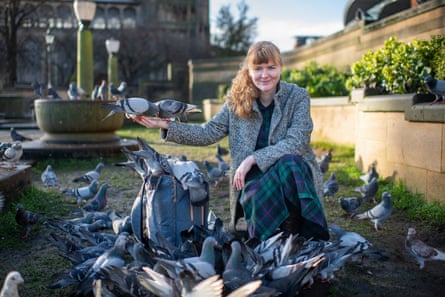
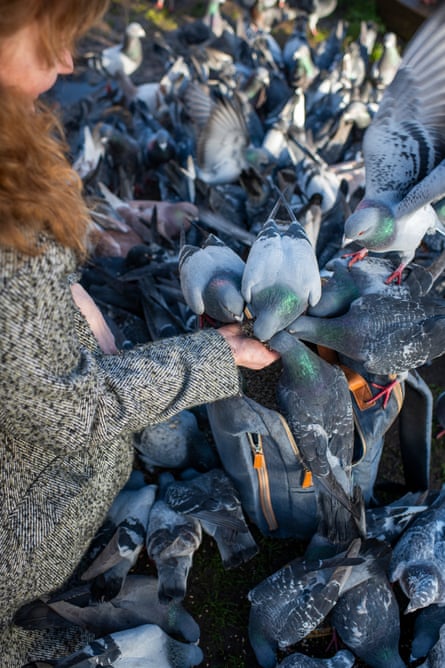
Jenny Coupland arrives on the scene a little later than her usual hour, with a backpack brimming with seed. As she begins doling it out, the birds descend from their perches and cover the ground, pecking furiously. The sun catches their bobbing heads, sending iridescent shimmers across their brown and grey feathers.
A few passersby stop to watch; one takes a photo. The sheer number of birds is a spectacle – not to mention startling, when they all abruptly take flight. “They’re a bit jumpy today,” says Coupland, 43. Judging by the wary glances she shoots at the onlookers, she’s not just referring to the birds.
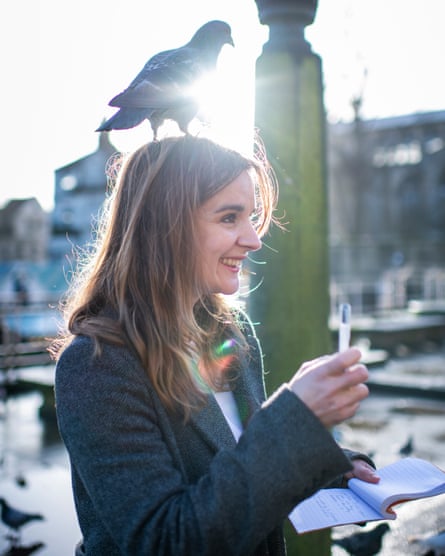
As the founder of the avian welfare group Peck Savers, Coupland has been feeding pigeons around Norwich for 10 years, but in recent months, she says, it has become “a tinderbox situation”.
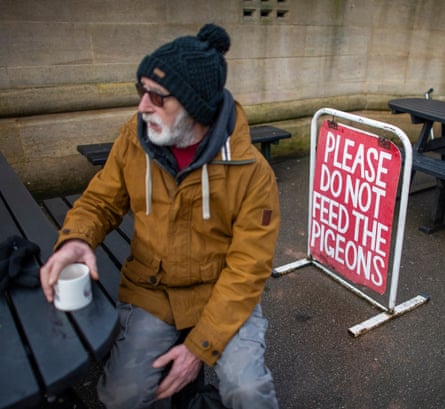
Over the past year, the flock here has swelled to about 300 pigeons, causing an increasing number of complaints from shoppers and traders. “I think they’re a damned nuisance, that’s my opinion,” says Eddie Graci from Horsford, who I find nursing a mug of tea at the picnic tables on the fringe of the market. He has seen the birds taking over these tables, trying to pinch chips, defecating on people’s clothing. And the Memorial Gardens, Graci adds, are a “damn mess. There’s bird droppings everywhere.”
National media have described scenes here as Hitchcockian. Norwich city council has come up with various solutions, including sending a Harris’s hawk over the market to scare the pigeons off and feeding the flock contraceptives. But giving birds contraceptives, it turns out, isn’t actually licensed in the UK and the four-week hawk pilot was put on hold. Councillor Carli Harper, the Labour cabinet member for finance and major projects, accused some people of inflaming the issue with “industrial amounts of birdfeed” to save the pigeons. Though feeding birds is not against the law, Harper has said the council is considering legal avenues to crack down on the “irresponsible … selfish few who do not see reason”.
This is a local story, but a global issue. Norwich is far from the only place with a pigeon problem: Rome, Venice, New York, Singapore and London have restrictions – and penalties – for feeding pigeons in certain areas (breaking the ban in London’s Trafalgar Square incurs a £500 fine). After a citywide ban on feeding pigeons in public spaces was introduced in Mumbai in July, where pigeon feeding is a longstanding pastime for some communities, months of protests and clashes with police followed. There was even a failed attempt to create a political lobby with the formation of a “Pigeon party”. Activists have attempted to rebrand the birds as “sky puppies”.
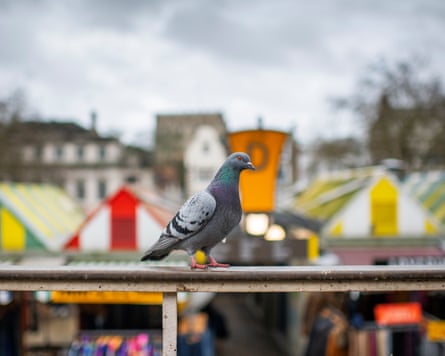
Coupland needs no persuading. Pigeons are “just perfect”, she says, describing their jewelled plumage and beady eyes. “If you’ve seen one robin, you’ve basically seen another one – but not with pigeons.” She accepts that not everyone feels the same. “Maybe you don’t like the way they flap their wings, or their coos, or something. But don’t not like them because you think they’re dirty, or spread disease – because it’s just not true.”
Pigeons do carry parasites and bacteria that can be hazardous to humans, particularly in cases of overcrowding, but the risk tends to be greatly overstated, says Will Smith, an evolutionary biologist at the University of Nottingham, who specialises in the birds.
Disease is typically transmitted through close contact with droppings. Infection is uncommon in the UK, though immunocompromised people are at greater risk. In 2019,an infection caused by pigeon droppings was a contributing factor in the death of a child at a Glasgow hospital, after excrement was found in a small break in the wall of the room, which was on the rooftop of the hospital.
There are also respiratory illnesses, such as the flu-like psittacosis, and allergies caused by prolonged exposure to the dust accumulated in pigeon roosts. But again, “that’s not something most people will experience”, Smith says. “I wouldn’t advise anyone to go and touch any wild bird and not wash their hands, but there’s nothing specific about a pigeon that makes it more dirty than a robin.”
As for avian influenza, now being actively managed across the UK, pigeons are actually lower risk than ducks, geese, seabirds and swans, having been shown to be unusually resistant to infection. Though the virus may evolve, “at the moment they don’t really get it”, Smith says.
That’s not to say there aren’t legitimate concerns about population numbers, he adds. A single pair of pigeons can produce up to 12 squabs every year, meaning flocks can grow exponentially. And though they are capable of flying great distances, they tend to stay put in just one or two streets. Feral pigeons are the descendants of wild rock doves that were domesticated centuries ago, then escaped and formed self-sustaining populations. “They wouldn’t exist if not for us, and they’re completely dependent,” says Smith. Many discussions about management, as in Norwich, proceed under the assumption that problematic flocks can be pushed to “just go somewhere else and forage in the wild”, Smith continues. “But for a feral pigeon, ‘the wild’ is the concrete jungle … Their natural diet is McDonald’s.” The overcrowding risk means populations do sometimes need to be managed, for the pigeons’ health as much as people’s, Smith says. The question is how to go about it.
Moving or barring birds from one area tends to result in just shifting the issue elsewhere. The increase in birds at Norwich market, in fact, is believed to have been driven by development work on the former Anglia Square shopping complex a mile away, sending that flock in search of a new home. Banning people from feeding pigeons wouldn’t necessarily make a dent in the numbers, Smith says. But if the food supply were to be abruptly cut off, there would be “a lot of suffering”.
Coupland argues that feeding the market flock is not just a private ritual, but a civic tradition and important for animal welfare. Along with providing nutritious seed, she and others in Norwich routinely remove entangled debris from pigeons’ feet (a common issue that can cause infection and even death) and facilitate veterinary care for sick birds. “They rely on us to help them, and to live.” She also says that without people like her feeding the birds, the result would be “hundreds of dead and dying pigeons on the street. Which is what Norwich city council is advocating for.”
Harper declined an interview, but said in a statement that the council was continuing to explore “humane, legal and proportionate measures” to manage the pigeons and support traders. “Let me be absolutely clear: we are not anti-pigeon. We are pro-Norwich market.”
Coupland, meanwhile, has designed stickers to drum up support for the pigeons’ cause stating: “Give Seeds a Chance”, “Your City Needs Coo” and “Norwich Shitty Council”. “The council has demonised us as these militant pigeon-feeders,” she says. “But people have been putting seeds down there for at least 10 years – it’s just that they’ve noticed now.”
The most ethical way to thin a flock, says Smith, is to gradually reduce food over several months, slowing reproduction, but “it’s quite difficult to do”, and authorities often lack the will. Part of this may be because of “bad PR” rather than fact, he continues. First dubbed “rats with wings” in 1966, by a New York City official looking to clean up parks, today pigeons occupy an uneasy no man’s land: not quite pets, not quite wildlife – and lower status than both.
Yet, for millennia, pigeons were cherished for sport, communication and companionship. Historically, doves (“basically white pigeons”, Smith points out) were symbolic stand-ins for gods. Messenger pigeons were used as far back as 950BC, and were bested only by the telegraph, invented in the 1830s. And pigeons informed Darwin’s theory of evolution. “They have given so much to us culturally … and we’ve kind of abandoned them,” Smith says.
Worse, their reputation as vermin has made them a target. In Portsmouth last month, 29 pigeons were found dead, believed to have been killed with aslingshot. And in 2021 in Norwich’s Memorial Gardens, a man allegedly decapitated two pigeons. According to Coupland, who spoke to horrified witnesses, he said he thought he was doing everybody a favour. “You don’t have to love pigeons to think that’s wrong,” she says indignantly.
Coupland says she has been verbally abused for feeding pigeons, which she considers proof of the impact of a decades-long “smear campaign”. “Trying to break all of that down is quite difficult.”
But not everyone is resistant. For 19-year-old Summer Loh, who moved to Norwich from Singapore last September to study, the flock at the market helped the city feel like home. In Singapore, Loh worked at a wildlife reserve, handling birds of prey, but she’d largely overlooked pigeons because of the strident national position against them. In Norwich she began feeding the flock and de-stringing birds’ feet in order to feel connected to animals again.
Loh has since been working with Coupland to stand up for pigeons. “They’re just little guys,” she enthuses. “They are genuinely so full of personality … They’re like dogs.”
If you watch pigeons for a while, Loh suggests, “you realise that they’re actually pretty nice to be around, and don’t mean any harm”. Some people in Norwich have told her that they find the birds beneficial for their mental health. “To watch them, feed them, the sound they make – it’s quite calming.”
If we can’t expect to eradicate pigeons from towns and cities, Loh and Coupland argue, one solution is to accommodate them better. They propose building a dovecote in nearby Chapelfield Gardens, drawing birds away from the busy market and enabling proactive management. For example, eggs can be removed from nests and replaced with dummies, effectively and ethically reducing numbers over time.
“It’s a win-win solution,” says Loh. Her Change.org petition, outlining the dovecote proposal, has received more than 4,000 signatures since December. Loh says that at a council meeting Harper dismissed it as a poor use of taxpayers’ money – yet, she says, “they spent £4,000 on a hawk”.
In her statement, Harper said the council was exploring “more suitable locations … for pigeons to gather”, but declined to comment specifically on the Chapelfield dovecote. Proposals can be expected later this year.
Smith says the dovecote is a good idea, and similar solutions have been successful overseas, but foresees it being a “tough sell” in the UK. “It seems like the sort of thing that, culturally, we’re not ready for.”
Pigeons are routinely overlooked in science and conservation. Despite their global abundance, we understand “disproportionately little” about them, Smith says, reflecting researchers’ preference for more charismatic or threatened species. But, he argues, “If we want to understand what future ecosystems are going to look like, we have to learn about the things that are thriving.”
That is what is behind Smith’s own interest, he adds. “I think there’s something special about that: they are survivors.” Coupland agrees they’re “brilliant” – but says in the case of the row rumbling on in Norwich, whether pigeons are good or bad is besides the point. “They’re always going to be here.” And even local people agree there are bigger issues at the market.
At the picnic tables, Andy Guy from Wymondham, Norfolk, doubts that there will ever be a “cure” for the pigeons: “They’re everywhere.” He’s more exercised by the council’s planned market revamp – a misuse of funds, he says. Until 2010, “the council used to be out here every night, washing, cleaning, picking up the rubbish … It just needs tidying up, but they don’t.”
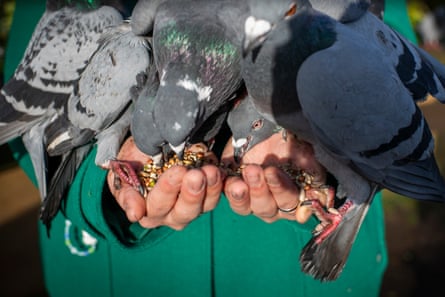
Long after Coupland is gone from the Memorial Gardens, 13-year-old Amelie turns up to spread some seed herself. “I’ve always adored them,” she says, as the birds crowd around her hand.
Amelie has no intention of stopping. The council’s effort to shift pigeons from the war memorial is ironic given the part they played in the first world war, delivering coded messages, saving lives, she points out. And if they really did spread disease, “surely half of Norwich would be sick by now”, Amelie says. “I just think that it’s rather silly.”