3 months ago
64
3 months ago
64
Christmas is lovely, but my kids think Chinese new year is by far the best holiday. I might be biased, but, unusually, I am inclined to agree with them. As my eldest puts it, “New clothes, cash, booze and food – what’s not to love?” There’s the added bonus that cash is absolutely more than acceptable – in fact, it’s de rigueur, so there’s no shopping for mundane socks and smelly candles. Chinese new year is full of rituals and, just as at Christmas, every family has its own, but they are all variations on a theme. Symbolism looms large in Chinese culture, and at new year it centres around messages of prosperity, luck and family. Symbolism extends naturally to the food, too. The word for “fish’” in Chinese, Mandarin and Cantonese sounds a lot like the word for “surplus”, so to have fish is to have an abundance, to have more than one needs, while dumplings represent wealth on account of their shape. I hope you enjoy these abundantly wealth-wishing recipes. Kung hei fat choi!
Steamed sea bass with spring onion and ginger (pictured top)
This is one of the most popular dishes at our restaurant in Somerset House, central London. The ingredients list and method is simple, but timing is everything. Timing and freshness.
Prep 15 min
Cook 15 min
Serves 4
For the light stock
5-6 coriander stalks
1 spring onion
1-2 slices fresh ginger
1 pinch each salt and ground white pepper
¼ tsp sugar For the fish
1 whole sea bass (at least 400g), cleaned, rinsed and dried
2-3 spring onions, trimmed and finely julienned
60g fresh ginger, peeled and finely julienned
Sea salt and white pepper
1 dash Shaoxing wine
30g coriander leaves
1 small ladle (about 60ml) hot neutral vegetable oil, to finish
Steamed jasmine rice, to serve
For the sauce
50ml light soy sauce
60ml light stock – see above and method
First, make the stock. Put all the ingredients in a small pan, add about 80ml water and bring to a simmer. Cook for eight to 10 minutes, until fragrant, then keep warm.
Take the fish out of the fridge at least 15 minutes before you want to cook it, and make an incision close to the dorsal fin, which will help it cook evenly. Stuff a small handful of the sliced spring onions and ginger in its belly, then season with sea salt, ground white pepper and a splash of Shaoxing wine.
Put the fish in a steamer, cover and leave to cook – as a rough guide, it’ll need about six minutes per 600g fish; it’s done when you can easily poke through the thickest part of the fish with a chopstick. Meanwhile, mix the light soy sauce into the hot fragrant stock.
Carefully lift the fish on to a platter and remove and discard the ginger and spring onion from its belly. Garnish generously with the remaining julienned spring onion and ginger and some coriander.
Dress the fish with the stock and light soy mixture, then pour a ladleful of sizzling-hot vegetable oil all over the spring onion and ginger topping, so the spring onion wilts. Serve immediately with steamed jasmine rice.
Chicken and Chinese mushroom potstickers
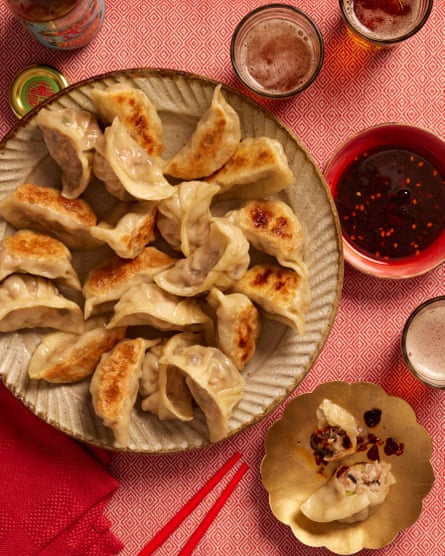
Gather your friends and family, and re-enact the dumpling-wrapping scene from Crazy Rich Asians. Depending on how big your wrappers are, and how generously you fill your potstickers, this amount of filling should easily make 40-50 potstickers. Hand-chopped chicken thighs are so much better than ready minced chicken, so if you have the time, I’d highly recommend it. Consider it a form of anger management.
Prep 15 min
Cook 45 min
Makes 40-50
500g boneless and skinless chicken thighs, or chicken mince
25g peeled fresh ginger, minced or very finely chopped
25ml light soy sauce
20g potato starch
20ml Shaoxing wine
1 tsp sugar
½ tsp salt
½ tsp ground white pepper
15ml sesame oil
200g rehydrated Chinese mushrooms (from about 30g dried), drained, squeezed dry and roughly chopped
50g spring onions, trimmed and finely chopped
Store-bought potsticker wrappers, from Chinese food stores and some large supermarkets (if you want to make your own, work with a ratio of 53% water to all-purpose flour)
Neutral oil, for frying
Chilli vinegar dressing, or chilli oil, to serve
Dice the chicken, then, using the back of the knife, hammer the meat until it’s broken down into a rough mince (or use the backs of two knives, one in each hand, and pretend you’re playing the drums).
Put the minced chicken in a stand mixer fitted with the paddle, then add the ginger, light soy sauce, potato starch, Shaoxing wine, sugar, salt and white pepper. Mix at a medium speed for about a minute, until everything is well combined, then pour in the sesame oil and mix at high speed for four to six minutes, until the mixture turns sticky and tacky. Add the chopped mushrooms and spring onions, then mix on a medium-low speed until they’re evenly incorporated into the meat mix. Scrape the filling on to a plate.
There are many ways to wrap a potsticker, but the most important thing is to seal the filling inside the wrapper so the juices stay inside when it’s cooking. Put about a teaspoon of the filling mixture in the centre of a wrapper, wet the edges of the wrapper with water, then fold over and seal (you’ll need less filling than you think, not least because overstuffed potstickers are hard to seal). Repeat with the remaining filling and wrappers.
Put a little oil in a large, hot frying pan for which you have a lid, then arrange the potstickers inside in a single layer, making sure they’re not touching; if need be, cook the dumplings in batches. Leave to fry gently on a medium-low heat until the bottoms start to take on some colour, then loosen the potstickers with a spatula and pour over just enough boiling water to come halfway up the sides of the potstickers. Immediately cover with a tight-fitting lid, then, still on a medium-low heat, cook for four to five minutes more. Uncover and cook until any residual liquid has evaporated and the bases of the potstickers are toasty brown and crisp.
Plate (or not: there’s something particularly satisfying about eating them straight from the pan, much like eating ice-cream out of the tub) and serve with chilli vinegar dressing or your favourite chilli oil for dipping.
-
Amy Poon is the founder of the Chinese heritage food brand Poon’s London