3 months ago
59
3 months ago
59
Some US athletes at the Winter Olympics in Milan and Cortina are speaking more openly than at any point since Donald Trump returned to the White House, describing a complicated mix of pride and discomfort about representing the country while political tensions at home and abroad spill into the Games.
The comments – and the fierce reaction they have triggered from political figures, online influencers and the president himself – have exposed a widening gap between how some athletes view their Olympic role and how parts of the political establishment believe they should use it.
Trump intensified the dispute on Sunday, saying it was difficult to support American athletes who publicly questioned his administration’s policies. He singled out freestyle skier Hunter Hess for criticism after the Oregon native said he felt “mixed emotions” about competing in the current political climate.
“Hess, a real loser, says he doesn’t represent his country in the current Winter Olympics,” Trump wrote on Truth Social, failing to convey the nuance of the skier’s expression. “If that’s the case, he shouldn’t have tried out for the team.”
The exchange has quickly become the most visible example yet of political friction surrounding the US team at the Milano Cortina Games, where athletes have largely avoided direct criticism of the Trump administration but now appear increasingly willing to discuss the tensions they are experiencing.
The shift has come as the Trump administration has taken a more aggressive posture internationally – including tariffs on key allies, military action in Venezuela and rhetoric about acquiring Greenland – moves that diplomats and analysts say have strained relations with traditional partners and contributed to a more politically charged atmosphere at the Games.
It has also unfolded against a visible political backdrop in Italy. Vice-president JD Vance spent five days in Milan attending multiple Olympic events, often alongside US secretary of state Marco Rubio in what at times felt like a soft-launch of the 2028 GOP presidential ticket. Vance took separate meetings with US athletes, Italy’s prime minister, Giorgia Meloni, and IOC president Kirsty Coventry, while drawing audible and sustained boos when shown on stadium screens during the opening ceremony (a reaction that appeared to be edited out of the telecast back in the US).
Athlete comments first drew attention during a news conference in Milan on Friday, when reporters asked the members of the US freeski team how they felt representing the country amid heightened immigration enforcement and domestic political division.
Hess said he saw a distinction between representing his nation and endorsing every policy carried out in its name.
“If it aligns with my moral values, I feel like I’m representing it,” he said. “Just because I’m wearing the flag doesn’t mean I represent everything that’s going on in the US.”
Fellow freestyle skier Chris Lillis struck a similar tone, saying he felt “heartbroken” about recent developments in US immigration policy while stressing that he still saw his Olympic appearance as a chance to represent a different vision of the country.
“I hope that when people look at athletes compete in the Olympics, they realize that that’s the America that we’re trying to represent,” he said.
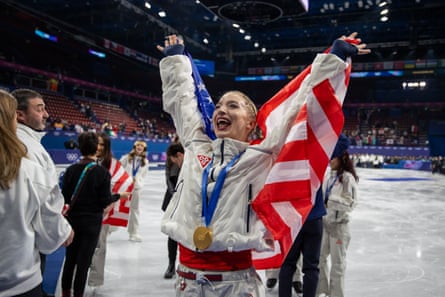
Figure skater Amber Glenn, days before winning an Olympic gold in the team event, said she believed LGBTQ+ Americans were facing a particularly difficult political moment. She later said she would be taking a break from social media after receiving what she described as a “scary amount” of hate messages and threats in the wake of her comments.
In response to questions, the US Olympic and Paralympic Committee (USOPC) said it was monitoring abusive online activity directed at athletes and working with social media platforms and law enforcement when credible threats emerged.
“The USOPC stands firmly behind Team USA athletes and remains committed to their well-being and safety,” the organization said.
The hostility has not been limited to current Team USA athletes. Team GB freestyle skier Gus Kenworthy, who previously represented the United States and won Olympic slopestyle silver in 2014, said he had received death threats after posting an image on social media criticizing US Immigration and Customs Enforcement.
“The other day I posted a photo with my thoughts on ICE and that photo has since gone everywhere,” Kenworthy said in an Instagram video posted on Sunday. “I’ve gotten a ton of messages and most of them honestly have been supportive and encouraging. But a lot of the messages have been awful – people telling me to kill myself, threatening me, wishing they’ll get to see me blow my knee or break my neck during my event, calling me slurs. It’s insane.”
Kenworthy, who will compete in the snowboard halfpipe in Livigno later in the Games, also voiced support for current US athletes who have spoken publicly about their discomfort with the political climate.
“I think sometimes people forget that you can love the US and be proud to be an American – I am – and still think they can be better,” he said. “Just because you love the US doesn’t mean you stand with this administration.”
The backlash has not been limited to the political sphere. Influencers and conservative commentators have also weighed in, including the YouTuber-turned-boxer Jake Paul, who criticized Hess on social media before attending a US women’s hockey game alongside Vance.
Former NFL quarterback Brett Favre, actor Rob Schneider and Florida congressman Byron Donalds were among public figures who also criticized athletes speaking out.
Richard Grenell, the Kennedy Center head who was the US ambassador to Germany during Trump’s first term, criticized Hess on social media, suggesting he “move to Canada if you aren’t proud to wear USA”.
“The guy said he has mixed emotions about representing America,” Grenell said. “[H]e is a loser for saying that while representing the greatest country in the history of the world.”
But many athletes have stopped short of directly attacking the administration, instead emphasizing a distinction between government and country.
Snowboard star Chloe Kim and cross-country skier Jessie Diggins have both spoken about representing what they describe as core American values – inclusion, opportunity and community – even while acknowledging political divisions.
Kim framed the moment through her family’s immigration story, saying recent events had “hit really close to home”.
“It is really important for us to unite and kind of stand up for one another with all that’s going on,” said the two-time Olympic halfpipe champion, whose parents immigrated from South Korea. “I’m really proud to represent the United States. It’s given my family and I so much opportunity. But I also think that we are allowed to voice our opinions of what’s going on. And I think that we should lead with love and compassion. And I’d love to see more of that.”
Diggins, who helped the US win a historic team sprint gold at the 2018 Winter Olympics and later added two individual medals in Beijing, said she saw her Olympic performances as representing Americans she believes are defined by empathy and community.
“I’m racing for an American people who stand for love, for acceptance, for compassion, honesty and respect for others,” Diggins wrote in an Instagram post. “For everyone out there caring for others, protecting their neighbours and meeting people with love – every single step is for you.”
Alpine skier Mikaela Shiffrin struck a similarly careful balance, saying it remained “an honor and a privilege” to represent the United States while adding she hoped to demonstrate values of diversity, inclusion and respect through her performance and public platform.
The tension has also intersected with protests in Italy linked to the presence of US immigration enforcement personnel supporting Olympic security operations. Demonstrations in Milan have drawn thousands of participants, with smaller groups clashing with police after rallies targeting the role of US immigration agencies abroad.
US officials and Italian authorities have emphasized that the personnel deployed are part of investigative units that typically assist with cross-border crime and athlete security rather than enforcement operations. Still, the optics have fueled criticism and reinforced the sense among some US athletes that domestic political debates are following them to the global stage.
The dynamic reflects a longer Olympic history of athletes navigating national identity and personal conscience, but the speed and scale of online reaction has given rise to new concerns about athlete safety and mental health.
Taken together, comments from several US athletes and former Olympians point to what many see as a defining tension of modern Olympic sport: representing a nation while maintaining individual political and moral beliefs.
“I’m representing my family, my community, the people who helped me get here,” Hess said. “That’s what wearing the flag means to me.”