3 months ago
68
3 months ago
68
Rare footage of a People’s Liberation Army (PLA) general who defied orders to lead his troops into Tiananmen Square and crush the 1989 student protesters has been leaked online, offering a highly unusual glimpse into the upper echelons of the military at one of the most fraught moments in modern Chinese history.
General Xu Qinxian’s refusal to take his troops from the PLA’s prestigious 38th Group Army, a unit based on the outskirts of Beijing, into the capital has been the stuff of Tiananmen lore for decades.
The six-hour video recording of Gen Xu’s court martial hearing the next year sheds light on the rare act of defiance. In the video, Xu said he refused because he did not want to become “a sinner in history”.
The video “confirms the legend about Xu Qinxian”, said Zhou Fengsuo, a leader of the Tiananmen demonstrations who now lives in exile in the US. “This is the first time that we have a clear first-person view of this period,” he added.
The source of the video is unknown. It was first posted online last month and has more than 1.2m views on one YouTube account alone. Wu Renhua, a historian of the Tiananmen movement who took part in the protests, was one of the first people to share it online. He said it was provided to him on one condition: that he keep his source secret.
Wu said the video was “perhaps the most important piece of data that I have gathered in my three decades of research”. He believes it is genuine as many of the details are corroborated by his separate research.
The demonstrations that gripped Beijing for weeks in the spring of 1989 ended with a bloody massacre in the early hours of 4 June, when PLA troops opened fire on civilians around Tiananmen Square, the 21.1 hectare (53 acre) central plaza of China’s capital. Hundreds, potentially thousands, of people were killed and the event remains one of the most sensitive in the Chinese Communist party’s rule over China. Discussion of the massacre is censored and there has never been any open or official reckoning with the events or the aftermath.
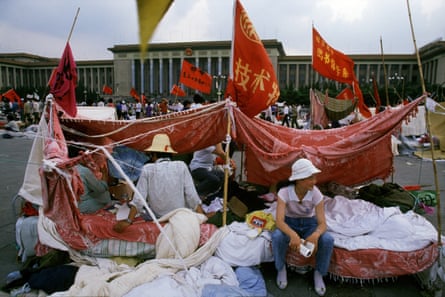
At the time, there were widespread rumours about dissent within the military. Zhou said many uniformed soldiers came to Tiananmen Square before 4 June to show their support for the protesters.
When the demonstrations started, Xu, who came from a working-class family of fruit and vegetable vendors, was in hospital recovering from kidney stones.
But on 18 May, he received orders to deploy his 15,000 troops to Beijing and impose martial law. In the video of his court martial, Xu explained his reservations. In a gruff, plain-spoken accent he said: “I said I had a different opinion on this matter. I said this was a mass political incident, and it should primarily be resolved through political means.”
He ultimately refused to carry out the order, although he did pass on the message. He said he told his superiors that if martial law was a failure, the commander who imposed it “might become a sinner in history”.
Joseph Torigian, an associate professor at American University and a historian of Chinese elite politics, said that the video showed the extent to which senior figures in China “exist in fundamentally ambiguous political environments”.
Xu’s testimony shows him grappling with what it means to be a loyal military general in a CCP-ruled system. He said he “worried about the potential for large-scale conflict or bloodshed”.
He said that, even if he had made a mistake, “whether a person is loyal to the party should be judged by their implementation of the party’s ideological and political line”, and that Chairman Mao and Deng Xiaoping had spoken about the importance of the party hearing differing opinions. Xu “seems to be struggling with himself about when exactly the right answer was”, Torigian said.
Tiananmen experts say one of the most important aspects of Xu’s testimony was that he questioned whether the decision to impose martial law could come from the Central Military Commission, which gave him the order. He said that such a serious matter should be discussed by China’s legislature, the National People’s Congress.
In the years since the massacre, the CCP has tightened its grip on the PLA and made it clear that the army serves the party, not any other authority. Torigian said: “The party knows and understands that its last line of defence for regime security and survival is the PLA.”
Loyalty in the PLA remains a preoccupation for the CCP. In recent months, Xi Jinping, China’s leader and commander-in-chief of the military, has purged several senior military leaders for alleged corruption violations.
Xu was expelled from the CCP and sentenced to five years in prison. He lived the rest of his life exiled from Beijing and died in 2021 at the age of 85.
Additional research by Jason Tzu Kuan Lu