3 months ago
71
3 months ago
71
All eyes are on Real Madrid again but in a different way than to which the 15-time Champions League winners are accustomed. Every fan expects Real to be among the best eight in Europe but they are in the playoffs for a second season in a row after a 4-2 defeat at Benfica in the final league fixture.
Looking back, Carlo Ancelotti’s impact at Real is even clearer, as is the case with Zinedine Zidane, who won three successive Champions League titles with the club. Why were they suited to this club? Because they themselves once stood on the pitch alongside outstanding footballers. Ancelotti also played under Arrigo Sacchi at Milan while Zidane scored key goals in Champions League and World Cup finals. People with this aura are respected by the best.
Ancelotti and Zidane have been part of packs brimming with talent throughout their professional lives. This enables them to assess accurately the qualities of top footballers as well as deal with their weaknesses. They have first-hand experience of what it takes to turn these characters into a unified team.
Xabi Alonso has the same profile. As a player, he was an institution in defensive midfield, winning everything with his club and national team. He is practically Ancelotti minus two decades of experience. Until now, Alonso had planned his career carefully. He knew what risk he was taking when he moved to Real. The experiment has failed but it has given him valuable knowledge for his future career.
At Leverkusen, Alonso had been the only star and enjoyed absolute authority at the club. Influenced by his own style of play he gave stability to the team, who in turn happily implemented his ideas, even if some aspects of their buildup play and possession were a little underdeveloped. After victories at the start of the season conviction turned into belief. Added to this was the fact that no one at the club expected titles. Under Alonso, Leverkusen won the German championship for the first time, achieving the double without losing a game.
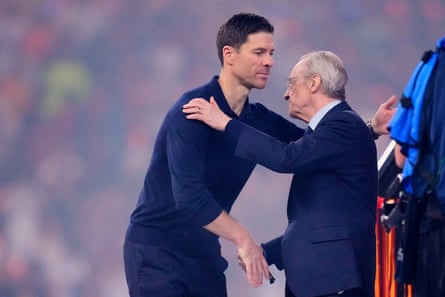
But Madrid are not Leverkusen. The spirit of Alfredo Di Stéfano, who inspired Real to five European Cup triumphs between 1956 and 1960, still wafts through the Bernabéu. Real are an even more radical form than Bayern, a players’ club. Florentino Pérez, the president, is a very powerful man who spends a lot of money on stars. Only in Saudi Arabia could Kylian Mbappé or Vinícius Júnior earn more. If one of his players doesn’t win the Ballon d’Or, Pérezthe president takes offence and refuses to attend the event.
Pérez considers Real Madrid coaches to be interchangeable, which makes this position the most challenging in world football. It is a feat to develop teamwork with the galácticos. What players from Leverkusen absorb, those from Madrid perceive as a restriction of their individuality and freedom.
Even José Mourinho, the Special One, struggled with these rules. Mourinho – now coach of Real’s opponents in the playoffs, Benfica – took up his post in 2010, at the peak of his career, having won the treble with Inter. He achieved his masterpiece when he knocked Pep Guardiola’s Barcelona out of the Champions League competition by “parking the bus” at the Camp Nou.
Mourinho stands for strong leadership. He considers his principles to be at least as important as the players. He also knew that the only way to defeat the all-powerful Barcelona was with his method. But Real are not a team that shut down the goal. To convince them of his tactics he was willing to use any means necessary. So he had them storm against Barça and run into the open knife, to prove to them that they wouldn’t win anything that way. Real lost 5-0.
The debacle helped Mourinho to push through his results-oriented thinking. He won the title and the 100 points they accrued that season remains a record in Spain. But while Mourinho’s style of football may be highly effective it is also stressful for the body and soul. Forcing Real to play defensively is simply not possible in the long run.
In 2013, shortly before Mourinho’s departure, his disillusioned and frustrated team lost a Champions League semi-final in Dortmund 4-1. In this embarrassing defeat, Xabi Alonso left the pitch after 80 minutes. So he personally experienced how risky it is to harass Real’s players with ideas that contradict their self-image.
It will now be interesting to see how Real reinvent themselves. To dominate Europe, special circumstances are needed. In the era that has come to an end, luminaries such as Sergio Ramos, Luka Modric, Toni Kroos, Karim Benzema and Cristiano Ronaldo complemented each other to form a whole that was even greater than the sum of its parts. That was the royal form of teamwork. However such a congenial mix of defence, midfield and attack is not presently available. Also a coach who has what it takes to manage Real, such as Ancelotti or another grand seigneur, is not on the market.
The best coaches around at the moment are Guardiola, Mikel Arteta and Luis Enrique. They have charisma, carry the gene of a great coach and have an active career to show for themselves. But they are ideologically inspired men of conviction, influenced by the Barça school.
Pérez therefore has a problem. He needs to step up his efforts in the transfer market and find players for midfield and defence so that a pack can form again, one that establishes its own order and hierarchy, one that sharpens its senses from game to game, from hunt to hunt. And one that is on a par with the Real of Di Stéfano, Ancelotti and Zidane.
Philipp Lahm’s column was produced in partnership with Oliver Fritsch at the German online magazine Die Zeit.