3 months ago
73
3 months ago
73
Juliana Conceição startled awake as the first shots of an infamous day were fired in the Complexo da Penha, the labyrinthine Rio favela where she was born and raised.
It was 4.30am on 28 October. Thousands of police had surrounded the community’s barricaded entrances and were preparing to swarm up its streets on foot and in black armoured personnel carriers with firing ports and bullet-cracked ballistic windows.
Clouds of smoke fouled the dawn air as drug traffickers torched tyres and cars and opened fire from above.
“It was like the shooting was inside our house … like we were in the middle of a war,” said Conceição, who sheltered indoors as her neighbourhood became a battleground.
By nightfall, the father of her six children, Ronaldo Julião da Silva, would lie dead in a nearby alley – one of 122 people killed in the deadliest police operation in Brazilian history. Five of the victims were police.
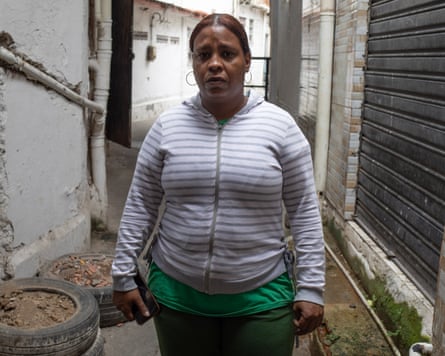
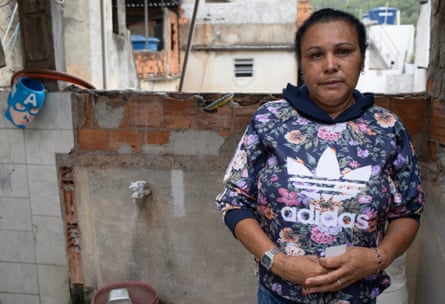
“It happened just down here,” Conceição said 10 days after the 17-hour raid, as she led the way down the passageway where her ex-husband was found, his skull and hand shredded by gunfire.
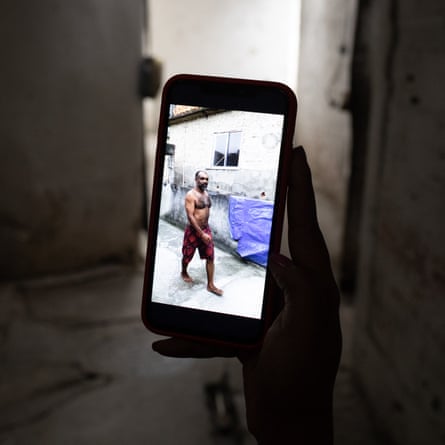
She carried a yellow certificate attributing Silva’s death – a day after his 46th birthday – to “cerebral and cardiac laceration [caused by] perforating blunt force”.
The bricklayer’s place of death was given as Saint Luke Square, the plaza at the foot of the favela where scores of bodies were dumped after police withdrew. But his life actually ended half a mile away, as he tried to reach his home on the favela’s southern rim. “My dad wasn’t a crook. My dad was a worker,” said his 20-year-old daughter, Ana Beatriz, wiping tears from her eyes.
Three months after the carnage of 28 October, many questions remain about Operation Containment, an incursion police chiefs and rightwing politicians celebrated as a historic blow to one of Brazil’s biggest organised crime groups – the Rio-born Red Command drug faction – but which activists, security experts, and even Brazil’s president, Luiz Inácio Lula da Silva, have called a futile massacre.
In more than two dozen interviews with community leaders, lawyers, security specialists and bereaved relatives, the Guardian pieced together the story of the bloodiest day in Rio’s modern history.
The investigation found that:
Of the 117 non-police fatalities, at least one person was not involved in crime, despite official claims that all those killed were traffickers.
The list of 100 arrest warrants justifying the operation featured none of the names of those 117 people.
In a sign of the Red Command’s rapid spread around Brazil, the majority of those killed were from regions outside Rio such as the Amazon states of Amazonas and Pará, the north-east and midwest.
Police refused to disclose the race of those killed but relatives, journalists and sources with knowledge of the forensic investigation said the vast majority were black, reinforcing research showing police violence disproportionately affects Afro-Brazilians.
Tracking ‘the Bear’
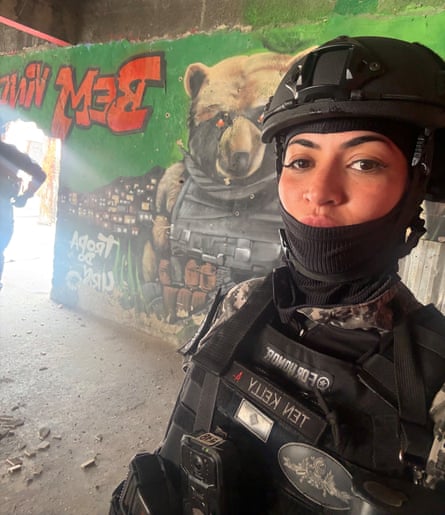
When Lt Kelly Patricia Camara da Silva, a 30-year-old member of a specialist high-risk military police unit called the Shock Battalion, woke at 3am on 28 October she had no idea she was about to face the most dangerous undertaking of her three-year career.
After 60 days of planning and a year’s investigation, police were preparing to launch a massive assault on the Complexo da Penha, which along with the neighbouring Complexo do Alemão, is considered the Red Command’s “national headquarters”.
One hundred arrest warrants had been issued, but the prime target was the local drug boss Edgar Alves de Andrade, AKA “the Bear”.
Police estimated the area was guarded by 800-1,000 traffickers armed with automatic rifles, explosives and grenade-launching drones. To outnumber them, 2,500 officers would be deployed – at least twice as many as in past operations.
Silva was the only woman commanding a unit that day and her seven-strong team was among the first groups to enter the Complexo da Penha at about 5am. Their task was climbing the favela’s steep, narrow alleyways to contain armed resistance so colleagues could follow and make arrests.
“The higher you go, the riskier it gets,” said Silva, whose target was Vila Cruzeiro, one of 13 communities forming the complex. “These favelas are on hillsides so when we’re at the bottom, we can’t see anything – but [the traffickers] have a full view of us from above.”
Barricades blocked almost every route. Where armoured vehicles could no longer advance, police continued on foot.
As Silva’s team progressed past murals honouring fallen Red Command members, many of the Bear’s foot soldiers melted into the bush above the community, apparently hoping to flee to safety in Alemão by crossing the Serra da Misericórdia, the Hill of Mercy, a vast rocky massif covered in Atlantic rainforest.
At about 6.50am, dozens of heavily armed criminals wearing black or camouflage outfits almost identical to police uniforms were filmed climbing a concrete staircase into a scrubland area known as Vacaria that is part of the Hill of Mercy. Most of them would never be seen alive again.
‘We’re surrounded!’
At around the same time, Erivelton Vidal Correia, a community leader, took advantage of a lull in the shooting and rushed to Vila Cruzeiro’s neighbourhood association near Saint Luke Square.
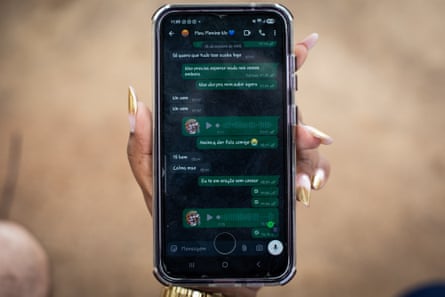
Outside, huddles of women – the mothers, sisters and partners of men involved in the local drug trade – had gathered seeking news. As the battle raged, Correia served coffee and comforted the women as their phones filled with WhatsApp messages from their besieged loved ones: We’re surrounded! We’re trapped! The police are here! See if you can come and find us!
One of those looking for her child was Tauã Brito, a 36-year-old salesperson, whose 20-year-old son, Wellington Brito Santos, was hiding in the forest.
Brito had raised Santos with help from her grandmother. “I’m a black woman from the favela struggling to raise her kids,” she said. “I always tried to do my best … within my financial situation.”
But four years ago Santos joined the gang – and it was he who warned his mother of the police’s arrival. “The operation has started,” he texted her at 4.45am.
Ten minutes later she replied, urging him to pray and remember Psalm 91. “Surely he will save you from the fowler’s snare and from the deadly pestilence,” it says. “He will cover you with his feathers, and under his wings you will find refuge.”
“Yes Mum,” Santos wrote back.
Soon after, Santos was one of the traffickers filmed climbing the staircase towards Vacaria. “You need to get it together,” his mother texted as he hid in the scrub. “I know mum,” he replied at 7.23am.
“It feels like I’m going to have a heart attack, Wellington. You don’t need this,” she went on, suggesting they leave the favela and start afresh. “I want to turn 21,” he said.
The last message Brito received came an hour later, at 8.22am. “I’m OK. Stay calm Mum,” Santos said.
“I’m praying non-stop,” she answered. There was no reply.
The wall
As they took flight across the Hill of Mercy, Wellington and his companions didn’t know there was no way out.
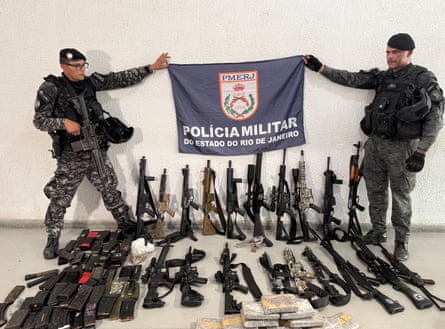
Under the cover of darkness, dozens of officers from the elite military police unit Bope – whose troops are called “skulls” for their dagger-pierced skull insignia – had climbed the mountain from the other side.
Wearing fluorescent green armbands to distinguish themselves from the traffickers, they took up position at the summit hoping to solve a problem they had faced in dozens of previous operations: whenever police entered Alemão or Penha, the traffickers would simply flee through the forest to other side.
Previously, police commanders had judged occupying the Hill of Mercy too risky. That day, for the first time, they decided to change tactics.
As planned, Sgt Jorge Martins’s team reached the hilltop at dawn to form “a wall”. “But sometimes things don’t always go the way we imagine,” he said.
As clusters of traffickers and police did battle on different parts of the mount, the situation began to spiral out of control.
At about 8.20am, a member of the dog unit was shot in the leg near a cluster of shacks known as the Promised Land.
An hour later, a group of civil police officers were attacked as they chased a group of traffickers into Vacaria. One officer was shot in the hand. A second in the belly. A third in the head.
The Bope team abandoned their positions to rescue their colleagues. “When we got there, that’s when things really started to heat up,” Martins said.
From then on, “it stopped being an operation to execute warrants and became a full-scale rescue mission”, the Bope commander, Lt Col Marcelo Corbage, later told the public prosecutor’s office.
‘Welcome to the jungle’
Not far away, Silva’s team had reached part of the favela called Cabaré, just outside the forest, which investigators believed housed one of the Bear’s main strongholds – a place they called his “lair”.
In a sign “the lair” was nearby, Silva spotted a mural showing a rifle-toting bear in a bulletproof vest and the warning: “Welcome to the jungle.” She took a selfie. “We knew it was a very hot area, that something could happen there.”
At about 9.40am it did. Word reached Silva’s team that a resident had been taken hostage by 26 traffickers who had stormed her home. Police shot one man dead and Silva began negotiating with the rest, even though her team was badly outnumbered – 14 officers versus 25 criminals. “I don’t think they really understood what was happening … If they’d realised they might have an advantage, the situation could have changed.”
Fearing execution, the men forced the homeowner to record their surrender. “You can come out, you’re not going to die … no one’s going to shoot,” an officer claimed as a cameraman filmed the scene. One by one, shirtless young men emerged and were arrested.
Chaos in the woods
But up on the Hill of Mercy, the gunfire never stopped. “You hear the shots, try to locate them, but then fire comes from the other side and, even with training, you get disoriented and can’t process it,” said Martins.
At 4pm, his team ran into a group of traffickers as they advanced through the forest. Martins was struck in the calf and a colleague in the leg. “I thought: ‘If I got hit, the guy can see me.’ So I threw myself down a slope with my colleague and we rolled … It was a serious wound but I thought: ‘I’m not going to die from this one,’” he said.
Both men were eventually rescued by an armoured ambulance and survived but two other Bope officers died from gunshot wounds. Three civil police officers also died while 14 police officers were injured. Never before in Rio had so many police been killed or wounded in a single operation. Most were hit on the Hill of Mercy – as were the vast majority of civilians killed.
A source close to the investigation questioned police claims that all those killed in the forest died resisting arrest. “If what the police say is true – that they were dealing with criminals who knew the area extremely well, who were hidden and entrenched – how is it possible that … despite the considerable number of officers killed, the number of dead criminals is so disproportionately higher?” they asked.
The source could not rule out a story circulating in the favela that, after rescuing their wounded and retrieving their dead, police killed every trafficker they could find on the hill as an act of revenge. The police vehemently deny this account.
‘Ronaldo’s dead’
Ronaldo Julião da Silva, a bricklayer, had spent nearly the whole day at the house of his sister, Vera. He feared being found at home by police and confused with a trafficker, with possibly fatal consequences. “Whenever there’s an operation he comes here to sleep,” said Vera, recalling how Silva passed the time chain-smoking on her roof.
At around 4pm Silva’s niece photographed her uncle on the veranda and sent his daughter the picture to show he was safe.
By about 7pm – more than 12 hours after the operation began – the shooting had subsided and Silva set off towards his house, near the edge of the forest, about five minutes’ walk away.
“He left and didn’t come back,” said Vera, 49, standing on the terrace where she last saw him. Residents say police shot Silva dead in an alley about 500 metres from his home. A friend broke the news to relatives: “Ronaldo’s dead.”
Authorities have insisted all of the 117 fatalities were criminals. “The only victims were police,” Rio’s rightwing governor, Cláudio Castro, told journalists. In a report submitted to the supreme court, police called those killed “neutralised opponents”.
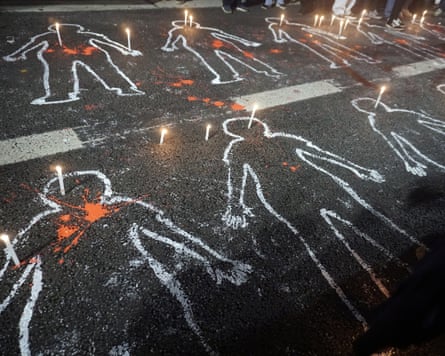
But Silva’s relatives are adamant he was not involved in crime. None of the 117 people killed were on the arrest warrant list justifying the operation. Even if they had been, Brazil does not have the death penalty.
Police later admitted 17 of those killed – including Silva – had no criminal record but claimed there were “indications” some were involved in crime. One man had posted a red triangle emoji supposedly symbolising the Red Command. Another had posted nothing since 2022, something officers took as proof of evidence concealment.
Of the operation’s 100 arrest warrants, only 17 were executed. The Bear remains at large.
Searching for the dead
As the last police vehicle was filmed leaving the favela at about 10pm, local women began hiking into the forest to find their men. Many hailed from the Amazon state of Pará, more than 1,200 miles (2,000km) to Rio’s north, which has become a major Red Command base because of its strategic location on one of South America’s most important cocaine smuggling routes.
Correia, the community leader, joined the searchers as they entered Vacaria, using mobile phone flashlights to navigate the boulder-strewn bush.
Almost immediately, they started seeing bullet-riddled bodies, many with horrific injuries. One 19-year-old, later named as Yago Ravel Rodrigues, had been decapitated, his head displayed on a tree.
“The women were shouting, they cried – and they were focused. The more [bodies] they found, the more they pushed on and the more they found,” said Correia, recalling how searchers relied on moonlight when their phone batteries died.
Tauã Brito was there and, at just after 1am, found her son near the stairway the traffickers were filmed climbing. “He’d been stabbed in the arm and shot in the head,” she said. One arm had a cord attached to it, as if his hands had been bound.
All night long, corpses were hauled out in sheets and stretchers. Pickups ferried them to Saint Luke Square, where they were placed on tarpaulins outside Correia’s office.
Some wore camouflaged ghillie suits, which locals cut off and discarded in a wheelie bin. Ronaldo Julião da Silva sported the same red shorts he was wearing when last seen alive.
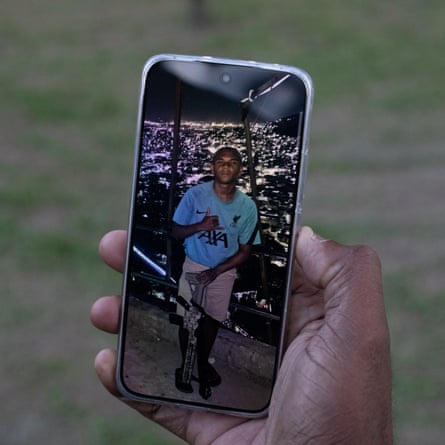
The dead included 14-year-old Michel Peçanha, who a family friend said had worked selling sweetcorn to tourists on Copacabana beach before joining the gang a few months earlier. “He wasn’t some kind of narco-terrorist,” insisted Edson Soares, a preacher who knows Peçanha’s father. “He didn’t even know how to shoot a gun.”
By 9am, more than 60 bodies lay there and broken-hearted women sat cradling the heads of their broken men.
“It’s evil. They kill for pleasure,” Tauã Brito said of the police as she guarded her son’s corpse. “They don’t do anything for the kids or for the community. This is all they know how to do.”
‘An infinite war’
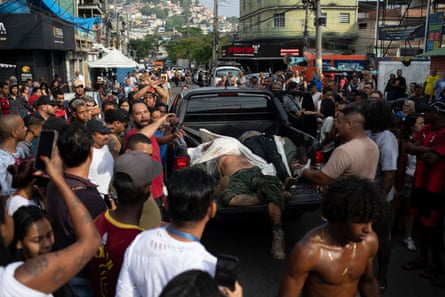
The activists in Vila Cruzeiro that morning voiced outrage at the bloodbath, even more lethal than 1992’s Carandiru prison massacre in São Paulo when 111 inmates died. Many demanded the removal of Governor Castro, who has overseen three of Rio’s deadliest police operations since taking power in 2020.
The former police chief Orlando Zaccone claimed the operation showed how the longstanding but illegal police tactic of “Trojan horse” attacks – where officers ambush targets from buildings, cars or trees – was now official policy. “The objective wasn’t to execute arrest warrants. The objective was to kill armed traffickers,” Zaccone said, something police deny.
Tauã Brito and others also question why their loved ones were killed, not arrested. “The aim was to kill everyone who tried to escape – and that’s exactly what was done. All of those boys were executed,” said Brito, who recently left the favela and moved to a beach town 100 miles away hoping to escape her pain. “There isn’t a single place in Penha where I don’t remember my son, where I don’t see Wellington,” she said, tears rolling down her cheeks. “A piece of me is missing.”
In the weeks after the operation, it became clear the purge had strengthened Rio’s governor, with polls suggesting widespread public support.
The civil police chief, Felipe Curi, claimed favela residents were crying out for more such operations. Curi, who was shot in Alemão in 2016, insisted the officers had acted in self-defence. Curi also claimed, without proof, that traffickers had decapitated Yago Ravel Rodrigues “to incriminate the police”.
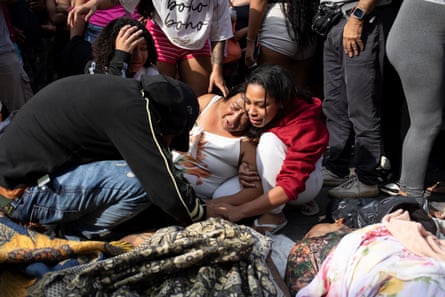
So far at least nine police officers have been charged over alleged offences on the day of the operation, including stealing a rifle, car parts and a mobile phone. Five of them have been arrested.
The public prosecutor’s office is still investigating other possible police crimes – a challenge since, despite all officers being legally required to wear body cameras during operations, fewer than half were. Even so, there are about 3,000 hours of footage to review.
The late civil rights lawyer Paul Chevigny, a pioneer in the study of police brutality, argued that when civilian deaths outnumber those of officers by 10 or 15 to one, it is an “almost unequivocal” statistical sign that lethal force is being used punitively, not defensively. In Penha, the ratio was 23 to one. “This is a disparity that raises serious concern,” said Paulo Roberto Mello Cunha, one of the prosecutors investigating police conduct.
“The police’s purpose is not to ‘neutralise’ people, but to arrest criminals,” Cunha added. “We will only be able to call the operation a success if I can state that all who died were in situations in which officers acted in legitimate self-defence.”
Authorities called the operation the greatest blow to the Red Command since it was founded in the 1970s in an Alcatraz-style prison nicknamed the “Cauldron of Hell”, although a police intelligence chief conceded it would have a “minuscule” impact.
When the Guardian returned to the Complexo da Penha a fortnight after the shootings, there was no sign of change. The gunmen were back. The barricades rebuilt. Drugs were on sale. Red Command signs ordering residents not to drop litter adorned the streets. Across Rio, the faction still rules hundreds of other favelas, controlling an area almost the size of Sheffield or Washington DC.
While the bodies have been removed from outside his office, Correia was still processing what he called the most traumatic day in his 48 years of favela life.
The community leader was certain of one thing: Rio’s conflict would never end. “You kill 100 traffickers and tomorrow another 100 will appear. Four police die today and tomorrow there will be four more in their place,” he said. “It’s an infinite war.”
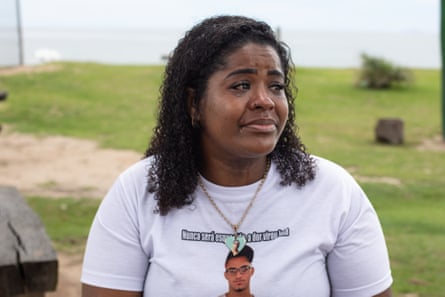
Additional reporting by Melissa Cannabrava in Rio de Janeiro