2 months ago
44
2 months ago
44
The first time Lucian Mîndruță crashed his car, he swerved to avoid a village dog and hit another vehicle. The second time, he missed a right-of-way sign and was struck by a car at a junction. The third time, ice sent him skidding off the road and into two trees. Crashes four to eight, he said, were bumper-scratches in traffic too minor to mention.
That Mîndruță escaped those collisions with his life – and without having taken anyone else’s – is not a given in Romania. Home to the deadliest roads in the EU, its poor infrastructure, weak law enforcement and aggressive driving culture led to 78 people per million dying in traffic in 2024. Almost half of the 1,500 annual fatalities are vulnerable road users such as pedestrians and cyclists.

“I was not careful enough, driving slowly enough, or really aware enough,” said Mîndruță, a journalist and radio host in Bucharest, whose last serious crash was 20 years ago. “I’ve learned the hard way.”
Cars are the biggest killer of children and young adults worldwide but efforts to save lives have struggled to attract public or political attention. Even in Europe, where fatality rates are low by global standards, five times more people are killed in car crashes than murdered. The EU is on track to miss its target of halving road deaths by 2030.
As public frustration with dangerous driving has mounted, the Romanian government has taken its first serious steps to make roads safer. Last year, it defined aggressive behaviour – such as tailgating and intimidating other drivers – in law and increased penalties for dangerous driving. A network of speed cameras is being introduced alongside a system to automatically detect traffic violations.
“Things are moving,” said Alexandru Ciuncan, the president of the Coalition for Road Safety (RSC), a group campaigning for road safety in Romania. “Not with the speed that we want, but we’re glad that something is happening now.”
There are signs of progress. The death rate on Romania’s roads fell slightly in 2024 to an average of four people a day, with a further nine people a day seriously injured. New police data shows the downward trend continued in 2025, with deaths falling by 13% and serious injuries by 4%.
Yet structural change remains elusive. In October, the European Commission sent Romania a letter of notice to properly implement its road safety directive. Campaigners complain of a pervasive “selfish” driving culture and fear changing mindsets will take more than a decade. In May, the country held its first road safety awareness week.
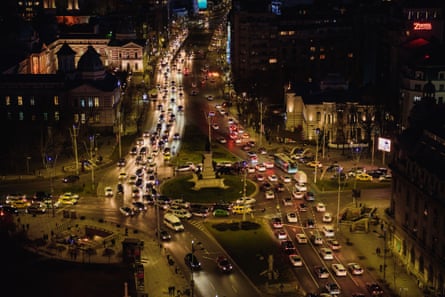
In the jam-packed, rush-hour traffic that fills the smoggy streets of Bucharest – the second-most polluted capital in the EU, according to the European Environment Agency – an aging car fleet often running on diesel fuel compounds the health risks from reckless driving.
Traffic is responsible for 60% of the city’s air pollution, according to the Environmental Platform for Bucharest, and the prevalence of old imported cars, with dirty exhaust pipes and few safety features, increases the death toll from both smog and crashes.
Raul Cazan, the president of 2Celsius, an environmental nonprofit, said imported “clunkers” often suffered from wear and tear, and lacked modern safety features such as electronic stability control and advanced airbags.
“You’re not only importing pollution from the west,” he said. “You’re also importing danger.”
Europe’s roads have grown safer over decades but progress has stalled in recent years, and the SUV boom threatens to reverse progress. The average bonnet height in new car sales in 2024 rose from 77cm (30in) in 2010 to 84cm (33in), with associated dangers for vulnerable road users.
In Romania, a major manufacturer of parts for the German automobile industry, SUVs make up about half of the new cars registered, and dominate online listings for used cars. The influx will lead to a more modern vehicle fleet but the vehicles’ extra mass and their drivers’ reduced vision is likely to undermine the benefits.
“All other things being equal, ever-bigger cars reduce safety for all other road users,” said James Nix from Transport & Environment, a Brussels-based nonprofit. “Increasing width is likely to bring more sideswipe crashes. Higher bonnets impair vision and increase injury severity in the overwhelming majority of collisions.”
Analysis of police data by the RSC found speeding was the biggest cause of deaths in 2024 and “pedestrian indiscipline” – such as jaywalking – the main factor listed in serious injuries. In the countryside in particular, a lack of safe crossings and pavements contributes to rural areas having double the fatality rate of urban areas. Almost half of deaths happen on high-speed national roads that cut through communities.
Mîndruță, an amateur cyclist who has lost friends to car crashes, said driving in other countries made him realise how rewarding it was to drive with care for his own safety and that of others.
Being an individualist on the road was really not good for your health or your soul, he said, looking back at the collisions in which he was involved. “Killing somebody else would have been a nightmare.”