3 months ago
83
3 months ago
83
Four dead after Russian strikes on Ukraine overnight amid reported US pressure on Ukraine to end war
At least four people died in overnight Russian strikes on Ukraine, as Moscow shows no signs of compromise just two weeks before the fourth anniversary of the full-scale aggression.
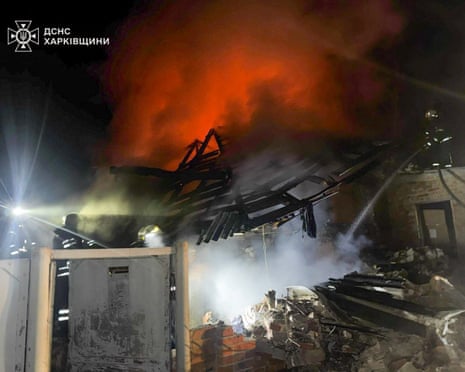
129 Russian drones were identified overnight, the Ukrainian air force said, adding that of these 112 were shot down or neutralised, Reuters reported.
There are now growing hints of US pressure on Ukraine to end the war as soon as possible and preferably before the summer, even at the cost of accepting far-reaching concessions.
On Monday, Matthew Whitaker rejected Ukraine’s claims that the US set a deadline to end the war by June, saying “I don’t think that is anything that the United States has put out there” (Europe Live, Monday).
But Financial Times reported (£) overnight that Ukraine is working on holding presidential elections and a referendum on peace deal, potentially as early as in May, with Washington pressing Kyiv to move as quickly as possible or risk losing critical security guarantees.
The paper pointed out that holding the election would be a major departure from Volodymyr Zelenskyy’s previously repeated suggestions that it was impossible, or at least impractical, to do it during an active war, with many voters either displaced or in active service struggling to take part.
FT suggested that Zelenskyy could announce the plan as early as on 24 February, the fourth anniversary of the full-scale aggression, but its actual implementation would still be conditional on the progress made in talks with Russia, with Moscow not showing signs of dropping its maximalist demands.
Key events Show key events only Please turn on JavaScript to use this feature
Russia will take 'countermeasures, including military ones' if west increases footprint on Greenland
Meanwhile, Russia’s foreign minister Sergei Lavrov warned that Moscow would take military “countermeasures” if the west boosts its own military footprint on Greenland.
“Of course, in the event of the militarisation of Greenland and the creation of military capabilities aimed at Russia, we will take adequate countermeasures, including military-technical ones,” Lavrov said in a speech to Russian lawmakers, AFP reported.
Norway defence chief says Russia could invade to protect nuclear assets

Shaun Walker
in Bergen
Meanwhile, Norway’s army chief has said Oslo cannot exclude the possibility of a future Russian invasion of the country, suggesting Moscow could move on Norway to protect its nuclear assets stationed in the far north.
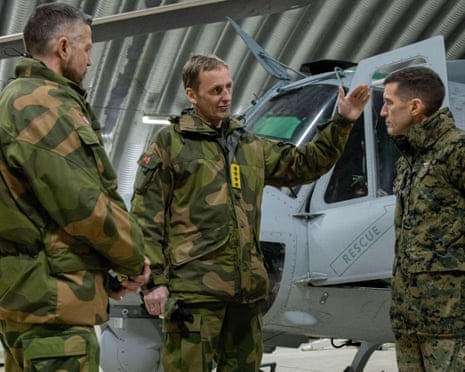
“We don’t exclude a land grab from Russia as part of their plan to protect their own nuclear capabilities, which is the only thing they have left that actually threatens the United States,” said Gen Eirik Kristoffersen, Norway’s chief of defence.
He conceded that Russia did not have conquest goals in Norway in the same way as it had in Ukraine or other former Soviet territories, but said much of Russia’s nuclear arsenal was located on the Kola peninsula, a short distance from the Norwegian border, including nuclear submarines, land-based missiles and nuclear-capable aircraft. These would be crucial if Russia came into conflict with Nato elsewhere.
“We don’t take that off the table, because it’s still an option for Russia to do that in order to make sure that their nuclear capabilities, their second strike capabilities, are protected. That’s sort of the scenario in the high north that we plan for,” he said.
Kristoffersen said that while Norway was keeping the threat of a traditional Russian invasion in mind, the current Russian tactics were more diffuse.
“If you prepare for the worst, there is nothing that prevents you from also being able to counter sabotage and more hybrid threats,” he said.
He added, however, that Norway and Russia still maintained some direct contact over search and rescue missions in the Barents Sea, and that there were regular meetings at the border between representatives of the two militaries.
He has recommended setting up a military hotline between the two capitals to have a channel of communication to avoid escalation based on misunderstanding. He said Russian actions in the far north had generally been less aggressive than those in the Baltic Sea.
Four dead after Russian strikes on Ukraine overnight amid reported US pressure on Ukraine to end war
At least four people died in overnight Russian strikes on Ukraine, as Moscow shows no signs of compromise just two weeks before the fourth anniversary of the full-scale aggression.
129 Russian drones were identified overnight, the Ukrainian air force said, adding that of these 112 were shot down or neutralised, Reuters reported.
There are now growing hints of US pressure on Ukraine to end the war as soon as possible and preferably before the summer, even at the cost of accepting far-reaching concessions.
On Monday, Matthew Whitaker rejected Ukraine’s claims that the US set a deadline to end the war by June, saying “I don’t think that is anything that the United States has put out there” (Europe Live, Monday).
But Financial Times reported (£) overnight that Ukraine is working on holding presidential elections and a referendum on peace deal, potentially as early as in May, with Washington pressing Kyiv to move as quickly as possible or risk losing critical security guarantees.
The paper pointed out that holding the election would be a major departure from Volodymyr Zelenskyy’s previously repeated suggestions that it was impossible, or at least impractical, to do it during an active war, with many voters either displaced or in active service struggling to take part.
FT suggested that Zelenskyy could announce the plan as early as on 24 February, the fourth anniversary of the full-scale aggression, but its actual implementation would still be conditional on the progress made in talks with Russia, with Moscow not showing signs of dropping its maximalist demands.
Morning opening: Ms von der Leyen, tear down these barriers

Jakub Krupa
European Commission president Ursula von der Leyen insisted this morning that the EU needs to “tear down” the economic barriers that prevent it from becoming “a global giant” and deepen its internal market, as she kicked off 48 hours of intensive discussions on the bloc’s economy.
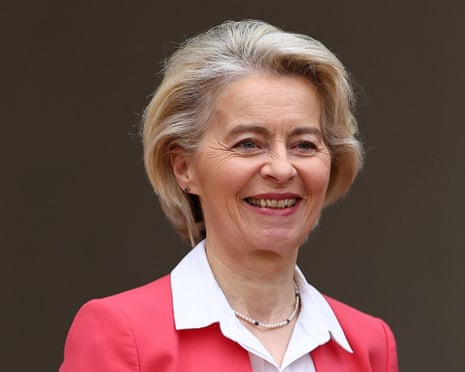
A number of EU leaders will meet today at an industry event in Antwerp, before they meet again tomorrow morning for a pre-summit discussion ahead of an informal summit proper later that tonight.
Addressing a largely empty hemisphere of the European Parliament in Strasbourg, von der Leyen said the bloc needed “to tear down the barriers that prevent us from being a true global giant,” as she warned that the current system amounts to “fragmentation on steroids” with many different, and potentially conflicting, legal regimes.
“We have the second largest economy in the world, but we are driving it with the handbrake on, and the good news is this can be fixed, but we need single minded focus on the single market, and we need to tear down barriers one by one,” she said.
Von der Leyen warned that “competitiveness is not just the foundation of our prosperity, but of our security, and ultimately, of our democracies too.”
The European Commission is planning to move forward a number of proposals, including its “EU Inc.” regime, which would allow people to register a company in any member state within 48 hours, fully online, and help with crossborder operations.
“This is the speed we need, and this is Europe made easy,” she said.
The commission wants a plan to be agreed by March and implemented by the end of next year.
But it’s fair to say that other leaders have some competing ideas, with a particularly strong anti-bureaucracy coalition forming around German chancellor Friedrich Merz and Italian prime minister Giorgia Meloni, so expect their voices to feature prominently in this debate. French president Emmanuel Macron also outlined his thoughts on this yesterday (Europe Live, Tuesday).
I will follow this closely for you.
Separately, I will bring you the latest on Ukraine, with EU defence ministers meeting in Brussels to discuss the situation in the country ahead of tomorrow’s separate Nato meeting, and more news from across the continent.
It’s Wednesday, 11 February 2026, it’s Jakub Krupa here, and this is Europe Live.
Good morning.