2 months ago
60
2 months ago
60
A new cargo and passenger ferry service directly linking Scotland and France could launch later this year as the port of Dunkirk embarks on a €40bn (£35bn) regeneration programme it claims will mirror the second world war resilience for which it is famed.
The plans could include a new service between Rosyth in Fife and Dunkirk, eight years after the last freight ferries linked Scotland to mainland Europe, and 16 years after passenger services stopped.
Political and industrial leaders have laid out their Dunkirk plans, already backed by about €4bn (£3.5bn) in private and public investment, that will lead to the 60-year-old port area being transformed into a vast hub including low-carbon energy projects, battery factories and maritime logistics to cater for the new industrial era.
“We are betting on the energy and ecological transition to redevelop an industrial region,” the former transport minister and second-time mayor of Dunkirk, Patrice Vergriete, said on launching a plan for the area over the next four years.
Redevelopment at the port, just north of Calais, is being closely watched around Europe as a potential model for reindustrialisation for communities hollowed out by the closure of heavy and dirty industries including coal.
Marie-Pierre de Bailliencourt, the director general of the Paris-based thinktank Institut Montaigne, described the area as a “laboratory” and “testing ground for European industrial renewal”.
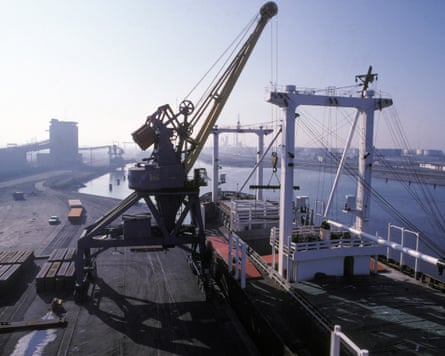
Vergriete said Dunkirk, the site of the huge allied evacuation in the second world war, was “a fairly good representation of what deindustrialisation has been like in western Europe”, with thousands of jobs in heavy industry in the postwar years down to just a few hundred by the 1980s.
“Not many regions in western Europe have done this: aligning around the same goal and the same vision, betting on the energy and ecological transition to redevelop the industrial region,” he said.
While Portsmouth and Dover were attempting to overcome physical barriers to growth, and were then hit by Brexit, Dunkirk – seen as a poor cousin of Calais – set about redefining its future. It harnessed the opportunities of being a maritime port but also the transition to decarbonisation, starting with Verkor’s car battery factory, which opened in December, and the French company’s partnership with the Renault Alpine sports car brand to work on developing a hydrogen fuel car at the Dunkirk site.
At the same time, the steelmaker ArcelorMittal is pressing ahead with the switch from blast furnaces to electric arc furnaces in Dunkirk, a move supported by €850m in French subsidies.
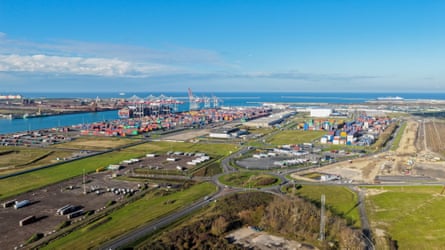
“Dunkirk is at the forefront of industrial revitalisation efforts in France and, more broadly, in Europe with decarbonisation on the one hand and the establishment of new, related industries on the other,” said a report on the town by Institut Montaigne in December.
At the centre of the transformation is a €1.7bn industrial revamp of a contaminated swathe of land once occupied by a refinery destroyed by the Germans in the second world war that was later reopened but eventually closed in 2010.
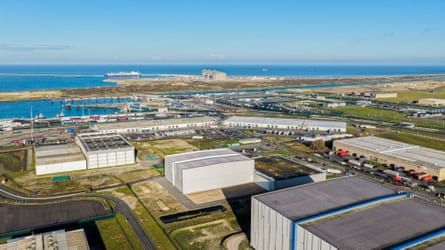
After the completion of a five-year clean-up of the soil, a French company, Technip Energies, will now move on to the land to open a battery factory and biofuel for aviation production plant alongside specialised import-export terminals to be run by the local Tepsa logistics site.
At the same time, Dunkirk port is expanding routes and tying in with a new €25m rail terminal to help the shift from truck to train and further reduce carbon emissions.
The Scottish route would initially involve one ship sailing to France three times a week from Rosyth, north-west of Edinburgh. It was previously reported that the route could be rebooted as early as this spring, but it is now expected later this year and could be run by the Danish-headquartered operator DFDS.
Freight-only services between Rosyth and Zeebrugge in Belgium ended in April 2018. Passenger services stopped in 2010, with Scottish travellers’ nearest option for ferries in Newcastle, which has daily 16-hour crossings to Amsterdam.
Daniel Deschodt, the deputy chief executive of the port of Dunkirk, said he hoped the route, which could involve a 20-hour sailing, would be popular with Scottish rugby fans, including for the Six Nations tournament early next year.
Plans for the revival of the route have been discussed for some time but require new post-Brexit border facilities for veterinary checks to be built as well as passport controls.
The Scottish agriculture minister, Jim Fairlie, announced a consultation in November to restart the route, with a plan to dock EU imports in Rosyth and carry out checks 20 miles away in Grangemouth.
The extra ferry route to Scotland is among several new routes planned at Dunkirk, including services to the Nordic countries and expansion of business with South America. One in four pineapples and bananas in France already come from Colombia via Dunkirk.
Dunkirk is also developing a hub that will capture and liquefy carbon emissions from industry all over Europe for export to stores, potentially including facilities in Scotland.