3 months ago
59
3 months ago
59
It is rare to watch a fictional romance and feel genuinely invested in the question of will-they-won’t-they – and even rarer for it to reflect familiar relationship turbulence. Many love stories on TV skip straight to wish-fulfilment, delivering instant chemistry, no challenges that can’t be overcome within the runtime and glib reassurance that Love Conquers All.
Netflix’s Nobody Wants This, for instance – based on a real couple, and ostensibly exploring whether a relationship can survive differences of faith – didn’t wait to resolve that question before bringing its leads together. In real life, promising connections fall at much lower hurdles, for such banal reasons as incompatible schedules.
So I’ve been thrilled to stumble upon a series that is not only redolent of real-life love, but understands that payoffs must be earned. The New Years (Los Años Nuevos), a Spanish miniseries streaming on Mubi, makes every other TV romance look as if it was scripted by AI; I’d say it is close to perfect.
Over 10 episodes, each set on New Year’s Eve, it follows the evolving romance of Óscar and Ana, from hooking up, to falling in love, then – gradually, in familiar ways – coming apart. Despite the decade-long scope, it’s not an especially grand love story; it is more truthful, exploring a formative connection and its ebbs and flows over time. Think Normal People or One Day, set in Madrid.

When we meet Óscar (Francesco Carril), on the last day of 2015, he is preoccupied by medical school and morose after a breakup. Free-spirited Ana (Iria del Río) hasn’t yet found her path but has big plans of moving abroad. Both are turning 30, and initially bond at a mutual friend’s house party over the fact their birthdays fall either side of the New Year.
Of course they get together – but not at once. When their hookup is cut short by Óscar’s on-off ex, it’s a year until they reconnect; a year after that, they’re in a relationship but still getting to know each other. The stop-start trajectory is more true to life than instant fireworks (who hasn’t had some loose ends to tie up?) and brings the audience along on their deepening bond.
Óscar and Ana are not just playing their parts in “boy meets girl”, going through the motions until they are granted their happy-ever-after, but individuals with their own ambitions, hangups and fears. Their somewhat stilted early encounters highlight their differences as much as their chemistry: Óscar is inclined to be dour, and also to worry about being perceived as dour, such as when he frets about what music to play during their first intimate encounter (relatable!). Ana, though not as confident as she appears, is independent, headstrong and sometimes selfish: when her friends throw her a birthday surprise, she ditches them for a party.
These naturalistic details give The New Years a wonderfully lived-in feel. As the years go by, traditions are carried over, such as eating grapes at midnight; but characters change as they reappear: a friend will go from racking up lines of cocaine in one episode to being exhausted by new parenthood the next. Likewise, by dropping in on a single day, we see how Óscar and Ana’s relationship has developed in the previous 12 months through changes in the way they navigate conversation, domestic challenges and familiar frustrations with family.
Over time they learn to accommodate each other, then grow together. Óscar initially rejects Ana’s armchair analysis of the impact of his upbringing; a year later, we see he has adopted her view. And along the way, naturally, there’s lots of sex – which, though explicit, resembles actual sex, with awkward manoeuvring, laughter and varying levels of passion.
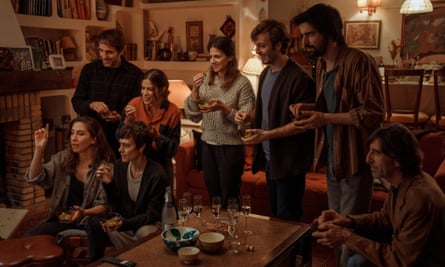
By episode four, the couple are living together, still charmed by each other’s idiosyncrasies (she clips her nails on the couch; he pees sitting down) and crowing to their parents about their effortless division of labour. Their parents humour them, opting to let time teach them the lesson that the course of true love never did run smooth.
Soon enough, the differences that attracted Ana and Óscar to each other in the first place threaten to cast them apart as her adventurousness chafes against his caution. It’s not too much of a spoiler to say that the honeymoon period concludes on holiday in Berlin, with a disastrous night out at Berghain (where else!).
So many of Óscar and Ana’s highs and lows spark poignant or painful recognition: the thrill of meeting a stranger and realising the attraction is mutual. The exhilaration that comes with overcoming your first challenges “as a couple”. The sinking realisation that love alone might not be enough.
With eight episodes now out and two to go, I don’t know how Ana and Óscar will find their way back to each other. I trust that they will, because the rules of narrative demand it – but their happy ending will be all the more meaningful for having been hard-won.