3 weeks ago
48
3 weeks ago
48
Surprisingly, the term “outsider art” was coined fairly recently – in 1972, when the art historian Roger Cardinal made it the title of the book with which he introduced the idea to the English-speaking world. Since then, debates have raged as to whether it’s really justified to use such a term to describe art made beyond the confines of the art world, and if any of the other competing terms – among them naive art, folk art and raw art – are really any better.
The Whitney Museum of American Art’s new show, The Lost World: The Art of Minnie Evans, offers audiences an opportunity to contemplate just how its subject may – or may not – have been an outsider to the art world, and to also revel in Evans’s increasing insiderness in the decades since her death in 1987. A comprehensive retrospective with nearly 100 pieces covering the entirety of Evans’s artistic output, the show occurs almost exactly 50 years after the Whitney first introduced the artist’s genius to New York’s art elite.
Born in 1892, Evans created her first artwork in 1935, just a few days after the death of her grandmother, when she drew two claustrophobic pen and ink pieces that she fittingly titled My Very First and My Second. Made on scraps of paper, they are obsessive and maze-like, composed mainly of seemingly abstract jags and spirals, with closer inspection revealing what appear to be a few recognizable forms: a rainbow and sun, a field of crosses that may be a graveyard, and a canoe-like vessel containing three passengers.
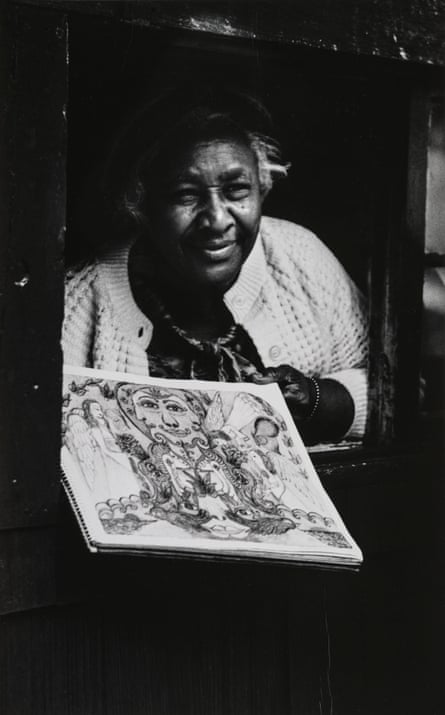
According to the Whitney curator Barbara Haskell, after dutifully signing and dating these pieces, Evans did not create so much as a single piece for another five years, until she had a chance encounter with these artworks as a sign that she should continue. “She painted all the time as a child, but then when she got married, she stopped making art,” said Haskell. “And then, in 1940, she took it up again.”
From there, Evans would create with an inspired fervor, largely fitting art-making into quiet moments during her employment as a housekeeper at the estate of the financier Pembroke Jones, and then later as a gatekeeper at the estate’s Airlie Gardens. What propelled her forward was tantamount to a religious calling.
“She felt that she saw God speaking to her from behind a wreath, three times, like this three-part conversion, and the third time she heard Him tell her to paint or die. So she had this divine calling that she felt she was answering,” Haskell said.
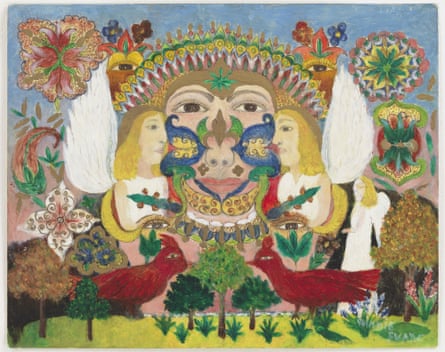
Evans’s art is dense and inspired: forms repeat in dazzling arrays, beings are decorated with a level of detail almost too tiny to believe, and mandala-like faces sport endless curves and crevices that become spaces for Evans’s exacting use of color and shading. Biblical imagery is frequently found, as well as lush, almost tropical-feeling depictions of greenery and flowers.
Evans’s pieces tend toward playful, 2D melanges bound up in symmetries radiating out from a central axis, although every now and then a more naturalistic piece will stop you cold, such as 1955’s haunting Temple by the Sea or Evans’s imposing 1954 depiction of the famed Airlie oak.
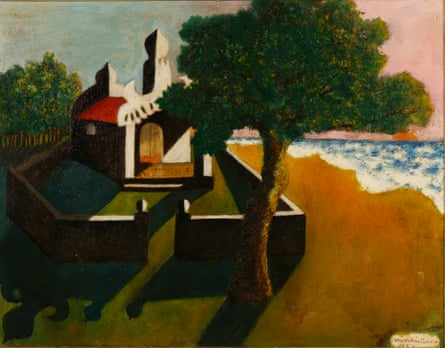
“They’re very dense, and there’s this kind of mixture of ecstasy and containment that’s very mesmerizing,” said Haskell. “You look at the pieces and you feel like you’re drawn into this forest of images that surround you.”
As she created, Evans staged makeshift shows of her works by hanging finished pieces on Airlie Garden’s front gates, and, although reluctant to formally exhibit her work, she had her first show in 1961 in the Little Gallery in Wilmington, North Carolina. With her reputation growing, she was sought out by the photographer and art historian Nina Howell Starr in 1962. Attracted by word of Evans’s renown, Starr was drawn to meet in person – she soon became Evans’s friend, and her de facto publicist, an arrangement that would last for a quarter century.
Starr helped Evans make her entry to the New York City art world and arranged for her first exhibition in the Big Apple in 1966, opening the way to a series of shows that culminated in a major exhibition at the Whitney in 1975 titled The Lost World. The show’s title was very much to the point, as Evans saw herself as depicting exactly that, a vision of a long past, glorious realm.
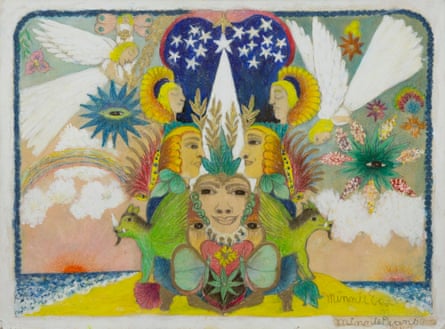
“Evans would talk about how she was creating this vision of a lost world, a paradise that had been destroyed by the great flood,” said Haskell. “She was recreating images of that world and allowing us to have access to it. It was also, in a sense, a world that would come into being.”
Given that Evans had been born in the south during the Jim Crow era and lived most of her life before Black Americans won any measure of civil rights, it is tempting to read her work through the lens of racial oppression, which, according to Haskell, many interpreters of her work have done. But Haskell argues for an interpretation that is instead grounded not in race but religion.
“There are a lot of images of eyes that are nestled in the foliage in her work, and many commentators see those eyes as references to the surveillance that she must have felt as a Black woman in the south,” said Haskell. “But I see them more as the eyes of God – she was definitely influenced by the Bible, and she had it right there with her when she took admissions at the gate. The amazing thing about her work is that it offers the ability for both interpretations to be true.”
According to Haskell, in the years since Evans’s death, she has grown more and more beloved by the art world – just the past year has seen substantial shows at the High Museum in Atlanta and the Museum of Fine Arts in Boston. “The trajectory of her public acceptance has just grown,” said Haskell. “Her reputation has exploded.”
The Whitney’s exhaustive retrospective offers visitors a rare chance to enter fully into Evans’s world, one that is largely a place of amazingly good feelings, grandiose luminosity and rare moments of tranquillity. It is an important reminder of the visionary force that art holds. As Haskell puts it, “she’s this remarkable artist who created an entire world of harmony and transcendency, even amid disquiet and unease. I hope people find solace in this show and hold the light in her wonder.”
-
The Lost World: The Art of Minnie Evans is on display at the Whitney Museum of American Art from 22 August to 10 January 2027