2 months ago
65
2 months ago
65
My mother grew up in Warracknabeal, a speck of a town four hours from Melbourne, Australia, in the wide, wheat country of the Wimmera – that part of Victoria where the sky starts to stretch, where you can see weather happening 100 kilometres away.
Once or twice a year, our family would pack into the rattling old LandCruiser and drive up to visit my grandmother. It can’t always have been blistering weather but my memories of those trips are shot through with summer heat: the peeling paint of my grandmother’s house, the blasted-dry grass of the reserve over the road and its ancient metal monkey bars, so hot they burned your hands. Once, a dust storm blew up while we were there, engulfing the small weatherboard house in howling dirty orange.
I thought of those summers this week while in the even-smaller town of Ouyen (population 1,170) in the Mallee, 150km directly north of Warracknabeal, as this months’s still-rolling, record-breaking heatwave built to its apex. These aren’t places well-known to people in the city. For many, north-west Victoria isn’t a destination, just somewhere to pass through, a detour on the way to Adelaide. Until the state’s maximum temperature records looked set to tumble there, and the media spotlight trained right on them.
Locals in these areas are used to hot summers. I remember those country summers as a kid being sharp and uncomfortable, full of painful sunburn and dust. But it’s hard to know how different they felt to this week’s searing heat. Did 38C back then feel like 48C now? Are our memories of past weather events softened or sharpened by how we feel about what’s happening now?
Extreme heat like we felt on Tuesday is a bully. The very air seems to be trying to smother you. It pushes on to you, around you, squeezing at your chest, quickly working its way through your clothes, into your throat. Bare skin quickly starts to hurt in the sun, but shade only gives relief from its harsh stab, not from the heat itself.
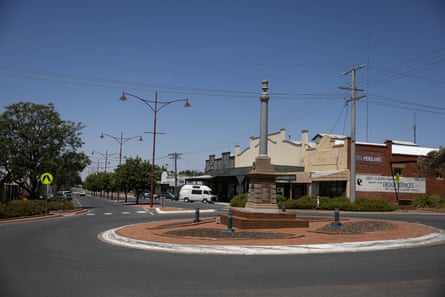
Outside, the concrete of the deserted main street was blinding, and the scent of sun-baked eucalypt leaves and pine needles hung in the heavy, insistent air. Even indoors, I could feel my body slowing everything down to cope. My fingers felt clumsier. Thinking took longer. Everything felt like it was swelling, and despite my diligent consumption of water and Hydralyte, I couldn’t quite escape the persistent, low-level nausea.
But the heat we felt the day before, when it reached 44.3C, was also deeply unpleasant. And strings of blasting hot summer days are a feature of this landscape, not a bug. Yes, they are getting worse, and scientists have told us again and again why that is, and what we need to do to stop it. But if you live out here, it’s easy to think, what’s a few degrees when you’re in the middle of nine days straight of what feels extremely normal?
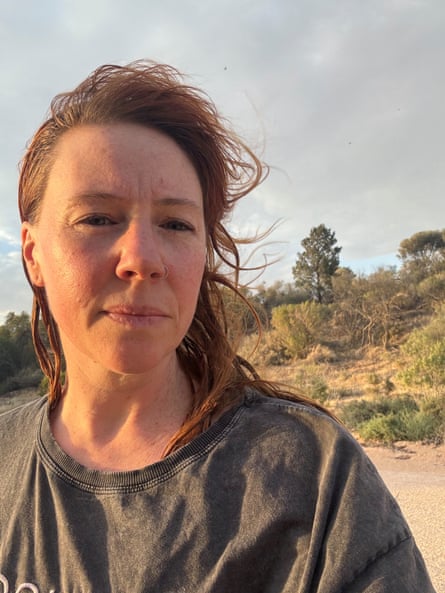
The last time I was in the country in heat like this was the last time those now-broken records were set: on 7 February 2009, the day we now call Black Saturday. I was in Buxton with friends, chasing a swim and then a party, as the hot winds dried our river-wet hair in minutes and we didn’t think much about the huge black plume billowing up in the west until the fire roared over the ridge in front of us and the trees exploded.
The wind in Ouyen was thankfully low until late Tuesday afternoon, when hot gusts began pushing in from the south-west, reminding me of that eerie afternoon nearly two decades ago, and the other parts of the state still battling out-of-control fires.
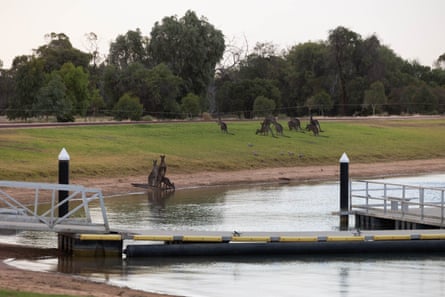
The Ouyen Lake had been deserted for most of the day as there’s no shade by the water’s edge, but as the sun started to sink towards the horizon, people began to venture down there. A small congregation of kids, adults and dogs splashed about in the shallows and bombed off the pontoon.
The birds and animals had the same idea. On the other side of the lake, a mob of kangaroos gathered on the grass. A kite floated above the scrub. And as I swam through that beautiful blue water, feeling properly cool for the first time all day, swallows looped overhead and a pair of rainbow bee eaters fought the hot wind to trill and whirl and splash down for a drink beside me.
The relief was welcome, but fleeting. It was still 43C at 7pm. It didn’t drop below 40C until 8.30pm, just as the sun set, a deep flaming red.