2 months ago
67
2 months ago
67
Frozen extremities are one of several obstacles facing voters in Japan as they prepare to cast their ballots at next month’s snap general election.
The vote, called by the prime minister, Sanae Takaichi, less than four months after taking office, will be held in the middle of a winter that has seen record snowfall in parts of the country, prompting concern about a low turnout.
Preparations for the lower house vote – an attempt by Takaichi to use her personal popularity to strengthen her fragile coalition – are already falling foul of the weather.
In several areas, billboards displaying posters showing the names, faces and political affiliations of candidates have disappeared beneath heavy snowfall.
Authorities in a town in Aomori prefecture in Japan’s far north have been forced to cut the number of billboards erected ahead of the vote to just 97, compared with 621 ahead of last year’s upper house elections, which were held in the summer.
Ten people have died over the past week as a result of the brutal weather, particularly along the Sea of Japan coast, the public broadcaster NHK said, adding that the accumulation of snow had already exceeded the yearly average.
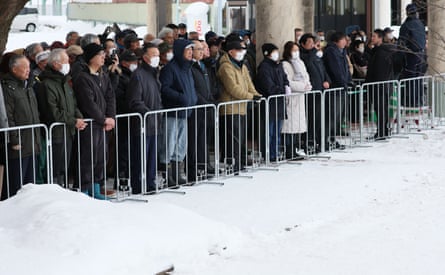
The weather has added to logistical headaches caused by the 16-day gap between the dissolution of the lower house of parliament and election day on 8 February – the shortest period in living memory.
The Japan Times reported that some local municipalities complained that they were struggling to make arrangements to accommodate voters, forcing employees to work overtime.
Observers believe a combination of cold weather, Takaichi’s high approval ratings and a weak opposition could combine to increase voter apathy – a feature of recent national elections irrespective of their timing.
“This time, all the conditions for a low voter turnout are in place,” non-fiction writer Satoru Ishido told Asahi TV news.
In addition, Takaichi’s Liberal Democratic party (LDP) can no longer rely on the organisational support of its former coalition partner Komeito, a Buddhist-backed party with a track record of getting out the vote among its supporters.
That means the LDP will have to attract more non-aligned voters, who may be less inclined to support the party. “It used to be the case that a lower voter turnout was advantageous for the LDP, but the conditions are different now,” Ishido said.
People hoping to listen to campaign speeches before deciding how to cast their votes could be in for an uncomfortable time after police warned this week that kairo pocket hand and body warmers could trigger metal detectors used during baggage security checks.
The national police agency has told prefectural forces to assign female officers and asked party officials to ensure female staff are present at stump speeches as they may have to carry out body checks.
The warmers, a must-have item in winter, contain iron powder and could set off alarms introduced to strengthen security following the 2022 assassination of Shinzo Abe, who was shot dead as he addressed voters in Nara.
The internal affairs minister, Yoshimasa Hayashi, has warned local authorities to prepare for the possibility of heavy snowfall on election day, as concern grows that the weather could delay the distribution of polling booth admission tickets.
“We will work to identify issues that could arise from snowfall … and take measures to support emergency communications in affected areas,” he said, according to the Yomiuri Shimbun newspaper.
The ministry has launched a task force to encourage local organisers to deploy mobile polling stations for early voting and to lay on transport to polling stations on election day.
Younger voters appear more eager to brave the elements and cast their votes – a trend that could benefit smaller parties, including Sanseito, a right-wing party whose calls for strict immigration controls appealed to younger voters at last summer’s upper house elections.
More than 58% of people in their 20s and 30s said they were comfortable with the timing of the election – the first lower house vote to be held in February since 1990s – compared with 47.5% of those in their 40s and 50s.
In north-east Japan, a region that experiences heavy snowfall, 61% opposed the timing, while 35% were supportive.
Takaichi acknowledged that her decision to call a snap election could prove challenging for voters in snowbound regions.
“For those in snowy regions in particular, I am truly grateful for the considerable effort it will take to reach the polling stations, as there may be challenging conditions underfoot,” she told reporters last week.