3 months ago
67
3 months ago
67
Starmer condemns Reform UK's 'racist rhetoric'
Yesterday the Labour party accused Nigel Farage of tolerating “flagrant racism” in Reform UK after Sarah Pochin claimed that she was right to complain about the number of black and Asian people in TV adverts.
Keir Starmer has now made the same point in his own words. Commenting on Sarah Pochin’s latest intervention, he told the Daily Mirror:
Yet again our country’s discourse is being poisoned and polluted by the racist rhetoric coming from Reform - pitting communities against one another and sowing division to suit their own ends. They should be apologising, not doubling down.
You only have to look at the toxicity flowing from their candidate for Gorton and Denton to know what they are about - dangerous ideas that pull at the fabric of who we are in Britain. They don’t have solutions to the challenges we face as a country. All they can offer is a smokescreen of hate and division.
Key events Show key events only Please turn on JavaScript to use this feature
EHRC welcomes court ruling rejecting claim its interim guidance on trans policy unlawful
The Equality and Human Rights Commission has welcomed a high court ruling defending the interim guidance it issued to organisations about the implications of the supreme court judgement saying that, when the Equality Act refers to sex, it means biological sex.
The guidance – described as an “interim update” – was controversial because it was seen as over-prescriptive, and the Good Law Project launched a legal challenge.
But today the high court has said the guidance was legal.
Mary-Ann Stephenson, chair of the EHRC, said:
We welcome the court’s conclusion that the interim update was lawful and the EHRC did not act in breach of its statutory duties.
We issued the interim update in response to a high level of demand immediately after the supreme court’s ruling. We were concerned that organisations and individuals could be subject to misinformation and misrepresentation of the judgment and its consequences. That might have led to them failing to comply with the law: adopting or maintaining discriminatory policies or practices, to the detriment of those the law is supposed to protect.
As Britain’s equality regulator, we uphold and enforce the Equality Act. This is the second time the way we have done our duty in the wake of the supreme court’s ruling has been tested in the courts. Both times our actions have been found to be lawful.
Jo Maugham, head of the Good Law Project, said that his organisation will appeal against the ruling, which he described as “quite clearly wrong”.
In a statement, he said:
It is wrong because it reduces trans people to a third sex. It is wrong because it gives little or no weight to the harm done to trans people by excluding them. And it is wrong because it is not interested enough in the rights of people who are trans to keep their status private.
But Maugham also said he regarded some aspects of today’s judgment as positive. He claimed it showed “it is entirely lawful for service providers to allow trans women to use the women’s toilets”. The Good Law Project has explained this argument in more detail here and here.
The leadership crisis that hit Westminster at the start of this week may not have been very good for the governance of the UK, but it has produced some good journalism. The New Statesman and the Spectator this week have both published impressive long reads this week about what has gone wrong for the government. Although not explicitly billed as such, they both read like first drafts of an obituary for Keir Starmer’s premiership.
In his essay in the New Statesman, Tom McTague, the magazine’s editor-in-chief, focuses on the ideas influencing the Starmer project. Here is an extract.
The tragic irony for [Morgan] McSweeney [Starmer’s chief of staff until Sunday] was that Starmer’s 18 months as prime minister have only vindicated Blair’s central analysis of their project. McSweeney and Starmer might have identified what they disliked most about the excesses of New Labour, but they never developed an alternative political economy of their own that might replace it. In place of Blairism there was no theory of political reform or coherent critique of British state failure, no analysis of Britain’s future place in the world or any kind of distinct moral mission. All there was was a promise to “clean things up” as Starmer put it to me. The mission became, in essence, conservative: to protect the settlement erected by Blair and eroded over the 20 years since his departure. Britain could thrive if it could only begin to live within its means, attract more foreign investment, reassure the bond markets and return a sense of “service” to government. After years of chaos, mere stability would be change. And this would be enough.
Where there was distinct radicalism – from McSweeney’s Blue Labour instincts – there was no mandate. McSweeney and Starmer had not fought an ideological battle to bring Blue Labour to government, as Wilson had done for socialist modernisation in the 1960s and Blair for liberal progressivism 30 years later. This was largely because Starmer never really believed in it in the first place and McSweeney, though a reflective thinker, was always more of an operator than political theorist. And so, the pair offered a programme without a programme, a government without ideas or the mandate to enact them.
And in his article for the Spectator, Tim Shipman, the magazine’s political editor, focuses more on Starmer’s weaknesses as a leader. Here is an extract.
Another of those who worked for [Stamer] adds: ‘He’s completely incurious. He’s not interested in policy or politics. He thinks his job is to sit in a room and be serious, be presented with something and say “Yes” or “No” – invariably “Yes” – rather than be persuader–in-chief.’ Even before he fell out with Starmer, Mandelson told friends and colleagues that the Prime Minister had never once asked him ‘What really makes Trump tick?’ or ‘How will he react to this?’.
Others dispute the claim of incuriosity. ‘There are subjects when he drills down and he’s really, really good,’ says another aide. ‘The idea he can’t think politically is also wrong. He will often think ahead.’ But even these loyalists admit Starmer lacks a ‘philosophical worldview’.
Nor does he seem to understand that the Whitehall system requires the PM to be very driven. Downing Street civil servants got used to Rishi Sunak constantly ‘bothering the policy team’. One official says: ‘You would never, ever see Keir charging around a building, asking “What’s going on with that?”’
A cabinet minister says: ‘You never get the 7 a.m. call on a Monday because he’s been thinking about something over the weekend.’ Even Boris Johnson fired off pre-dawn salvos of thoughts at aides and ministers. A former aide agrees: ‘Nobody hears from the guy from Friday lunchtime through till about Monday morning.’
Both articles are very good, and well worth reading in full.
Starmer condemns Reform UK's 'racist rhetoric'
Yesterday the Labour party accused Nigel Farage of tolerating “flagrant racism” in Reform UK after Sarah Pochin claimed that she was right to complain about the number of black and Asian people in TV adverts.
Keir Starmer has now made the same point in his own words. Commenting on Sarah Pochin’s latest intervention, he told the Daily Mirror:
Yet again our country’s discourse is being poisoned and polluted by the racist rhetoric coming from Reform - pitting communities against one another and sowing division to suit their own ends. They should be apologising, not doubling down.
You only have to look at the toxicity flowing from their candidate for Gorton and Denton to know what they are about - dangerous ideas that pull at the fabric of who we are in Britain. They don’t have solutions to the challenges we face as a country. All they can offer is a smokescreen of hate and division.
The Manchester Evening News has now posted a video of its Gorton and Denton byelection hustings held yesterday on YouTube.
Here is Hannah Al-Othman’s report from the debate.
And this is how it starts.
Labour and Reform candidates came head-to-head at a hustings in Greater Manchester for the Gorton and Denton byelection, with Labour’s candidate saying women in the constituency were scared to leave the house because of her rival’s rhetoric.
Angeliki Stogia hit out at Reform’s Matt Goodwin, who arrived at the offices of the Manchester Evening News, which was hosting the event, with security.
Goodwin responded by saying he had had “very real threats” on his life and suggested women were instead afraid because Labour was “running a policy of open borders, which is putting women and girls at risk”.
Stogia said: “Matthew, how can you be sat here with a couple of security guys following you around? When I, just this morning, was with a group of interfaith women representing our community, who told me that our women in this constituency, they’re scared to leave their house because of the rhetoric that you have been peddling.”
It was the fiercest clash at the event which was attended by people living and working in the constituency, including doctors, college students and representatives from community and campaign groups.
UK ban on Palestine Action unlawful, high court judges rule
The co-founder of Palestine Action has won a legal challenge to the home secretary’s decision to ban the group under anti-terrorism laws, Haroon Siddique reports.
Here is the press summary of the judgment.
And here is the ruling in full.
Taz Ali has more coverage on our separate live blog.
At the high court we are about to get the judgment in the case arguing that the government’s decision to proscribe Palestine Action was unlawful. Taz Ali is covering this on a separate live blog.
O'Donnell suggests Antonia Romeo would be 'excellent' candidate to be next cabinet secretary
In his Today interview Gus O’Donnell was also asked about the claim by Simon McDonald, the former permanent secretary at the Foreign Office, that Antonia Romeo should not be appointed as the next cabinet secretary without more “due diligence”. McDonald made this claim in an interview on Wednesday, in a reference to a complaint about Romeo from when she worked for the Foreign Office in 2017.
O’Donnell said that he could not comment on individual candidates because he was on the panel that shortlisted candidates when Wormald was appointed. Romeo was one of the four candidates on the shortlist. O’Donnell said that the four people shortlisted were “all excellent candidates, in my view”.
O’Donnell said he did not know what process would be used to select a cabinet secretary this time. But, asked if he thought that the selection process would have to be started again from scratch, with the appointment of a new selection panel, O’Donnell indicated that he did not think that would be necessary.
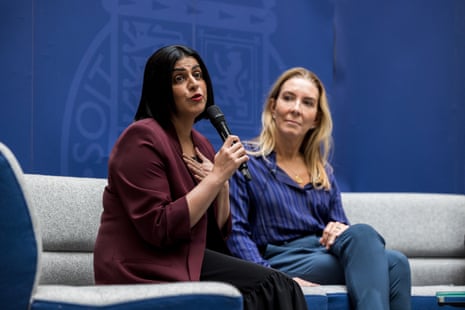
Former cabinet secretary Gus O'Donnell defends No 10's use of ministerial direction to approve Wormald's pay-off
In a story in the Times today Oliver Wright and Steven Swinford say that “government officials refused to sign off on Sir Keir Starmer’s decision to sack Britain’s most senior civil servant because it would cost the taxpayer a quarter of a million pounds that could not be justified”. They report:
In an unprecedented move, senior civil servants told Starmer that ministers would have to issue a formal “direction” to officials to make the redundancy payment to the Sir Chris Wormald, the cabinet secretary, because there were no clear and compelling reasons why he should be sacked.
On the Today programme, it was put to Gus O’Donnell, the former cabinet secretary (see 9.15am) that this was a sign of the fact that civil servants did not approve of the decision to get rid of Wormald. O’Donnell did not accept that.
He said the PM has “every right” to replace the cabinet secretary. That is allowed under the cabinet manual, he said.
And he said that Wormald’s pay-off – reportedly worth around £260,000 – would be decided by the HR department.
But, he said, the official deciding the level of the pay-off would be someone who actually reported to Wormald – creating a conflict of interest. That is why the decision would have to be taken by the PM, requiring a ministerial direction.
Reform UK’s Kent council faces ‘extreme risk’ after passing first budget
Reform UK’s showcase council in Kent faces “extreme risk” and “instability”, opposition politicians have warned, after it passed its first budget. Ben Quinn has the story.
Ex-cabinet secretary condemns PM's treatment of Wormald as 'shabby' and says he must 'get a grip' on 'disastrous' aides
Good morning. Keir Starmer is heading off to the Munich Security Conference today, where he will no doubt be glad to be able to put UK domestic politics behind him for a bit. Patrick Wintour has a good article here about what is on the agenda.
But, as Starmer gets ready to leave, he is still facing criticism over his decision to defenestrate the cabinet secretary, Chris Wormald. Here is our overnight story by Rowena Mason and Pippar Crerar.
It is not unusual for prime ministers to want to change people at the top of the civil service, and to replace them with individuals with whom they can establish a better working relationship. But there is no precedent for a PM ousting a cabinet secretary they personally appointed just over a year previously.
Gus O’Donnell, who was cabinet secretary for six years under Tony Blair, Gordon Brown and David Cameron, was on the Today programme this morning and he said that the treatment of Wormald had been “shabby”. He said:
Where it shabby is the fact that we’ve got to this place and that they have briefed anonymously against the cabinet secretary, saying it’s not working.
They’ve been doing this for a long time. This is a process that this government, I’m afraid, [it’s] one of their biggest failings. You’ve seen it right from the start with Sue Gray, briefings against her, all the rest of it. This is the fundamental problem.
O’Donnell blamed the PM’s special advisers (or spads, as they are called) for the negative briefings. And he criticised Starmer for failing to stop this.
Really good spads are really useful. I’ve worked with Ed Balls, Alastair Campbell, Jonathan Powell. If they’re good, they understand their subject, they can make the the relationship between ministers and civil servants work a lot better.
Bad special advisers turn out to be second rate PR people. [They] can be disastrous. You saw in the run up to the budget; it was a complete omnishambles from a comms point of view, whatever you think about the economics of it.
So that’s where the prime minister must take responsibility and get a grip.
Here is the agenda for the day.
10am: The high court delivers its judgment on a claim that the Home Office’s decision to proscribe Palestine Action was unlawful.
Morning: Ed Davey, the Lib Dem leader, is on a visit in Scotland.
Noon: Zack Polanski, the Green party leader, attends the Attitude 101 awards celebrating trailblazers in the LGBTQ+ community.
Afternoon: Keir Starmer arrives at the Munich Security Conference.
And Kemi Badenoch is in Llandudno, where she is speaking at the Welsh Conservative conference.
If you want to contact me, please post a message below the line when comments are open (between 10am and 3pm), or message me on social media. I can’t read all the messages BTL, but if you put “Andrew” in a message aimed at me, I am more likely to see it because I search for posts containing that word.
If you want to flag something up urgently, it is best to use social media. You can reach me on Bluesky at @andrewsparrowgdn.bsky.social. The Guardian has given up posting from its official accounts on X, but individual Guardian journalists are there, I still have my account, and if you message me there at @AndrewSparrow, I will see it and respond if necessary.
I find it very helpful when readers point out mistakes, even minor typos. No error is too small to correct. And I find your questions very interesting too. I can’t promise to reply to them all, but I will try to reply to as many as I can, either BTL or sometimes in the blog.