3 months ago
60
3 months ago
60
Saturday night at the Gabba witnessed a collapse to rank among England’s most demoralising on Australian soil. In fact the entire third day could be filed under that category: three sessions of one-way traffic on Vulture Street that mean the Ashes urn is unlikely to change hands.
Even the word “unlikely” is a simple nod to the fact that in nearly 150 years of Test cricket a 2-0 deficit has been overcome once before; that it remains mathematically possible. But the way the first five days of this series have played out – the way Mitchell Starc has taken residence in English minds and painted the walls fuchsia pink – this is the stuff of fantasy.
As the two sides left the field of play at the close, England were staring at the point of no return. Having conceded a first innings deficit of 177 runs after Starc’s first half-century at home for nine years, they crumbled to to 134 for six still 43 runs away from simply making their opponents bat again. Sunday will see the final rites, both of the match and possibly a team.
And to think England’s reply actually started well. For the six overs before the second interval Zak Crawley was sending the pink ball racing across the green outfield like he was Ronnie O’Sullivan, while Ben Duckett had got himself off a pair. Starc was a bit wayward, Michael Neser grassed a tough caught and bowled, and 45 runs were wiped off the deficit.
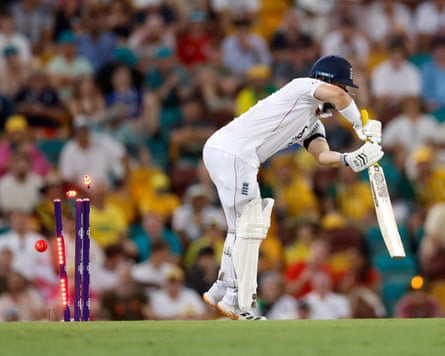
But it turned out this was just the twitching of a corpse that was soon to be found lying flat on the table with its entrails on show. First came Scott Boland exploiting some low bounce to bowl Duckett off the toe-end of his bat, then Neser rediscovering his grip with two sharp return catches to remove Ollie Pope, 23, and Zak Crawley, 44, on the drive.
The moment the plug was truly yanked out was the wicket of Joe Root, however, and delivered by the man of the moment. As the decibel levels rose at the Gabba, Starc hurtled in and found the edge of a tired cover drive that needed a review to confirm the contact. Off went Root, having tumbled down the other side of a mountain climbed 48 hours earlier.
Of the top seven, only Ben Stokes could hold firm amid the maelstrom, Boland finding Harry Brook’s outside edge on 15 the ball after seeing one overturned, and Starc then repeating the dose to Jamie Smith. England’s captain will resume with Will Jacks alongside him, some handy lower-order hitters thereafter, and Australia will be eyeing a quick kill.
Already this series is shaping up to be known as Starc’s Ashes. Not content with simply hurting England with that lethal left-arm – 16 wickets at 12 runs apiece from his first three outings – he added a new form of torture here: two and a half hours of rock-solid batting that stuck 511 on the board and ensured England latest inquisition would start under lights.
England had struck either side of the second new ball during the opening session. Michael Neser wafted Ben Stokes behind on 16, while Alex Carey’s counter-attacking 63 was finally snuffed at the third attempt to hand Gus Atkinson his first wicket of the series. At this stage Australia were 418 for six, a lead of 84 that still needed further embellishment.
after newsletter promotion
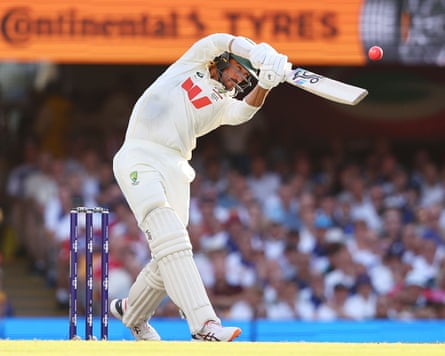
But runs and wickets are not the only currency in Test cricket. Forcing an opponent to toil is another way to break them down, with Starc and Boland repelling everything that Stokes could squeeze out of his weary players in 30-degree heat. Remarkably, a ninth-wicket stand worth 75 runs was, at 27.3 overs, the longest of what has so far been a hurtlingly quick series.
One wonders whether England’s lower order would have the wherewithal to deliver such a calculated performance were the roles to be reversed; or whether they would simply try to blast as many boundaries as possible before the inevitable occured. Starc struck 13 fours, Boland chiselled out three, but the dot balls amassed in between were what hurt the most.
Starc may have shielded Boland – the No 10 was still secure when called upon en route to a career-best 21 not out – but this was an innings built on collective responsibility. All 11 Australians made it to double figures, with five individual scores and six partnerships travelling north of 50 runs.
Not for the first time in this part of the world, England could learn a thing or two.