1 month ago
57
1 month ago
57
A man has received threats from the Taliban after his work for the Afghan police was revealed by a Ministry of Defence leak and the UK refused his application for resettlement.
Hamid* worked for the Afghan national police special unit and received certificates for his work signed by senior British figures praising his “dedication, unparalleled service and leadership”. His details were also included in an accidental 2022 leak by an MoD official that identified 18,700 Afghans who had worked with or for the British government.
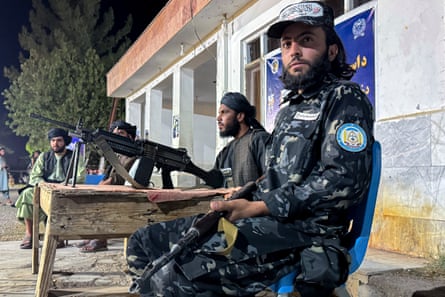
Hamid said he had received a number of threats from the Taliban, including a video he shared with the Guardian in which a man cradling a rifle and sitting below a Taliban flag threatens to pursue him and cites knowledge of his previous movements.
The MoD, however, has rejected his application for resettlement under the Afghan relocations and assistance policy (Arap) scheme. His most recent rejection, received on 31 July, stated that Hamid had not provided evidence of “working alongside, in partnership with or closely supporting a UK government department”. It gave him 28 days to appeal.
Hamid said: “This is extremely painful because I have already submitted every document available to me proving my service. Furthermore, many of my former colleagues who served in exactly the same department and performed the same duties have already been relocated to the UK through the Arap scheme.
“Despite this evidence, my case continues to be refused. I believe my case raises serious questions about how some former Afghan partners of the UK continue to be treated despite years of loyal service.”
Hamid’s plea for help comes five years after the Taliban retook power in Afghanistan on 15 August 2021 after the withdrawal of US and Nato forces. The UK government launched the Arap scheme on 1 April 2021 and closed it to new applications on 1 July last year. Pre-existing applications continue to be processed.
Under Arap, high risk of death or serious injury are only taken into account if the rest of the criteria are deemed to have been met, which they have not in Hamid’s case. “Must I wait until I am captured, tortured or killed by the Taliban before my service and the danger I face are finally recognised?” he said.
“Following the Ministry of Defence data breach, my personal information was exposed, placing me at even greater risk. Since then, my life has changed completely. I cannot safely leave my home to work. I live in constant fear of being recognised or targeted.”
After the leak, the then defence secretary, John Healey, said the dataset included people who had made speculative applications under Arap and had not worked with British forces. He said being included in the leak “doesn’t give them a right to claim access to Britain”.
“It doesn’t give them a right to claim asylum. It doesn’t make them eligible for the special [Arap] scheme that Britain put in place for those who’d worked alongside or served with our forces,” he said.
Hamid said that because he was in hiding he had no reliable income and relied on his wife, who supports the family by doing small jobs from home. “This is our family’s only source of income, and even then we struggle simply to survive,” he said.
“The emotional impact has been devastating. My wife and I have become deeply exhausted, depressed and hopeless after years of fear, uncertainty, repeated refusals and financial hardship.
“I am not asking for special treatment. I am only asking for a fair review based on the evidence I have already provided.”
An MoD spokesperson said: “Each application is considered on a case-by-case basis, assessed against the evidence provided, such as how they supported the UK mission in Afghanistan, and in line with the publicly available eligibility criteria.
“Since the Taliban takeover, the UK has resettled almost 39,000 Afghan men, women and children through Afghan resettlement schemes.”
-
Name has been changed