3 months ago
63
3 months ago
63
Valeriia Kholkina was out buying ice-cream with her husband and four-year-old daughter when a man overheard them speaking Ukrainian. “Teach your daughter to speak Polish,” said the stranger. Then he physically assaulted both parents.
The incident, which happened in the city of Szczecin in north-west Poland, reflects an increasingly hostile atmosphere for Ukrainians in the country, a dramatic turnaround from the mood in 2022. Then, in the aftermath of Russia’s full-scale invasion, hundreds of thousands of Poles put on a show of support and hospitality for their neighbours, volunteering at the border and offering up their homes to refugees.
Now, that outpouring of goodwill is wearing thin, as the war approaches its fourth anniversary, and surveys show an increasingly negative perception of Ukrainians in Poland, stoked by a political debate that has moved further to the right on migration and the resurfacing of historical grievances.
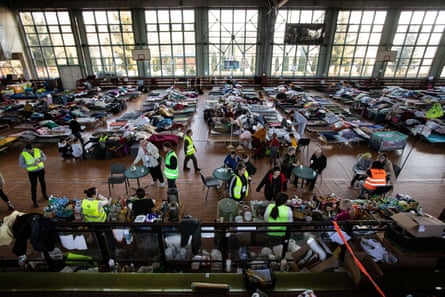
There are about a million Ukrainian refugees in Poland, according to UNHCR statistics from September. Kholkina is not one of them; she is one of nearly half a million Ukrainians in the country who arrived prior to 2022, and has lived in Poland for more than a decade. “I’m more Polish than Ukrainian now … but I never thought someone would lecture me on how to talk to my own family,” she said. Since the assault, she has panic attacks, and has told her daughter to never speak Ukrainian in public.
Her experience was extreme – and the attacker ended up being sentenced to 14 months in prison – but the experience of receiving abuse for speaking Ukrainian in public has become widespread.
“Things feel more tense now,” said Aliona, a 39-year-old entrepreneur who lives in a small town in western Poland. “Nowadays, when we go out, the kids whisper: ‘Mum, let’s speak Polish now.’ It wasn’t like this before. No one used to comment. Even if they heard my accent, they’d just smile,” she said.
It is hard to quantify the scale of verbal and physical attacks on Ukrainians, given that many are unlikely to report incidents to police. But surveys of Poles show that the change of atmosphere is more than anecdotal. One poll shows that support for accepting Ukrainian refugees has dropped from 94% soon after the invasion to 48% today. Another survey shows Polish support for Ukraine joining the EU is down to 35%, from 85% in 2022.
“There is an attitude in society that we don’t owe anything to the Ukrainians any more,” said Piotr Buras, of the European Council on Foreign Relations in Warsaw.
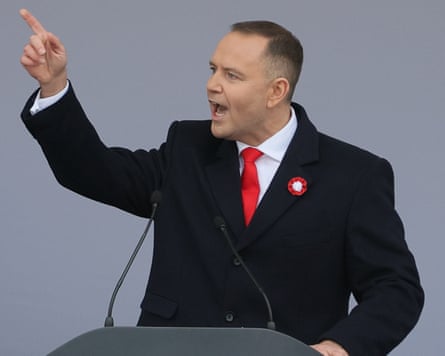
Many things have combined to bring about this change of feeling. Resentment has been stoked by disinformation and viral videos online. Moreover, the election of rightwing populist Karol Nawrocki as president in June 2025 followed an acrimonious campaign which shifted the whole political debate further to the right. Ukrainians are more often portrayed as ungrateful and hungry for benefits, despite economic data showing they are net contributors to the Polish economy.
There have been similar shifts in other European countries. The German chancellor, Friedrich Merz, has said he has spoken to Ukraine’s Volodymyr Zelenskyy about the increase in young Ukrainian men travelling to Germany. “I asked the Ukrainian president to ensure that young men in particular from Ukraine do not come to Germany in large numbers — in increasing numbers — but that they serve their country,” he said. His government is working on a bill that would tighten access to benefits for Ukrainian refugees.
In Poland, Nawrocki vetoed a government bill in August that would have extended financial support for Ukrainian refugees, and instead proposed his own legislation that made benefits contingent on being in employment. In the end, a compromise bill was adopted.
Oleksandr Pestrykov, of the Ukrainian House in Warsaw, said anti-Ukrainian sentiment first appeared online in 2023, with any news article relating to Ukraine on Polish media immediately swamped with negative comments. Some have accused Russian bots of stoking prejudice online, and for a while the online hatred did not seem to make its way into the real world. That, he said, is now changing.
“Until summer this year, this negativity rarely left the bounds of the internet; the complaints we would get from Ukrainians would be sporadic, and similar to the situation before the full-scale war. But starting from summer we’ve had a pretty large number of people reporting attacks to us, thankfully so far mostly verbal attacks,” he said.
The complicated history between Poland and Ukraine also plays a role, with the massacre of over 100,000 Poles between 1943 and 1945 by Ukrainian nationalists attempting to ensure the Volhynia region did not become part of Poland a frequent talking point. Ukraine has now allowed Poland to exhume the bodies of victims, but work is moving slowly and the topic is an emotive one for many in Poland.
“The level of support for Ukraine in 2022 was an anomaly; now we are kind of returning to normal,” said Buras. This historical context is what allows much of Polish society to turn against Ukrainians while still claiming to be firmly anti-Russian. “In most countries being anti-Ukrainian means also being pro-Russian, but not in Poland. Because our relations with Ukraine are laden with history, resentments and disagreements,” he added.
A flashpoint came when footage of people waving a wartime nationalist Ukrainian flag during the concert of a Belarusian rapper at a Warsaw stadium went viral. The sighting of the red-and-black flag, which is widespread in Ukraine but considered offensive in Poland, led to clashes in the stadium, and ended up with Poland deporting 63 people, 57 of them Ukrainians. Increasingly, right-wing discourse about the evils of migration has begun to include Ukrainians, whereas in 2022 and 2023 they were usually positively contrasted with non-European refugees trying to cross into the country from Belarus.
Not all Ukrainians in Poland have negative experiences. In a survey released late last year, 58% of Ukrainians said they expected their children to reside in Poland “for many years”. And discrimination is not universally felt, particularly among those who live in bigger cities.
Anastasiia Zhelezniak, 39, a child psychologist from the city of Kryvyi Rih, moved to Warsaw with her two children in the summer of 2023, after deciding that her home city, which is subjected to regular Russian attacks, was becoming too scary a place to raise her children. She chose Warsaw because her niece had already moved there.
Since then, she has learned Polish through government-sponsored language courses, retrained as a massage therapist and recently opened her own salon in central Warsaw. “Personally, I’ve had nothing but good experiences in Poland,” she said. When her children, now 10 and 15, started school in Warsaw, the teachers and other parents went out of their way to be helpful, she said. “At one parents’ evening, everyone was asking how they could help. It almost brought me to tears,” she said.
The only negativity she has experienced has been online. Whenever she opens Facebook or other social media she is bombarded with negative comments about Ukrainians. “I’ve just started not to look any more,” she said.
Zhelezniak said that while many of her Ukrainian friends have started to leave, citing the changed atmosphere and increasing cost of living, she now hopes to make a future in Poland. “I think it would be better for my children and give them more opportunities than going back home,” she said.