2 months ago
67
2 months ago
67
Last week, after torrential rain in Sydney, fresh poo balls washed up on the beach at Malabar, the closest beach to the problematic Malabar sewage treatment plant.
Signs were erected on the beach warning people not to touch the “debris balls” or swim. But authorities didn’t let the wider community know. There were no other warnings issued by Sydney Water, the Environment Protection Authority (EPA) or the state government.
Sydney Water has been slow to take responsibility for the poo balls that closed more than a dozen beaches from October 2024 to January 2025. Questions have also been raised about how willing the NSW EPA has been to share information publicly.
In October 2024, when the balls initially washed on to Coogee beach, they were referred to as “mystery” tar balls.
In mid-October, Guardian Australia reported the team of scientists analysing the debris was investigating whether the balls could be linked to sewage and whether they could have come from a nearby water treatment plant.
Sydney Water pushed back hard. Its media team attempted to have any reference to the corporation removed from the story.
Elsewhere, it continued to be widely reported that they were tar balls.
Guardian Australia understands the EPA knew the pollutant material was consistent with human-generated waste as early as 25 October 2024.
But the finding that they were mini fatbergs containing human faeces was announced late on Wednesday 6 November – right when US election results were dominating news headlines. At the time, the source of the balls was still said to be unknown.
“NSW regulator chose to reveal content of Sydney’s mystery beach balls on day of US election,” Guardian Australia reported.
Sign up: AU Breaking News email
The EPA said: “Due to the complex makeup of both organic and inorganic materials, we are unable to definitively pinpoint a source.”
A Sydney Water spokesperson said: “There have been no issues with the normal operations of the Bondi or Malabar wastewater treatment plants.
“Sydney Water acknowledges the tar balls may have absorbed wastewater discharge, which was already present in the water while forming, however, they did not form as a result of our wastewater discharges.”
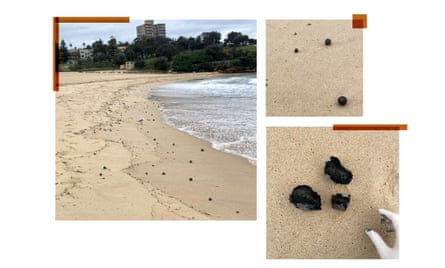
Guardian Australia reported in mid-January 2025 that experts believed Sydney’s deepwater ocean outfalls were to blame.
The corporation again insisted its plants were “operating normally”. Sydney Water said it was investigating potential illegal dumping into the wastewater network or stormwater system.
In early April 2025, the EPA finally admitted the poo balls likely originated from Sydney Water’s land-based sewage treatment network.
Again, Sydney Water and the EPA did their best to manage the fallout. Sydney Water’s acting executive general manager of water and environment services, Louise Beer, said “it is important to note, all coastal treatment facilities are operating normally, and we are compliant with regulatory standards”.
It was only after a five-month freedom of information battle waged by Guardian Australia that the source was finally narrowed down in October 2025. The debris balls were coming from the deepwater ocean outfalls – as multiple experts had suggested.
But even then, when Guardian Australia had a briefing about the redacted report, Sydney Water and the EPA didn’t reveal they had pinpointed the source even further, to the Malabar outfall specifically.
That information was only released after Guardian Australia published its story on 24 October.
The oceanographic report, commissioned by Sydney Water, suggested the state-owned corporation could have known as early as 3 February 2025 that the debris balls were likely from its ocean outfalls. That is the date of the “preliminary draft”. The final report was completed in late May.
In October 2025, a Sydney Water spokesperson told Guardian Australia: “We do believe that fat is accumulating somewhere in the system. We know [it’s] in the pipes, definitely, [but] we’re unsure of its whereabouts specifically.”
A Sydney Water report dated 30 August, obtained by Guardian Australia this month, revealed the exact whereabouts of the fatberg. We reported on 17 January: “Fatberg the size of four buses likely birthed poo balls that closed Sydney beaches – and it can’t be cleared”.
The August 2025 report on the deepwater ocean outfalls handed to the EPA has never been released. But Guardian Australia’s reporting reveals how serious and intractable the problem is.
The report suggests fats, oils and grease had accumulated “in an inaccessible dead zone between the Malabar bulkhead door and the decline tunnel”.
Fixing the problem would require shutting down the outfall – which reaches 2.3km offshore – for maintenance and diverting sewage to “cliff face discharge”, which would close Sydney’s beaches “for months”.
This has “never been done” and is “no longer considered an acceptable approach”, the report acknowledges.
When Guardian Australia asked questions about this report, before publishing the story, Sydney Water and the water minister, Rose Jackson, went into pre-emptive spin mode. They dropped a reheated announcement about spending $3bn on “the Malabar system investment program” to another media outlet.
The problem was that the $3bn was not new money. It was not even government money. It was part of Sydney Water’s now $34bn long-term capital and operational plan, which was announced in September 2024 and reported on extensively by Guardian Australia in early 2025.
The document outlines capital spending over the next 10 years, but the works won’t increase the level of sewage treatment at the Malabar, Bondi or North Head plants. Instead, it aims to reduce the load heading down to those coastal facilities.
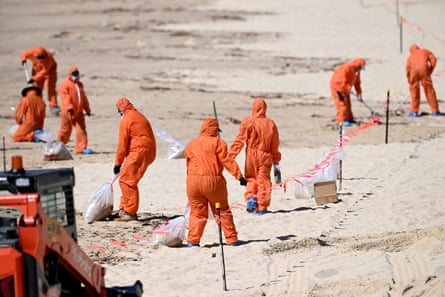
Interestingly, Ipart – the Independent Pricing and Regulatory Tribunal – may have crimped that vision.
Sydney Water initially wanted to increase customers’ bills by 53% over five years, but Ipart has only agreed to a maximum 13.5% in the first year, and 5% a year after that – including inflation.
So whether there will be sufficient funds for the massive capital works plan remains unclear. The 2025-26 NSW budget did not include any capital allocations for Sydney Water, noting the Ipart decision would come after the budget was delivered.
When Jackson reannounced the $3bn Malabar system program, she confirmed that the government had not allocated taxpayer funding.
Sources say Jackson’s request for government funding to expand Sydney’s desalination plant has been knocked back by the NSW treasurer. That plant is deemed critical to meet Sydney’s future water needs.
The deepwater ocean outfalls were opened from 1990, mainly because they were the cheapest option when it was no longer tenable to discharge sewage at the cliff face. Funding a fix now will take political will – and some impressive engineering.
-
Do you know more? Contact [email protected]