3 months ago
66
3 months ago
66
How could it be anything else? Adolescence is the Guardian’s best television series of 2025. And you’d have to assume that we’re not the only ones who think so. In any available metric – story, theme, casting, performances, execution, impact – Adolescence has stood head and shoulders over everything else.
So ubiquitous was Adolescence upon release that it would be easy to assume that everyone in the world has watched it. But just in case, a recap. Adolescence is the story of a terrible crime, and how its shock waves ripple out across a community. In episode one, 13-year-old Jamie Miller is arrested on suspicion of murdering a female classmate. In episode two, we follow a pair of police officers through a school, and learn that Jamie was radicalised online. The third is a two-hander between Jamie and his psychologist, in which Jamie’s anger rushes to the surface. The fourth returns to Jamie’s parents, as they question what more they could have done to stop this from happening.
To say that it landed with a bang would be a terrible understatement. The issues that Adolescence dealt with – boys losing their way, and finding solace in the ugly world of the manosphere – were so utterly of the moment that they were discussed in parliament, with calls for it to be shown in British secondary schools.
But themes alone don’t make a good show, and to concentrate solely on Adolescence’s message would be a disservice. Above all else, this was a human story about people who felt real. Stephen Graham, who co-wrote Adolescence with Jack Thorne, as well as starring as Jamie’s father, was very clear that he didn’t want the motive to be too neat. The easiest thing in the world would have been to make Jamie the victim of abuse himself, but Graham and Thorne resisted this at every turn. Jamie’s parents are normal people. They love their son, but there’s an element of helplessness. They might see their son on his phone, but they don’t understand that he’s slipping out of their reach.
Speaking of Graham, it is essentially a fact at this point that he’s the best actor we have. But to watch Adolescence is to see how much of that comes from his ability to surround himself with equally talented people. There isn’t a single duff performance in the entire show. Ashley Walters (who plays the investigative officer) is basically the lead for half the series, picking through the case with a warm, weary humanity. Erin Doherty, the psychologist, offered a masterclass in her sole episode, a two-hander with Jamie. Christine Tremarco was an open wound as Jamie’s mother. And Faye Marsay, who was bizarrely overlooked in the praise heaped upon the show, played an extraordinarily vital role as Walters’s partner; she was, after all, the character who reminded us that this was a crime with a victim, and urged her name not to be lost in the chase for the perpetrator.
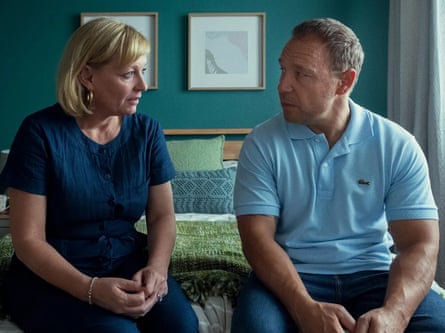
And then there was Owen Cooper. The find of the year, maybe even the decade. As Jamie, a lot was asked of Cooper. He had to play young and vulnerable at the moment of arrest, then surgingly angry during his hour with Doherty. Not many performances can blow Graham off the screen, but that is exactly what Cooper did. And remember: this, with all its emotional and technical difficulties, was his first ever on screen performance. He came out of nowhere and stole the show.
One funny little nugget to come out of Adolescence’s promotional cycle is the fact that when Cooper gained his next role – a retrospectively tiny part in Aimee Lou Wood’s Film Club – he struggled with the notion of editing. He had grown so used to long scenes without cuts that it took him a moment to adjust to traditional filming methods. Presumably now he has, though, and bigger things await. In February he plays young Heathcliff in Emerald Fennell’s Wuthering Heights. Even grander things are surely coming.
As if this wasn’t enough, every episode of Adolescence was filmed in a single shot. The vaults that director Philip Barantini managed to take with his camera – winding through locations from vehicle to vehicle, leaping through windows and (in a shot that became an instant classic) literally taking off and flying through the sky – were truly unbelievable. Long takes have a tendency to become a little self-indulgent, a chance for directors to show off at the expense of everything else, but the genius of Barantini lay in how every one of his camera movements was in perfect service to the story.
I’ve been doing this job for a long time now, and Adolescence may well be the only genuinely perfect show I’ve watched in that entire time. No matter where you look, or how hard you scrutinise it, you are met with nothing but wall-to-wall excellence. In 2025 there was Adolescence, then a huge gap, and then everything else. What a show this is.