3 months ago
73
3 months ago
73
We Gotta Groove – The Brother Studios Years, a new 73-track box set, picks up the story of the Beach Boys at a deeply peculiar juncture in their career. On the face of it, they were back on top. Their commercial fortunes had been revived by the huge success of some timely compilations: in the US, 1974’s Endless Summer sold 3m copies, while 20 Golden Greats became Britain’s second-biggest-selling album of 1976. Their leader Brian Wilson was apparently, miraculously, match fit after years of addiction and mental health struggles. “BRIAN IS BACK!” ran the advertising slogan for 15 Big Ones, the first Beach Boys album to bear his name as sole producer since Pet Sounds, and the first to be made at their newly founded Brother Studios. Buoyed by a media campaign that included an hour-long TV special, it duly became their most successful album of new material in 11 years.

But, as ever with the Beach Boys, it was more complicated than it initially seemed. As a succession of features noted, Wilson didn’t seem to be terribly well at all. A Rolling Stone writer dispatched to meet him was startled when Wilson asked him for drugs midway through the interview, and expressed grave doubts about Eugene Landy, the controversial psychologist supposedly responsible for Wilson’s recuperation. A Melody Maker journalist who saw the Beach Boys live that summer declared that Wilson “shouldn’t be subjected to being propped up onstage”, noted that he looked visibly distressed and made no musical contribution. Rather than a triumphant return, 15 Big Ones was a hastily thrown-together mess of cover versions and wan new material, its sessions marked by disagreements, not least over whether Wilson was even capable of producing an album. The band’s members openly disparaged it on release: Dennis Wilson bluntly described one track as a “piece of shit”. The public who bought it seemed to lose interest quickly: the Beach Boys did not score another Top 10 album of new material for 36 years.
There are people who have made some wild retrospective claims for 15 Big Ones’ artistic merit, among them Brian Wilson himself, but this box set’s compilers tactfully skirt around its existence despite its roots in Brother Studios. The original album isn’t included, its presence here confined to a scattering of outtakes, none of which seem fit to cause anyone to reassess their views, unless your opinion is likely to be swayed by the sound of Mike Love crooning his way through Johnny Preston’s Indigenous American-themed 1959 novelty hit Running Bear. Indeed, the inclusion of a handful of tracks that predate 15 Big Ones (from sessions abandoned because of Wilson’s reluctance to get involved) suggest the Beach Boys might have been making better music before his “recovery”: even in their unfinished state, Dennis Wilson’s Holy Man and 10,000 Years Ago are vastly superior to anything the Beach Boys’ comeback had to offer.
Instead, We Gotta Groove concentrates its attention on 15 Big Ones’ less commercially successful successor. Entirely composed and mostly played by Wilson, 1977’s Beach Boys Love You was both a radical departure – it’s dominated by the sound of synthesisers – and a drastic improvement: the opening seconds of Let Us Go on This Way have more life in them than every track on 15 Big Ones put together. That isn’t the same as suggesting it’s a masterpiece. Your enjoyment of it is likely to depend on whether you view Wilson’s lyrics as charmingly naive, a fascinating insight into a damaged psyche or just completely excruciating. “He sits behind his microphone, he speaks in such a manly tone,” offers his appraisal of talk show host Johnny Carson. “Saturn has rings all around it,” notes Solar System. “I searched the sky and I found it.”
Still, you don’t want for melodies beautiful enough to suggest that Wilson’s primary songwriting skill remained intact, despite all that had been visited upon it in the preceding decade: The Night Was So Young, I Wanna Pick You Up, Airplane. Whatever you make of the lyrics to Roller Skating Child – “I go and get my skates on and I catch up with her / We do it holding hands, it’s so cold I go ‘brrr’” – the tune and the stacked vocal harmonies are fantastic.
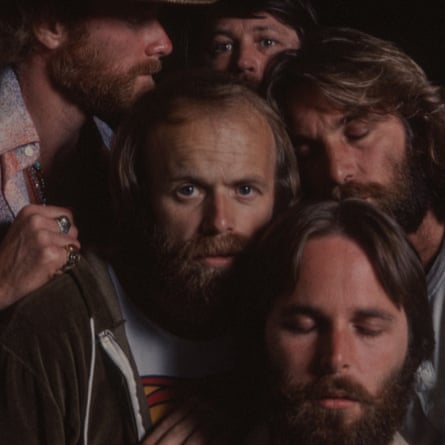
Despite its muted commercial response, Beach Boys Love You appeared to embolden Wilson further. His next project was a set of songs that drew on pre-rock’n’roll pop, an idea out of left field, but not one entirely without precedent. Wilson was a huge fan of George Gershwin and the Four Freshmen, a 50s vocal group whose oeuvre drew extensively on pre-war pop and jazz: a cursory listen to their 1955 album Four Freshmen and 5 Trombones reveals how much they influenced the Beach Boys’ harmonies. Moreover, his own work had occasionally seemed to reach back past the birth of rock’n’roll. It’s not a huge stretch to imagine Pet Sounds’s You Still Believe in Me or Don’t Talk (Put Your Head on My Shoulder) hailing from the 30s or 40s rather than 1966, although they were less explicit in their intentions than his new material: Wilson intended for Frank Sinatra to sing Still I Dream of It. Sinatra turned him down, but no matter: it’s hard to imagine a version more potent than Wilson’s, his cigarette-ravaged voice amplifying the effect of its wistful lyrics. Another sumptuously orchestrated ballad, It’s Over Now, is similarly great, as is Wilson’s cover of the 1930s hit Deep Purple.
The concept wasn’t completely out of step with contemporary trends – not long after Wilson recorded these songs, Willie Nelson released Stardust, an exquisite album of Great American Songbook standards that sold millions – but somehow things went off piste. First, Wilson taped a selection of tracks that seemed to have nothing to do with his original idea, among them the frankly appalling Hey Little Tomboy, a song that’s even creepier than its title suggests. Then the tracklisting of the projected album, Adult/Child, was padded out with early 70s outtakes, apparently in the belief that the world was desperate to hear HELP Is on Its Way, a 1971 paean to organic food, and its capacity to guard against “doughy lumps, stomach pumps, enemas too” (neither the outtakes nor Hey Little Tomboy are here, the latter presumably excised on the grounds of taste). Then the whole thing was scrapped: in a weird echo of Smile, Mike Love’s response to the 40s-style songs was: “What the fuck do you think you’re doing?”
It’s a question that seems more germane to the remainder of the Beach Boys’ recording career. Their next release turned out to be the abysmal MIU Album, home to the tennis-themed Match Point of Our Love, which succeeded in making the lyrics on Beach Boys Love You seem as erudite and multi-layered as Sad Eyed Lady of the Lowlands. It says something about the Beach Boys’ increasingly catastrophic judgment that the only track to survive the Adult/Child sessions and make it on to MIU was Hey Little Tomboy. You might have thought MIU represented the band’s artistic nadir, until you heard its follow up, LA (Light Album). And if you thought that was their nadir, you hadn’t heard 1980’s Keepin’ the Summer Alive, and so on and so on.
It’s a sorry story that places the music on We Gotta Groove in context: wildly variable in quality, even at its best not in the same league as the stuff that made the Beach Boys famous; for fans only. But, filled with strange diversions and what proved to be dead ends, it’s seldom boring: in fact, the Beach Boys would never be so interesting again.