3 months ago
62
3 months ago
62
The Six Nations championship is fast approaching but, ahead of rugby union’s beloved annual fiesta, two recent away club victories are worth contemplating. The first was Northampton’s stunning win at Bath last month with a supposedly weakened team: the sharp attacking angles, deft handling and speed of thought were supremely good. Then there was Bristol’s 60-point altitude-defying romp in Pretoria at the weekend against a Bulls side containing 10 Springboks.
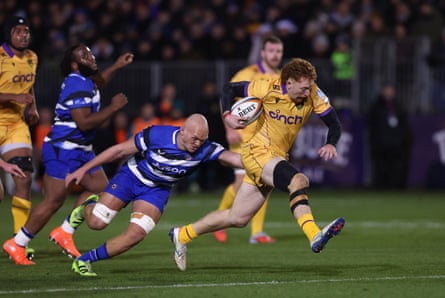
Both merit closer examination. Northampton, in particular, lost the overall territory battle to Bath and kicked out of hand only 15 times in 80 minutes. For every kick they attempted they threw a dozen passes, the aim being to shift the point of attack and chase space rather than follow the orthodox template of routine kicking, set-piece dominance, lineout drives and close-quarters power.
The Bears were slightly different in that they kicked more frequently, understandably so when the ball flies for miles and there is a chance to give your perspiring forwards a momentary breather in demanding conditions. Still, though, it was their passing movement, pace on to the ball and keen understanding of how and where to strike that shredded the Bulls and facilitated the startled hosts’ nine-try drubbing.
It prompts some interesting philosophical questions, not least around some of modern rugby’s casual assumptions. The prevailing kneejerk reaction to the Bristol scoreline is to say the Bulls’ defence was poor. Which it sometimes was. But what if that presumption misses the point as spectacularly as the Saints and the Bears both played? No one is saying defence, intelligent kicking and rugged scrummaging are not all critically important in modern rugby but perhaps people are underplaying the growing importance of a razor-sharp, proactive attacking game. Look at Bordeaux, the free-wheeling defending Champions Cup holders, and the theory gains further weight.
This feels like a timely week, then, to seek some sharp-eyed tactical advice. The analyst Sam Larner, who clearly has a brain the size of a planet and pores over more match footage than is good for him, has written a book called Attacking The Space, which will be published on 29 January. Subtitled “Inside rugby’s tactical and data revolution” it seeks to demystify aspects of the game that often confuse or infuriate newcomers.
It is well written, insightful and thought-provoking. “Possession is meaningless unless it’s in the opposing 22”. Or “Kicking is not killing rugby. It’s improving it.” Larner even argues that “kicking is a beautiful thing which can be adored rather than endured in the same way that paying tax and seeing the benefits can give you a sense of civic pride.” You can’t help but wonder how many readers resident in the Isle of Man or Monaco will share that sentiment.
Aged 33 and still playing and coaching at grassroots level, the Yorkshire-based Larner is a child of the digital generation. He loves data and knows the value of a box kick to the nearest decimal point. On average, he says, teams will go through 5.4 phases before a mistake is made resulting in a loss of possession. Which is why so many sides are more than happy to hoof the ball skywards at the earliest opportunity, hoping to sweep up the crumbs. The average number of kicks per game at the 2023 Rugby World Cup – 57 – was up by 20% and the highest recorded since 1995.
All very interesting. Larner was originally inspired to pursue the rugby analysis route after reading Michael Lewis’s Moneyball at the age of 16 and some of his findings have surprised even himself. “The biggest thing that came out of it was how similar defences are at the best and worst teams in the leagues.” Minimal differences, he found, can be crucially multiplied by other related factors. “It might just be that the worst team are missing tackles in the area of the pitch that matters most.”
But hang on. To what degree does following the numbers throttle ambition and create an increasingly formulaic product? Think of the clunk-click inevitability of the midfield scrum penalty, the kick to the corner, the driven maul and the burrowing hooker. Will that really woo millions of entranced new eyeballs? In that context another of Larner’s throwaway lines – “Style is irrelevant in the pro game” – also jars slightly. Of course he is right in a literal sense but the game is still played – for now at least – by human beings not robots. Take someone such as Henry Pollock. If people watch the remarkable try he scored against Bordeaux on Sunday and the main takeaway is “Yes, but he dropped the subsequent restart”, rugby really does have a promotional problem.
As Larner himself points out, there are echoes here of that old line about the similarity between analysing a joke and dissecting a frog. No one enjoys it and the frog dies. Equally, though, he believes a complex sport can still be enjoyed by novices if the messaging is clear enough. “If you look at sports that have really rocketed in popularity in recent years like American football and Formula One you couldn’t think of two more complicated sports. But they’ve rocketed partly through presentation and confidence in what they do. In rugby if we have one round of the Six Nations that is a bit dross we practically have a referendum on the game.”
His personal remedy is for rugby to become collectively less insecure and to reduce further the amount of dead time in games. “I would put in a ‘Taking the piss’ rule. You want there to be constant movement forward, you don’t want a feeling of ‘Nothing’s really happened for two minutes.’ For example, don’t allow players to repeatedly walk to lineouts. It would make the whole game feel a little crisper and snappier.” Interesting. And if more teams start to take a few more risks and attack as enthusiastically as Bordeaux, Northampton and Bristol so much the better.
-
This is an extract taken from our weekly rugby union email, the Breakdown. To sign up, just visit this page and follow the instructions.