3 months ago
117
3 months ago
117
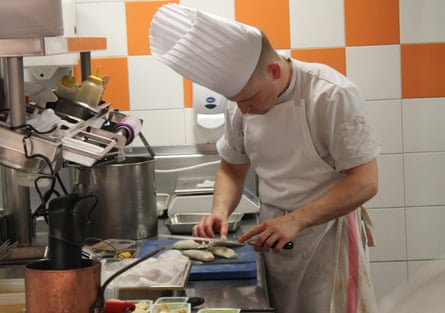
It’s 9am on a weekday morning and although I’ve just finished my porridge, the chef Richard Wilkins is making my mouth water. “My signature dish is soft Scottish langoustines wrapped in very thin, crispy pastry, served with Japanese sushi rice and a langoustine bisque.”
His other specialities include turbot in a spinach and champagne sauce, buttery wagyu steak with English peas, and raspberry millefeuille. Sadly, I won’t be able to sample any of them and neither will anyone else. At the end of April, Wilkins took the painful decision to close his west London Michelin-listed Restaurant 104 after seven years.
“The financial pressures became brutal,” says Wilkins, who previously worked with Gordon Ramsay at Pétrus. “We were very small, with only 12 covers. So when things like business rates or VAT rates change, it’s the smallest people who are hit the hardest.”
At the end of last year, Wilkins was determined to fight back. “I did a five-figure refurb. I upped my marketing, leafleting and talking to hotel concierges to ask them to recommend us. But looking at the bookings coming in, compared to the rising costs, it just didn’t add up any more. And I was so fatigued.”
He shut down immediately after making the decision because he was concerned about taking produce from suppliers whom he might not be able to pay. “I have the site until the end of June and we’re offering private dining and collabs with guest chefs. It’s strange to still have it – like having a family member who is on life support.” He is planning to get a job in someone else’s kitchen so he can focus on cooking, not number crunching.
Wilkins’ spot joins the ranks of the three hospitality sites that closed every day in the UK in the first quarter of 2026. It is happening at every level of the industry, but, at the top end, since 2021, London has lost 24 of its 112 Michelin-starred restaurants, while more than 20% of Michelin-starred restaurants in England and Wales (52 out of 240) have closed since the pandemic.
And all of this comes after a decades-long gastro boom in which culinary luminaries fell over themselves to acknowledge Britain’s influence on the world food scene. The legendary French chef Joël Robuchon hailed London as the foodie capital of the world. “When it comes to what’s new in cooking, to innovative cuisine, it’s all happening in London ... The epicentre is not Paris but London,” he said in 2011. The New York Times came to a similar conclusion in a 2018 feature “Beyond Porridge and Boiled Mutton: A Taste of London”.
Outside London, Cumbria hit the headlines four years ago when it became the UK county with the most Michelin stars. Thom Hetherington, an industry judge and the chief executive of the Northern Restaurant and Bar trade event in Manchester, described the density of world-class restaurants in the region as “mind-blowing” and compared it to Tokyo, Paris and San Sebastián as a foodie destination. “For me, the Lake District is absolutely at that level.”
So what’s behind the high number of closures? Hospitality businesses were still recovering from VAT going back up to 20% in April 2022, after a temporary reduction during the pandemic to 5% and then 12.5% . Then, in April this year, the 40% discount on business rates, also introduced during the pandemic, was fully abolished for restaurants.
Kate Nicholls, the chair of the trade body UK Hospitality, says: “Even busy, successful businesses have been pushed to the margins as a result of the last two budgets. From our own research, we have seen menu prices going up by 6%, but the cost of doing business has gone up by between 8% and 12%. So that’s not being passed on to diners. People are spending less than they used to, and probably going out to eat less frequently.”
Even the most starry and long-established restaurateurs are struggling with the current economic challenges. Tom Kerridge, a TV regular, owns five fine dining pubs and restaurants including the Hand and Flowers in Marlow, Buckinghamshire, the first gastropub ever to receive two Michelin stars, as well as Kerridge’s Bar & Grill at the Corinthia hotel in central London.
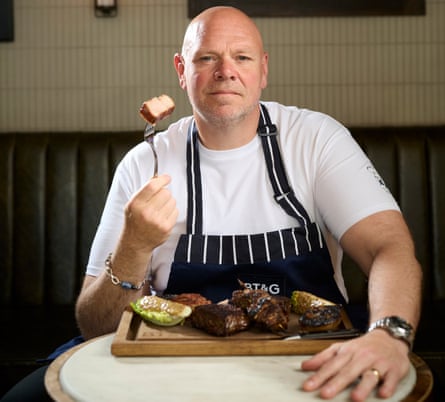
Kerridge says: “If a young chef told me: ‘I’m going to borrow half a million quid to open a restaurant in a small market town,’ I would tell them not to bother. Genuinely, the revenue isn’t out there. The customer base is smaller than it used to be. And the people that are eating out are spending less money. Our guest numbers are down by 15-20% and for those that do come, their spend is down by about the same percentage. Currently, we are operating at 100% cost and in one case we’re at 115%, so it’s a loss. And that is with me having 21 years’ experience of running restaurants. It’s unviable.”
Kerridge points out that restaurants have never been easy to run, and that profit margins even in boom times are only normally at 10%. “There are five major reasons why restaurants are struggling now: food inflation, national insurance increases, minimum wage increases, utility bill increases and business rates. All of those are squeezing margins to extinction. If you consider each of the factors I’ve mentioned taking away 2.5% of profit, you’re left with zero.”
He believes that government support is urgently needed. “They know exactly what to do because they just did it to make family days out more affordable this summer, including reducing VAT on kids’ meals,” he says. “VAT is on average 10% for restaurants across Europe. Cutting VAT doesn’t just help businesses, it makes it possible for operators to pass on savings to guests. And it’s the difference between 21 businesses closing a week or staying open.”
UK Hospitality has been lobbying hard on the issue. Nicholls is sceptical about the recent government package on children’s meals. “I don’t think it will make much difference to the bottom line unless it can somehow drive greater demand for eating out overall. But maybe having conceded the principle that reducing VAT is the best way of delivering a boost, the chancellor might be inspired to offer something bolder and more ambitious for all restaurants in the future.”
The stakes are high if action isn’t taken, suggests Kerridge. “Over the last 20 to 30 years, we have seen the British food scene go from being processed food from the microwave and deep-fat fryer into being one of the most creative and exciting food destinations in the word. But when everyone is forced to cut costs, standards will go down. Ultraprocessed foods will start dropping into the menu, corners will be cut and the skill set in kitchens will disappear because we can’t afford to employ the staff.”
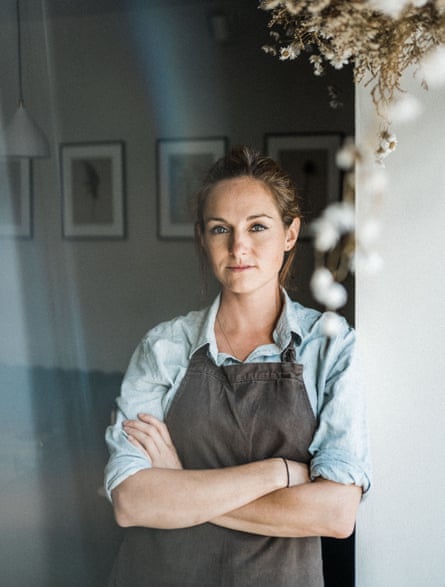
Staff costs were a major factor in chef Harriet Mansell’s decision to close her restaurant Lilac in Lyme Regis. “You’ve now got young, inexperienced people coming in on the new minimum wage of £12.71 an hour [for ages 21 and over], which, in theory, is a good thing. But, hypothetically, you might have a 42-year-old front-of-house person. Maybe they’ve dedicated their life to this career. And they’re only on £16 an hour. And there’s no more money in the wages pool to give them a commensurate rise.”
Mansell, who represented the south-west region on the BBC’s Great British Menu, opened Lilac in 2021 in a 400-year-old converted cellar. The emphasis was on sustainability and foraged ingredients. A sample dish was griddled Cornish octopus with orange, fennel, saffron shellfish sauce and rock samphire.
Then, out of the blue, Mansell was hit with a devastating utility bill increase. “We’d been paying £350 a month and suddenly they demanded £3,500. We tried everything to reduce it, installing individual meters on every appliance, wondering if there was a leak somewhere. It was never resolved.”
Last summer, Mansell started experiencing worrying physical symptoms – tremors, loss of feeling in her hands and extreme migraines. “I was in and out of A&E, I had to have brain scans. In the end, they told me it was all down to acute stress.” When Lilac’s landlords gave her an option to relinquish the lease early, she decided to take the opportunity to close. “Even though the restaurant was still very busy, the financial forecasts told a different story. I realised that Lilac simply wasn’t sustainable.”
Mansell has now found a creative way of avoiding the UK economic challenges: she has just opened a pop-up summer restaurant at La Closerie de la Beyne estate in the Dordogne, south-west France. “The ethos there is similar to mine, all about using sustainable ingredients, without the financial challenges we’re dealing with in the UK at the moment.”
Despite the economic gloom, some restaurants still appear to be thriving. Andy Hayler is an influential food blogger whose claim to fame is that he has eaten at every three-star Michelin restaurant in the world (the UK has 10 out of 158 in total). “There are still an awful lot of people opening restaurants, at least in London. If you take just one genre, Indian restaurants, recently I went to Oudh 1722 in Southwark and Trèsind, a big flashy opening in Mayfair, then there’s the Ambassador’s Clubhouse [also in central London], opened two years ago, but try getting a table in there. I know of many restaurants where it’s still very difficult to get in.” He gives me a long list and challenges me to get a table at any of them. And he’s broadly correct, if we’re talking about a prime-time dinner slot late in the week or weekend.
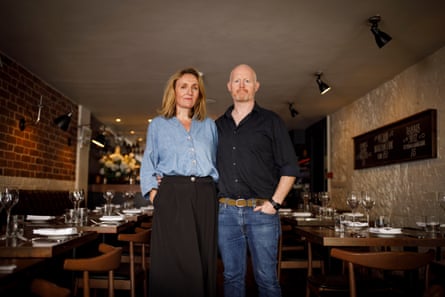
But being busy doesn’t necessarily denote profitability. “There’s an old saying: turnover is vanity, profit is sanity,” says Nicholls. “Some high-end restaurants are still taking good money yet are unable to make a profit because of the high costs.”
Hayler argues that the restaurant business has always been volatile. “There are a bunch of people who go into it for sort of romantic reasons – people who’ve had a windfall or retired early. Or chefs who want to own their own place, but don’t know how to run it. There’s a subset of restaurants that are not real businesses at all.”
But that’s not to say that all of the recent closures are down to mismanagement, he adds. “Restaurants open and close for all sorts of different reasons. A more useful thing to consider is that restaurants are really a fashion business. People want to go out to the next exciting place. So other places will fade over time. Very few restaurants last for decades.”
One such rare establishment is the Gingerman in Brighton, which opened in 1998. Yet, a few weeks ago, the husband-and-wife owners, Ben and Pamela McKellar, announced its impending closure.
“It was a horrendous decision. We’ve been open for 28 years, we survived the 2008 crash and the pandemic,” says Ben, citing the cost of produce, wages, energy and the tax burden as the reasons for shutting down.
“And what’s sad is we weren’t losing money until the last two budgets,” says Pamela. “Our small restaurant was paying £150,000 in VAT per year, plus we’re paying into national insurance, plus business rates. There’s a strong chance whoever takes this space over won’t be a food business. There used to be five restaurants on this street and we are the last one. If it turns into a residential space, the council tax generated will only be about £2,000. That scares me, because far less money is going into the economy to pay for services.”
The McKellars say that now, instead of spending their time thinking up new, creative dishes, such as the pork fillet with miso apple puree and crispy black pudding currently on offer, they are forced to focus on cost-cutting ways to keep their three other restaurants open. “We’re looking at cutting our bin collections. And if we are having to save on, say, buying from the local florist, the wider neighbourhood economy is affected, too,” says Ben.
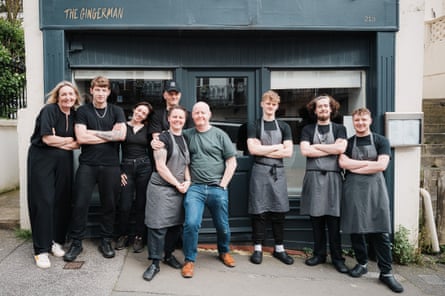
Pamela says that the recent increase in minimum wage has had an unintended negative consequence for society. “Previously, when we advertised for staff, we would get two or three applicants. Now we get 200. We used to love employing students, the ones who had no choice but to wait tables to support their studies at one of the two universities here in Brighton. Mostly, they were inexperienced and sometimes hungover. Now, at the higher wage point, we can only justify hiring experienced staff.”
Since Gingerman announced its closure, its proprietors have been reminded that a restaurant is more than a business; it’s also a place of celebration and a keeper of cherished memories. “We had one email from a couple in Canada who had their wedding reception at the restaurant. They’re flying back to the UK to have a final meal. A family got in touch to say we were their late mother’s favourite place, and another from a couple who had their first date there years ago.”
Even restaurateurs who are thriving are sounding the alarm. Chef-patron Angela Hartnett’s restaurants – the Michelin-starred Murano and four Cafe Murano branches in London – are so busy that it takes me a week to get hold of her on the phone.
“We are doing fine,” she says. “But I’m not sitting here saying: ‘I’m all right, Jack, and that’s all that matters.’ If we lose restaurants, we lose so much. They give us hospitality, communication and connection. We can’t afford to lose that – there’s a loneliness epidemic.”
She too is concerned that the UK food scene is in danger of losing everything it has gained. “What’s great is that we’ve come so far. We now have every cuisine under the sun, pretty much, in the UK. It’s not about luxury products – our greatest chefs get great flavour out of humble ingredients like beef cheek and seasonal vegetables. But we are in danger of being outpriced.”
Hartnett recalls that early in her career, 25 years ago, she visited Tokyo. “I was gobsmacked at how expensive eating out was. I remember ordering a glass of orange juice and it cost the equivalent of £10. But the way London is heading, it’s already up there with New York on price. We don’t want to become so unaffordable that people decide they’re better off staying at home. And there’s a very real danger of that happening now.”